


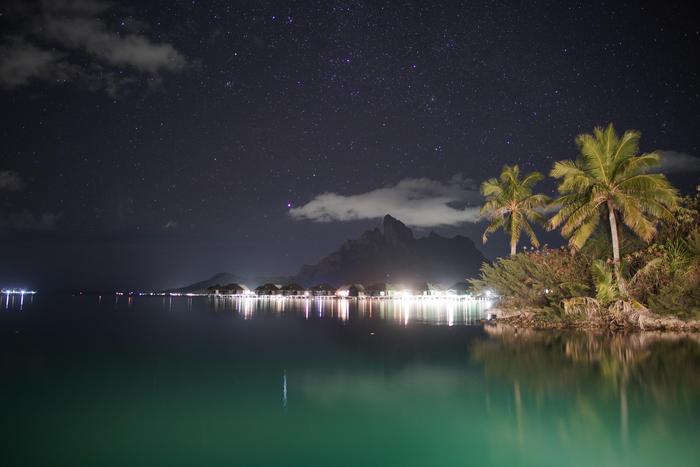
New research finds that artificial light at night (ALAN) attracts larval fish away from naturally lit habitats, while dramatically lowering their chances of survival in an “ecological trap”, with serious consequences for fish conservation and fishing stock management.

Credit: Jules Schligler
New research finds that artificial light at night (ALAN) attracts larval fish away from naturally lit habitats, while dramatically lowering their chances of survival in an “ecological trap”, with serious consequences for fish conservation and fishing stock management.
“Light pollution is a huge ongoing subject with many aspects that are still not well understood by scientists,” says Mr Jules Schligler, a PhD student at CRIOBE Laboratory (Centre de Recherches Insulaires et Observatoire de l’Environnement) in Moorea, French Polynesia.
ALAN is the product of human-related activities such as the use of electrical lights along roads, factories, residences and resorts near bodies of water. “ALAN is everywhere and marine wildlife is not exempt to its effects,” says Mr Schligler. “A quarter of the world coastline is impacted and this level is increasing every year.”
Mr Schligler and his team set out to investigate the effects of ALAN on larval recruitment in tropical fish. Larval recruitment is the number of fish that settle in their habitat and survive their juvenile years before becoming an adult. “Larval recruitment is a key life history trait for fish that impacts on stock replenishment and adult fitness,” he says. “Larval fish are also very dependent on the natural light cycle.”
To investigate these effects, Mr Schligler used 48 corals that were split into two treatments: control corals with only natural light exposure, and ALAN corals that were exposed to light pollution at night of a similar intensity that beach resorts and streetlights produce. They focused on two dominant coral reef damselfish native to French Polynesia, the yellowtail dascyllus (Dascyllus flavicaudus) and the blue-green chromis (Chromis viridis).
“First, we monitored fish settlement to the corals to see if they preferred natural or artificial light conditions,” says Mr Schligler. “The fish were then subjected to a range of experiments to better understand the impact of ALAN after they had settled.” These experiments measured various aspects of development and survival such as growth, metabolic rate and risk of predation.
This research finds that many young fish actually prefer environments with artificial light, recruiting 2-3 times as many fish than naturally lit environments.
The study also reveals the harmful effects of ALAN on fish growth, metabolic rate and overall survival. “ALAN has produced an ecological trap where these fish, misled by human activity, now prefer habitats where their fitness will be lower,” says Mr Schligler. “In other words, ALAN has the potential to attract organisms to a less suitable environment, generating a peculiar anthropogenic stressor.”
These results have implications for fish conservation and harvesting policies. “Marine protected areas have only started to consider light pollution in their management policy very recently,” says Mr Schligler. “To better understand fish stock replenishment and conservation, it is crucial to take into account as many factors as we can, such as the rarely considered effects of light pollution.”
This research is being presented at the Society for Experimental Biology Annual Conference in Prague on the 2-5th July 2024.
Cite Scienmag News
Courtney Benton. (July 3, 2024). Artificial light is a deadly siren song for young fish. Scienmag. https://scienmag.com/artificial-light-is-a-deadly-siren-song-for-young-fish/
Courtney Benton. "Artificial light is a deadly siren song for young fish." Scienmag, 3 July 2024, https://scienmag.com/artificial-light-is-a-deadly-siren-song-for-young-fish/. Accessed 3 September 2026.
Courtney Benton. "Artificial light is a deadly siren song for young fish." Scienmag. July 3, 2024. https://scienmag.com/artificial-light-is-a-deadly-siren-song-for-young-fish/

