


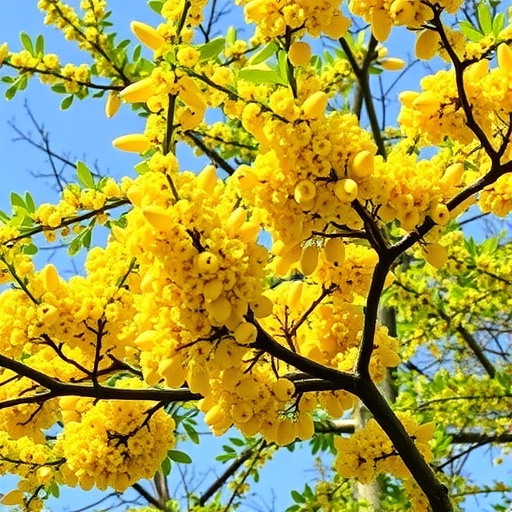
In the ever-evolving landscape of ecological research, one particular species is capturing attention for its ability to thrive in a rapidly changing world: the honey locust tree, scientifically known as Gleditsia. This species has long been recognized for its resilience and adaptability, yet new findings emphasize its potential in the face of global climatic upheaval. As environmental conditions shift, understanding the ecological drivers of honey locust’s expansion and the associated risks of hybridization becomes crucial for both conservation efforts and urban planning.
Honey locusts are primarily native to the southeastern and central United States but have exhibited a remarkable ability to colonize new realms, often in tandem with anthropogenic disturbances. Their disturbance-promoted nature allows them to flourish where other species may falter, raising the question of how this tree can be framed as a “winner” amid the challenges presented by global change. Researchers have begun to pinpoint the nuanced ecological dynamics that underlie this phenomenon, shedding light on how alterations in temperature, rainfall, and soil conditions create favorable scenarios for honey locust proliferation.
The tree’s extensive root system plays a significant role in its survival amidst ecological upheaval. Honey locust roots exhibit a unique adaptability, allowing them to access water and nutrients efficiently, even in less-than-ideal soil conditions. This characteristic is particularly beneficial in areas experiencing shifting climatic patterns, where water scarcity is a growing concern. Furthermore, the tree’s ability to fix nitrogen through root nodules not only enhances its growth but also benefits surrounding vegetation, making it a vital player in local ecosystems.
Researchers emphasize that honey locusts may possess a kind of “ecological plasticity.” This term refers to the species’ capacity to adjust its growth and reproductive strategies in response to environmental stressors. Such versatility enables the honey locust to survive in a range of conditions, from urbanized landscapes to abandoned agricultural fields. This adaptability is not merely an individual trait; it is compounded by the species’ ability to hybridize with other nearby locust species, which can introduce new genetic variations that further enhance its resilience.
Hybridization presents both promising opportunities and concerning risks. On one hand, the crossing of different locust species can generate hybrids with comparable or superior adaptive traits, enabling better survival rates under changing climatic conditions. On the other hand, the potential for hybridization can threaten genetic diversity, particularly if hybrids dominate at the expense of traditional species. This creates a compelling argument for careful monitoring of honey locust populations as they expand and interbreed in novel environments.
The implications of honey locust’s expansion extend beyond mere ecological interest; they raise critical questions about urban ecology and land management practices. As cities worldwide expand into natural habitats, the presence of honey locusts can influence local plant communities and alter habitat structures for various wildlife. Conservationists and urban planners must consider these interactions carefully, as the growing prevalence of honey locusts may lead to unforeseen consequences on local biodiversity.
In urban settings, honey locusts are often appreciated for their aesthetic appeal and shade-providing canopy. However, their presence can also alter the composition of urban green spaces, affecting not just native plant life but also the overall ecological integrity of these areas. Understanding how urban environments facilitate or hinder honey locust expansion could become critical as city planners aim to harmonize human development with native ecosystems.
The study of honey locust populations offers key insights into broader themes of ecological resilience and adaptation. As researchers delve deeper into the mechanisms that enable this species to thrive amid adversity, they shed light on potential strategies for conserving biodiversity and mitigating the effects of climate change. The lessons learned from honey locust could inform broader conservation efforts, revealing how resilience and adaptability can be harnessed in other vulnerable species facing similar challenges.
Moreover, the global expansion potential of honey locust reflects an urgent need for cross-disciplinary collaboration. Engaging ecologists, urban planners, and policymakers will be vital in developing comprehensive strategies that address both the ecological and socio-economic dimensions of this tree’s expansion. By sharing knowledge and perspectives, stakeholders can devise solutions that balance the benefits of honey locust growth with essential conservation priorities.
In conclusion, honey locusts represent a complex intersection of ecological resilience and hybridization risks in the context of global change. Their ability to expand into new environments while simultaneously adapting and hybridizing poses significant implications for biodiversity and ecosystem health. As research continues to unfold, the findings will undoubtedly influence how society approaches land management, conservation, and urban planning in an era defined by rapid environmental shifts. It is imperative that we remain vigilant and informed about such changes, as the implications for our ecosystem and urban landscapes are profound and far-reaching.
The future of honey locust is not merely about the tree itself; it is woven into the fabric of human interactions with our environment. A close examination of this species acts as a bellwether, indicating how our ecosystems may respond to ongoing global pressures. As we move forward, understanding these complex relationships will be integral to fostering resilient and sustainable ecosystems that can withstand the challenges ahead.
Busk, K.Ø., Svenning, JC. A global-change winner? Global expansion potential, ecological drivers and hybridization risk of the disturbance-promoted honey locust (Gleditsia).
Discov. Plants 2, 277 (2025). https://doi.org/10.1007/s44372-025-00358-2
Cite Scienmag News
Gavin Prescott. (September 30, 2025). Honey Locust: Global Expansion and Ecological Challenges Ahead. Scienmag. https://scienmag.com/honey-locust-global-expansion-and-ecological-challenges-ahead/
Gavin Prescott. "Honey Locust: Global Expansion and Ecological Challenges Ahead." Scienmag, 30 September 2025, https://scienmag.com/honey-locust-global-expansion-and-ecological-challenges-ahead/. Accessed 3 September 2026.
Gavin Prescott. "Honey Locust: Global Expansion and Ecological Challenges Ahead." Scienmag. September 30, 2025. https://scienmag.com/honey-locust-global-expansion-and-ecological-challenges-ahead/


