


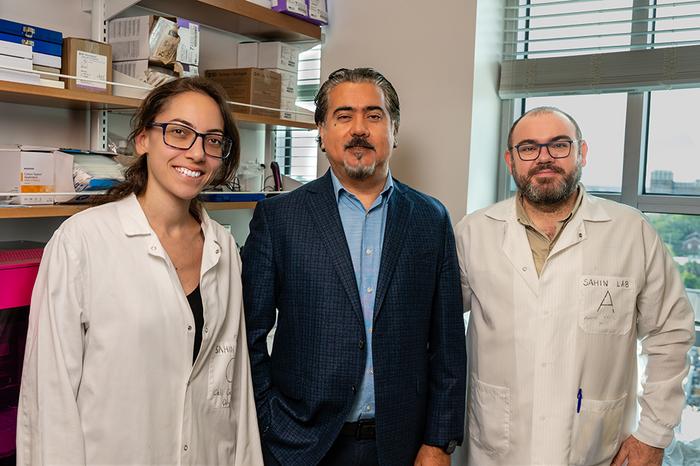
A new compound developed by researchers at MUSC Hollings Cancer Center shows promise in overcoming chemotherapy resistance in triple-negative breast cancer – and could potentially be applied to fibrotic conditions like liver fibrosis or pulmonary fibrosis.

Credit: MUSC Hollings Cancer Center
A new compound developed by researchers at MUSC Hollings Cancer Center shows promise in overcoming chemotherapy resistance in triple-negative breast cancer – and could potentially be applied to fibrotic conditions like liver fibrosis or pulmonary fibrosis.
At the center of this work is preventing the protein lysyl oxidase, or LOX, from going overboard in doing its job and, therefore, helping to produce a “stiff,” or desmoplastic, environment around tumors.
“The main function of this protein is to crosslink the collagens and elastins in the extracellular matrix (ECM) in the tumor microenvironment. These will basically provide stiffness around the cells, and this will prevent the penetration of drugs, including chemotherapy,” explained Ozgur Sahin, Ph.D., the SmartState Endowed Chair in Lipidomics and Drug Discovery in the Department of Biochemistry and Molecular Biology.
“By using a LOX inhibitor, you can open up this structure, make it softer and the drugs can penetrate better,” he said.
The Sahin Lab, in collaboration with other researchers at Hollings and at the University of South Carolina College of Pharmacy, published a paper July 22 in Cell Chemical Biology introducing the novel compound.
Sahin’s work had previously shown the key role that LOX plays in chemotherapy resistance.
Building upon that insight, his lab partnered with Campbell McInnes, Ph.D., medicinal chemist at USC and Peggi Angel, Ph.D., a Hollings scientist who uses proteomics to understand the molecular changes that prompt the reorganization of collagen, particularly in breast cancer.
These partnerships helped his team to go beyond typical tests, like measuring LOX activity in tissue.
“We also showed that we could change the architecture of the collagen using the MALDI-MSI, together with Peggi,” he said.
MALDI-MSI is a type of mass spectrometry imaging that allows researchers to see the physical layout of proteins and molecules within a sample.
“We collected the tumor tissue and analyzed the proteome with different mass spec approaches, and we could see that our inhibitor has a huge impact on the ECM, collagen and other structural proteins,” Sahin said.
By changing the architecture of the ECM to allow for better drug penetration, the LOX inhibitor enables the chemotherapy to stress the tumor into producing more reactive oxygen species (ROS) more effectively. At high enough levels, ROS creates DNA damage that can lead to cell death. Importantly, inhibiting LOX also blocks focal adhesion kinase (FAK) signaling, which would otherwise promote DNA repair. Taken together, these effects can overcome chemotherapy resistance. Further, these effects were found in different types of models, including triple-negative breast cancer cell lines, in vivo models and organoid models created from patient-derived xenografts.
Sahin’s research has focused on triple-negative breast cancer because this aggressive subtype has fewer treatment options than other types of breast cancer.
However, pancreatic cancer and kidney cancer are also highly stiff cancers that could potentially benefit from this inhibitor.
The team’s current frontrunner compound is stable and hasn’t shown signs of toxicity. However, the team will continue to refine it as they spend the next two or so years working toward an Investigational New Drug (IND) application with the U.S. Food and Drug Administration. Obtaining IND status would clear the way for clinical trials.
“In drug development, you never stop,” he said. “This one we identified is the current best option, but we know that there needs to be some optimization, like with every drug. In collaboration with USC, we are now producing new versions of this molecule and testing them in different biological and pharmacological assays.”
The content is solely the responsibility of the authors and does not necessarily represent the official views of the National Institutes of Health.
About MUSC Hollings Cancer Center
MUSC Hollings Cancer Center is South Carolina’s only National Cancer Institute-designated cancer center with the largest academic-based cancer research program in the state. The cancer center comprises more than 130 faculty cancer scientists and 20 academic departments. It has an annual research funding portfolio of more than $44 million and sponsors more than 200 clinical trials across the state. Dedicated to preventing and reducing the cancer burden statewide, the Hollings Office of Community Outreach and Engagement works with community organizations to bring cancer education and prevention information to affected populations. Hollings offers state-of-the-art cancer screening, diagnostic capabilities, therapies and surgical techniques within its multidisciplinary clinics. Hollings specialists include surgeons, medical oncologists, radiation oncologists, radiologists, pathologists, psychologists and other clinical providers equipped to provide the full range of cancer care. For more information, visit hollingscancercenter.musc.edu.
Journal
Cell Chemical Biology
Article Title
A highly potent bi-thiazole inhibitor of LOX rewires collagen architecture and enhances chemoresponse in triple-negative breast cancer
Article Publication Date
22-Jul-2024
COI Statement
O. Sahin is the co-founder and manager of OncoCube Therapeutics LLC, founder, and president of LoxiGen, and member of scientific advisory board of A2A Pharmaceuticals Inc. M.C., O. Saatci. A-H.R., C.B., C.M., and O.S. are inventors on patent US 11,712,437. The other authors declare no potential conflicts of interest.
Cite Scienmag News
Nathaniel Bowman. (July 22, 2024). Hollings team marks milestone in progress toward investigational new drug for triple-negative breast cancer. Scienmag. https://scienmag.com/hollings-team-marks-milestone-in-progress-toward-investigational-new-drug-for-triple-negative-breast-cancer/
Nathaniel Bowman. "Hollings team marks milestone in progress toward investigational new drug for triple-negative breast cancer." Scienmag, 22 July 2024, https://scienmag.com/hollings-team-marks-milestone-in-progress-toward-investigational-new-drug-for-triple-negative-breast-cancer/. Accessed 5 September 2026.
Nathaniel Bowman. "Hollings team marks milestone in progress toward investigational new drug for triple-negative breast cancer." Scienmag. July 22, 2024. https://scienmag.com/hollings-team-marks-milestone-in-progress-toward-investigational-new-drug-for-triple-negative-breast-cancer/

