


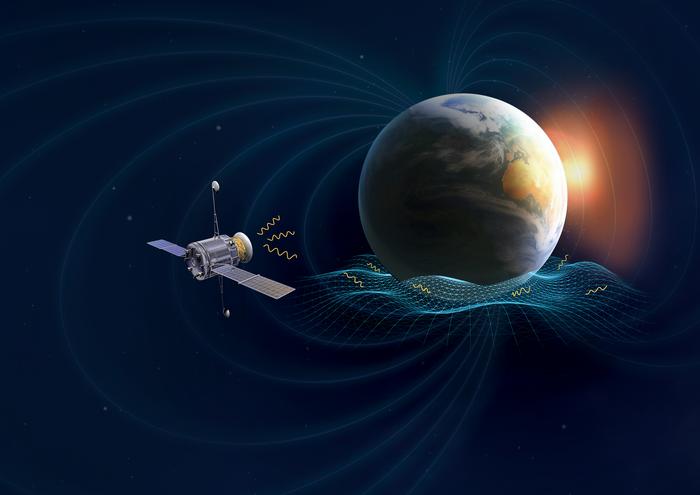
A groundbreaking method of detecting high-frequency gravitational waves (HFGWs) has been proposed by a research team led by Prof. Tao LIU, Associate Professor from the Department of Physics at the Hong Kong University of Science and Technology (HKUST). The team’s innovative approach may enable the successful detection of HFGWs by utilizing existing and technologically feasible astronomical telescopes in planetary magnetosphere, opening up new possibilities for studying the early universe and violent cosmic events in an effective and technically viable way.

Credit: HKUST
A groundbreaking method of detecting high-frequency gravitational waves (HFGWs) has been proposed by a research team led by Prof. Tao LIU, Associate Professor from the Department of Physics at the Hong Kong University of Science and Technology (HKUST). The team’s innovative approach may enable the successful detection of HFGWs by utilizing existing and technologically feasible astronomical telescopes in planetary magnetosphere, opening up new possibilities for studying the early universe and violent cosmic events in an effective and technically viable way.
Gravitational waves (GWs) are produced by various astronomical phenomena, such as phase transitions in the early universe and collisions of primordial black holes. However, their effects are extremely weak and have been discovered only in relatively low frequency band using the method of interferometry. Observing the universe using GWs thus presents significant technological challenges, particularly in probing the high-frequency band above one kilohertz, where the usage of interferometry becomes strongly restricted.
To address this difficulty, Prof. Tao LIU and his postdoctoral fellow Dr. Chen ZHANG have collaborated with Prof. Jing REN from the Institute of High Energy Physics at the Chinese Academy of Sciences, and achieved a significant breakthrough in their recent study. The research capitalizes on the intriguing physical effect that GWs residing within a magnetic field can be converted to potentially detectable electromagnetic waves. By leveraging the extended paths within planetary magnetosphere, the conversion efficiency is increased, yielding more signals of electromagnetic waves. The detection capability can be further enhanced for telescopes with a wide field of view because of the expansive angular distribution of signal flux within such a planet laboratory.
This innovative method allows a single astronomical telescope to function as a detector for GW signals. By combining multiple telescopes, a wide coverage of HFGW frequencies, ranging from megahertz to 10^28 hertz, can be achieved. This frequency range is equivalent to the electromagnetic spectrum used in astronomical observations and includes a large portion that has never been explored in the detection of GWs before. The study provides an initial assessment of sensitivity for satellite-based detectors in low Earth orbit and ongoing missions within Jupiter’s magnetosphere.
The research was published in Physical Review Letters in March and was subsequently highlighted by Nature Astronomy in an article titled “Planet-sized laboratories offer cosmological insights” in May. This emphasizes the significance of the research in paving the way for future studies into novel GW detection technologies.
Journal
Physical Review Letters
Method of Research
Data/statistical analysis
Subject of Research
Not applicable
Article Title
Limits on High-Frequency Gravitational Waves in Planetary Magnetospheres
Article Publication Date
28-Mar-2024
Cite Scienmag News
Bethany Barker. (June 5, 2024). HKUST researchers boost cosmological explorations with novel method of detecting high-frequency gravitational waves in planetary magnetospheres. Scienmag. https://scienmag.com/hkust-researchers-boost-cosmological-explorations-with-novel-method-of-detecting-high-frequency-gravitational-waves-in-planetary-magnetospheres/
Bethany Barker. "HKUST researchers boost cosmological explorations with novel method of detecting high-frequency gravitational waves in planetary magnetospheres." Scienmag, 5 June 2024, https://scienmag.com/hkust-researchers-boost-cosmological-explorations-with-novel-method-of-detecting-high-frequency-gravitational-waves-in-planetary-magnetospheres/. Accessed 4 September 2026.
Bethany Barker. "HKUST researchers boost cosmological explorations with novel method of detecting high-frequency gravitational waves in planetary magnetospheres." Scienmag. June 5, 2024. https://scienmag.com/hkust-researchers-boost-cosmological-explorations-with-novel-method-of-detecting-high-frequency-gravitational-waves-in-planetary-magnetospheres/

