


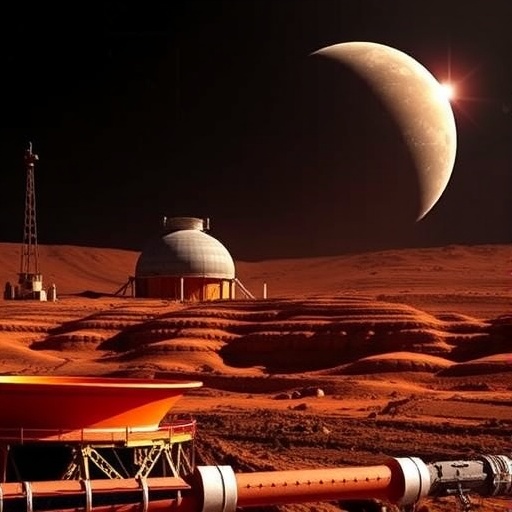
The University of Hong Kong (HKU) is poised to make a landmark contribution to planetary science and space exploration through its pivotal role in China’s ambitious Tianwen-3 mission. Spearheaded by HKU’s Department of Earth and Planetary Sciences, the development of a cutting-edge Short-Wavelength Infrared Spectrometer (SWIR) has been selected to serve as a crucial payload aboard the Tianwen-3 service module. This high-precision spectrometer, designed and led by HKU researchers, embodies the convergence of advanced hyperspectral imaging technology and planetary science expertise aimed at unlocking the mysteries of Mars.
Tianwen-3 marks China’s first foray into Mars sample return missions, with a targeted launch date in 2028 and a sample return milestone set for 2031. The mission’s genesis lies in addressing some of the most profound scientific questions humanity faces today: the origins and uniqueness of life on Earth, and whether the biochemical pathways we observe are universal across the cosmos. HKU’s involvement, through the SWIR instrument, places the university at the forefront of planetary scientific inquiry, while also aligning strategically with global efforts to explore Mars in unprecedented detail.
The Short-Wavelength Infrared Spectrometer specializes in detecting and analyzing material compositions on the Martian surface with a spatial resolution capable of detailed mineralogical mapping. Utilizing hyperspectral imaging, the instrument captures a spectrum of light beyond visible wavelengths, focusing on the short-wave infrared range where key molecular signatures, such as those from hydrous minerals and potential biosignatures, can be identified. This allows scientists to discern the presence of water-bearing minerals and organic compounds, which are critical indicators of past habitability and possible extant life.
Beyond the detection of minerals, the SWIR instrument fulfills a vital operational role in ensuring the success of the Tianwen-3 lander’s descent and landing on Mars. The Martian environment is notorious for dust storms that can obscure visibility and interfere with landing procedures. By continuously monitoring the emergence and development of dust storms in the potential landing zones, the spectrometer provides real-time data to make landing maneuvers safer and more precise. This capability represents an essential enhancement over previous missions, reducing risks associated with landing on a volatile planetary surface.
Once the lander touches down and begins collecting samples, the SWIR instrument transitions into a supervisory role from orbit, enabling the high-spatial-resolution mapping of the Martian surface. This orbital perspective supports the selection of scientifically valuable sites for detailed study, guiding the sampling efforts with greater accuracy. Such detailed mineralogical surveys are critical not only for understanding Mars’s geology but also for providing context to the samples returned to Earth, allowing researchers to correlate physical mineralogy with the returned sample’s laboratory analyses.
Following the successful return of Martian samples, the spectrometer is slated to remain operational in orbit for a minimum of five additional years. This extended mission phase will allow sustained observation of Mars’s low-latitude regions, facilitating long-term monitoring of mineralogical changes and seasonal variations. Such longitudinal data are expected to contribute significantly to our understanding of Martian climatology and surface processes, enriching the global scientific community’s insights into the planet’s ongoing evolution.
Professor Yiliang Li, leading the project at HKU, underscores the significance of this mission from both a scientific and a regional perspective. Employing hyperspectral imaging technology, the instrument directly targets the detection of biosignatures and hydrous minerals—markers that could indicate the possibility of life, past or present, on Mars. This technology represents a leap forward from conventional imagery, allowing a nuanced spectral fingerprinting that advances the search for life beyond our planet.
The interdisciplinary collaboration behind the SWIR instrument extends beyond HKU, involving Zhejiang University and the Chinese Academy of Sciences’ Changchun Institute of Optics, Fine Mechanics, and Physics. This synergistic partnership blends expertise in planetary science, optics, and engineering, fostering innovation and technological advancement. The selection of this payload not only affirms HKU’s international stature in planetary sciences but also advances China’s strategic objectives in deep-space exploration.
In addition to scientific endeavors, the project aligns with broader developmental goals. These include expanding Hong Kong’s scientific research capabilities, particularly in cosmochemistry and astrobiology, with focus on bodies like asteroids, Mars, and Jupiter within the solar system. Moreover, the mission supports Hong Kong SAR Government’s strategic vision to build a local aerospace industry ecosystem, leveraging the region’s geographical and technological strengths to carve a niche in the burgeoning global aerospace market.
HKU President, Professor Xiang Zhang, reflects on the profound implications of the university’s participation in this national space mission. He notes how the selection of HKU’s research instrumentation for Tianwen-3 highlights both the university’s profound scientific expertise and its role in bolstering China’s stature as a leading space power. This partnership signals a new era of frontier research, expanding human knowledge through exploratory missions that transcend Earth-bound boundaries.
The Tianwen-3 mission’s success hinges on precise scientific instrumentation, and HKU’s Short-Wavelength Infrared Spectrometer stands as a testament to cutting-edge innovation in planetary remote sensing. Hyperspectral imaging technology opens unprecedented opportunities to understand the Martian surface composition, contributing invaluable data that intertwines planetary geology with the search for extraterrestrial life. The instrument’s extended operational phase promises to yield a rich dataset, illuminating Mars in ways previously unattainable and setting the stage for decades of scientific discoveries.
In the dynamic context of global space exploration, Tianwen-3 exemplifies the synthesis of ambitious goals and multidisciplinary collaboration. HKU’s leadership in this mission highlights the increasing globalization of space science, where expertise and technology transcend borders to unravel the complexities of our solar system. The ongoing expansion of HKU’s capabilities in Earth and planetary sciences, combined with this landmark space mission, signifies a bold push towards future planetary discoveries and the deepening of humanity’s cosmic understanding.
The integration of the Short-Wavelength Infrared Spectrometer on Tianwen-3 not only promises to enhance the scientific yield of the mission but also demonstrates the vital role of advanced instrumentation in planetary exploration. By providing real-time environmental monitoring, high-resolution compositional mapping, and sustained orbital observations, this instrument encapsulates the sophistication needed for future interplanetary missions. Its deployment reaffirms the commitment of the scientific community to harness technology in unraveling the enigmas of Mars and beyond.
As the countdown to 2028 progresses, the scientific community eagerly anticipates the data and insights that HKU’s spectrometer will deliver. The mission stands at the intersection of planetary science, astrobiology, and advanced engineering, driving forward humanity’s quest to comprehend planetary habitability and the potential ubiquity of life in our universe. The Short-Wavelength Infrared Spectrometer symbolizes not just an instrument of measurement, but a beacon of hope and discovery in the relentless pursuit of knowledge beyond Earth.
News Publication Date:
Information not specified in the source content
Web References:
https://mediasvc.eurekalert.org/Api/v1/Multimedia/cca6e164-99c1-470f-8b08-e32b64d4aa87/Rendition/low-res/Content/Public
Keywords
Tianwen-3, Mars Sample Return, Short-Wavelength Infrared Spectrometer, hyperspectral imaging, planetary science, Mars dust storms, Mars mineralogy, biosignatures detection, astrobiology, HKU, Earth and planetary sciences, space exploration
Cite Scienmag News
Grant Pearson. (May 7, 2026). HKU Research Team to Create Short-Wavelength Infrared Spectrometer for China’s Tianwen-3 Mission, Enhancing the Hunt for Martian Life. Scienmag. https://scienmag.com/hku-research-team-to-create-short-wavelength-infrared-spectrometer-for-chinas-tianwen-3-mission-enhancing-the-hunt-for-martian-life/
Grant Pearson. "HKU Research Team to Create Short-Wavelength Infrared Spectrometer for China’s Tianwen-3 Mission, Enhancing the Hunt for Martian Life." Scienmag, 7 May 2026, https://scienmag.com/hku-research-team-to-create-short-wavelength-infrared-spectrometer-for-chinas-tianwen-3-mission-enhancing-the-hunt-for-martian-life/. Accessed 5 September 2026.
Grant Pearson. "HKU Research Team to Create Short-Wavelength Infrared Spectrometer for China’s Tianwen-3 Mission, Enhancing the Hunt for Martian Life." Scienmag. May 7, 2026. https://scienmag.com/hku-research-team-to-create-short-wavelength-infrared-spectrometer-for-chinas-tianwen-3-mission-enhancing-the-hunt-for-martian-life/


