


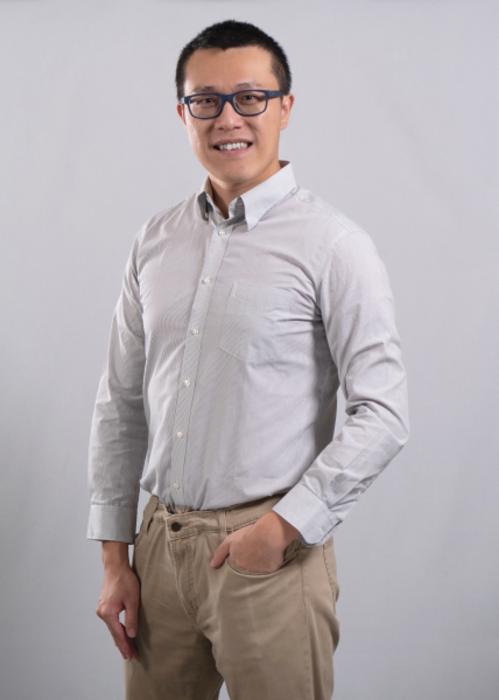
Professor Yi YANG, an Assistant Professor in the Department of Physics at The University of Hong Kong (HKU), has been honoured with the 2024 Croucher Tak Wah Mak Innovation Award for his pioneering research in photonics, specifically his work on “Nonrelativistic free-electron-light interaction with nanophotonics”.
The Innovation Awards are designed to offer substantial support to early-career scientists engaged in research at universities in Hong Kong. The awards enable researchers to pursue their scientific, intellectual and professional inclinations, to advance their expertise, engage in bold new work, and contribute to the development of education and research in Hong Kong. To be eligible for the award, candidates must be new or recent recruits with tenure-track faculty positions at a university in Hong Kong, and demonstrate a strong, internationally competitive track record in research. The total value of each Innovation Award is HK$5 million.
“This is an important recognition of my research achievements in the past and research ideas for the future,” said Professor YANG.
Professor Yi Yang and his research team aim to realise strong free-electron-light interaction by interfacing slow nonrelativistic electrons with nanophotonic environments. The growing synergy between free electron optics and nanophotonics has spurred new discoveries and applications, such as the stimulated inverse Cherenkov effect, entanglement between free electrons and photons, tunable integrated radiation sources and particle accelerators, and even biomedical imaging.
Professor Yang explained, “Much of the synergy between free electron optics and nanophotonics relies on the strong interaction between free electrons and photons. Nonrelativistic electrons hold great promise for achieving such a strong interaction because their energy is comparable to photon energy. Such a strong interaction could give rise to unique quantum-recoil phenomena and multiple photon processes from the interplay between nonrelativistic electrons, Van der Waals materials, and nanostructures.”
Professor Yang aims to provide a general framework to elucidate the maximal quantum interaction limit between free electrons and photons. Based on the quantum limit, he will utilise optimal structures to demonstrate the advantages of slow-electron in radiation generation and quantum light manipulation by studying cathodoluminescence in electron microscopes.
“Our research can be useful in electron microscopy and spectroscopy. It could generate entangled electrons and photons for quantum light generation and manipulation. It may also enable integrated free-electron radiation sources and accelerators,” said Professor Yang.
Biography of Professor Yi Yang
Professor Yi Yang is an accomplished researcher in the field of nanophotonics and optical physics. His research focuses on topics such as free-electron-light interaction and synthetic gauge fields. His past work includes a general framework that incorporates nonclassical optical responses at the extreme nanoscale, synthesis and observation of non-Abelian gauge fields in real space, an upper limit to spontaneous free-electron radiation in arbitrary photonic environments, and the observation of enhanced free-electron-light interaction from photonic flatbands.
Professor Yang’s academic journey started at Peking University, where he obtained his bachelor’s and master’s degrees in 2011 and 2014, respectively. He then got his PhD degree at Massachusetts Institute of Technology (MIT) in 2019, and continued to work as a postdoctoral fellow at MIT before joining HKU as an Assistant Professor in 2022. Professor Yang has been selected as Physical Science Fellow in 2023 Asian Young Scientist Fellowship, the 2022 Innovators under 35(China) by MIT Technology Review, and the 2022 Excellent Young Scientists fund (Hong Kong and Macau) under the National Natural Science Foundation of China, an organisation managed by the Ministry of Science and Technology (MOST).
More information about the research group of Professor Yi Yang:
For media enquiries, please contact Ms Casey To, Assistant Manager (Communications) (tel: 3917 4948; email: caseyto@hku.hk / Ms Cindy Chan, Assistant Director of Communications of HKU Faculty of Science (tel: 3917 5286; email: cindycst@hku.hk).

Credit: The University of Hong Kong
Professor Yi YANG, an Assistant Professor in the Department of Physics at The University of Hong Kong (HKU), has been honoured with the 2024 Croucher Tak Wah Mak Innovation Award for his pioneering research in photonics, specifically his work on “Nonrelativistic free-electron-light interaction with nanophotonics”.
The Innovation Awards are designed to offer substantial support to early-career scientists engaged in research at universities in Hong Kong. The awards enable researchers to pursue their scientific, intellectual and professional inclinations, to advance their expertise, engage in bold new work, and contribute to the development of education and research in Hong Kong. To be eligible for the award, candidates must be new or recent recruits with tenure-track faculty positions at a university in Hong Kong, and demonstrate a strong, internationally competitive track record in research. The total value of each Innovation Award is HK$5 million.
“This is an important recognition of my research achievements in the past and research ideas for the future,” said Professor YANG.
Professor Yi Yang and his research team aim to realise strong free-electron-light interaction by interfacing slow nonrelativistic electrons with nanophotonic environments. The growing synergy between free electron optics and nanophotonics has spurred new discoveries and applications, such as the stimulated inverse Cherenkov effect, entanglement between free electrons and photons, tunable integrated radiation sources and particle accelerators, and even biomedical imaging.
Professor Yang explained, “Much of the synergy between free electron optics and nanophotonics relies on the strong interaction between free electrons and photons. Nonrelativistic electrons hold great promise for achieving such a strong interaction because their energy is comparable to photon energy. Such a strong interaction could give rise to unique quantum-recoil phenomena and multiple photon processes from the interplay between nonrelativistic electrons, Van der Waals materials, and nanostructures.”
Professor Yang aims to provide a general framework to elucidate the maximal quantum interaction limit between free electrons and photons. Based on the quantum limit, he will utilise optimal structures to demonstrate the advantages of slow-electron in radiation generation and quantum light manipulation by studying cathodoluminescence in electron microscopes.
“Our research can be useful in electron microscopy and spectroscopy. It could generate entangled electrons and photons for quantum light generation and manipulation. It may also enable integrated free-electron radiation sources and accelerators,” said Professor Yang.
Biography of Professor Yi Yang
Professor Yi Yang is an accomplished researcher in the field of nanophotonics and optical physics. His research focuses on topics such as free-electron-light interaction and synthetic gauge fields. His past work includes a general framework that incorporates nonclassical optical responses at the extreme nanoscale, synthesis and observation of non-Abelian gauge fields in real space, an upper limit to spontaneous free-electron radiation in arbitrary photonic environments, and the observation of enhanced free-electron-light interaction from photonic flatbands.
Professor Yang’s academic journey started at Peking University, where he obtained his bachelor’s and master’s degrees in 2011 and 2014, respectively. He then got his PhD degree at Massachusetts Institute of Technology (MIT) in 2019, and continued to work as a postdoctoral fellow at MIT before joining HKU as an Assistant Professor in 2022. Professor Yang has been selected as Physical Science Fellow in 2023 Asian Young Scientist Fellowship, the 2022 Innovators under 35(China) by MIT Technology Review, and the 2022 Excellent Young Scientists fund (Hong Kong and Macau) under the National Natural Science Foundation of China, an organisation managed by the Ministry of Science and Technology (MOST).
More information about the research group of Professor Yi Yang:
For media enquiries, please contact Ms Casey To, Assistant Manager (Communications) (tel: 3917 4948; email: caseyto@hku.hk / Ms Cindy Chan, Assistant Director of Communications of HKU Faculty of Science (tel: 3917 5286; email: cindycst@hku.hk).
Cite Scienmag News
Courtney Benton. (August 8, 2024). HKU physicist Yi Yang receives 2024 Croucher Tak Wah Mak Innovation Award. Scienmag. https://scienmag.com/hku-physicist-yi-yang-receives-2024-croucher-tak-wah-mak-innovation-award/
Courtney Benton. "HKU physicist Yi Yang receives 2024 Croucher Tak Wah Mak Innovation Award." Scienmag, 8 August 2024, https://scienmag.com/hku-physicist-yi-yang-receives-2024-croucher-tak-wah-mak-innovation-award/. Accessed 3 September 2026.
Courtney Benton. "HKU physicist Yi Yang receives 2024 Croucher Tak Wah Mak Innovation Award." Scienmag. August 8, 2024. https://scienmag.com/hku-physicist-yi-yang-receives-2024-croucher-tak-wah-mak-innovation-award/

