

In the landscape of modern electronics, silicon (Si) has long been the cornerstone material across countless applications owing to its favorable properties. However, its limitations become glaringly apparent when subjected to the high-radiation environments typically encountered in applications such as high-energy particle accelerators, nuclear reactors, and even future space explorations. Prolonged exposure to substantial radiation doses can result in performance degradation, malfunction, and ultimately failure of silicon-based devices, which underscores the pressing need for alternative semiconductor materials capable of sustaining reliable function in these extreme conditions.
There exists a promising class of materials known as wide-bandgap semiconductors, famed for their robust atomic bonding which imparts them with the radiation tolerance needed in harsh environments. Among the contenders in this category, gallium nitride (GaN) stands out, especially for its established applications in blue light-emitting diodes (LEDs) and high-frequency, high-power electronic devices. Yet, until now, GaN had not been the focus of research regarding its utility in advanced particle detection, especially in two-dimensional sensing applications vital for both particle and nuclear physics.
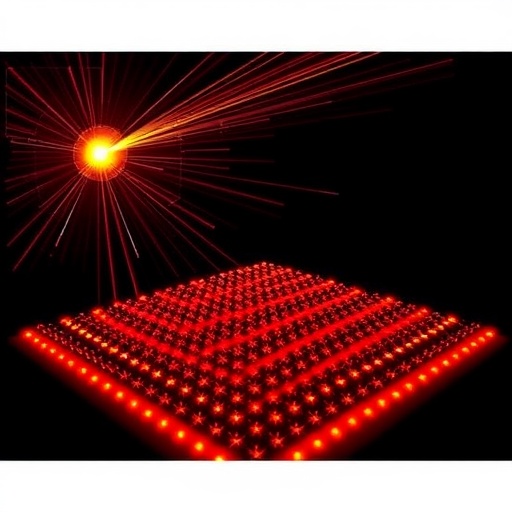
In a groundbreaking study conducted at the University of Tsukuba in Japan, researchers have successfully developed a vertical GaN particle detector featuring a pixel size of just 100 micrometers. This novel device enables real-time, two-dimensional position detection of individual alpha particles and xenon (Xe) heavy ions, representing a significant leap in detector technology. The practical implications of this innovation are vast, as it provides a viable alternative in environments where conventional silicon-based detectors cease to function effectively due to high radiation levels.
The GaN detector’s performance is particularly noteworthy; it has demonstrated stable operation even at radiation levels that are approximately an order of magnitude greater than those manageable by its silicon counterparts. This improvement is essential for various high-energy astrophysical experiments and applications, as it allows researchers to maintain the integrity and functionality of detection systems that must endure extreme conditions over prolonged periods.
Significantly, this achievement is made possible by the availability of large-area, high-quality GaN wafers. The enhancement in detector technology offered by GaN not only paves the way for scalable detector systems but also holds promise for transforming the way we approach numerous applications in particle physics and nuclear science. This is especially crucial as the global scientific community pushes towards more ambitious experimental setups, including the exploration of fundamental particles, the quest for new physics beyond the Standard Model, and advanced nuclear experiments.
The implications of such technology stretch beyond academic research, as it is expected to accelerate the development and improvement of high-energy accelerator facilities, which are central to exploring the fundamental constituents of matter. Additionally, the growth of space exploration instrumentation leveraging this technology will bolster missions that venture into deep space and enduring extraterrestrial environments, wherein traditional silicon technology falls short.
Moreover, radiation-based medical diagnostics, which demand reliable and precise detection mechanisms amidst radiotoxic environments, stand to benefit significantly from these advancements. The capability to reliably detect and analyze particles and ions in such scenarios has the potential to revolutionize approaches in both diagnostic imaging and therapeutic analytics in the medical field.
As the study manifests, the transformative nature of GaN in particle detection is not merely a theoretical concept but a practical reality. Researchers are optimistic that the findings will inspire further innovation and collaboration across fields, prompting more research into expanding the utility of wide-bandgap semiconductors in challenging applications.
Ultimately, the successful demonstration of GaN radiation detectors not only marks a pivotal moment for materials science but also sets the stage for future breakthroughs that could reshape our understanding and interaction with both nuclear and particle physics. The future of high-energy experiments now appears clearer, with GaN paving the path towards accomplishing previously insurmountable challenges that lie ahead in these noble scientific pursuits.
This critical advancement, funded through multiple grants and collaborations, underscores the importance of support in fostering innovation. The involvement of programs such as JSPS KAKENHI and MEXT’s Strategic Professional Development for Young Researchers highlights a community working collaboratively towards overcoming the limitations of current technologies in favor of more resilient solutions.
As researchers look forward, the results from this study fuel excitement not only for the potential provided by GaN but also for the collaborative spirit driving scientific discovery. It is an affirmation that, even against strenuous odds, new materials hold the key to unlocking the secrets of the universe and enhancing our capability to explore complexities beyond our current comprehension.
This remarkable achievement casts a hopeful light on the future of electronic devices operating in extreme environments, demonstrating that the journey towards more efficient, reliable, and powerful detection systems is very much underway.
Subject of Research: Development of GaN radiation detectors for particle detection
Article Title: GaN radiation detectors with low-gain avalanche diode structure
News Publication Date: 6-Jan-2026
Web References: DOI Link
References: Japanese Journal of Applied Physics
Image Credits: University of Tsukuba
Keywords
GaN, semiconductor, radiation tolerance, particle detection, wide-bandgap materials, nuclear physics, high-energy physics, space exploration, medical diagnostics, technology advancement.


