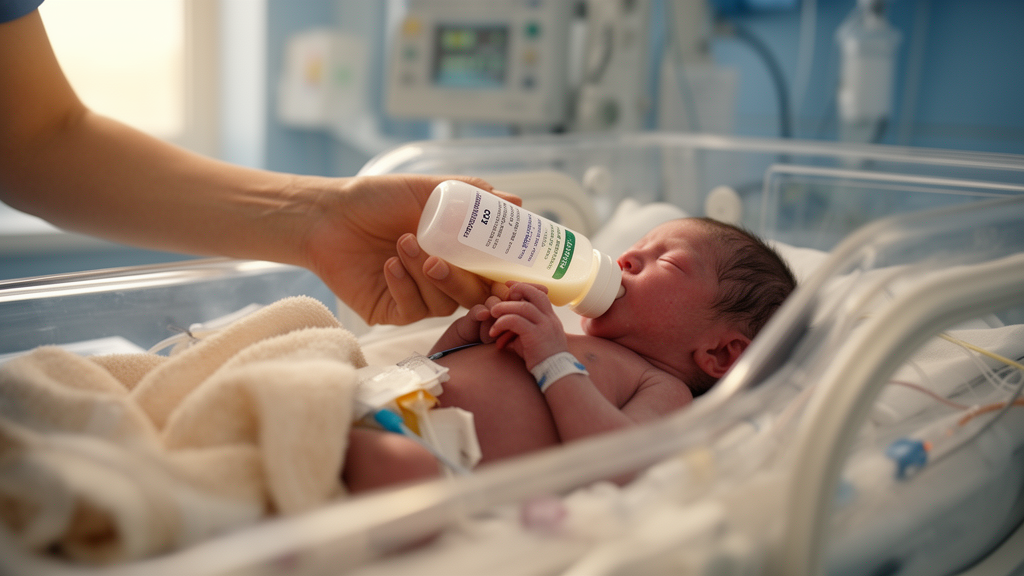
In a retrospective study of 230 very preterm infants, those who received a higher proportion of human milk at full enteral feeding had lower incidences of feeding intolerance and necrotizing enterocolitis than infants in the formula-feeding group. These associations were not accompanied by detectable differences in early growth velocity, time to full enteral feeding or hospitalization duration. The researchers said the findings require confirmation in larger, multicenter studies.
The study population comprised infants born at 28 to 31 weeks and 6 days of gestation who were admitted to a tertiary neonatal intensive care unit between July 2020 and December 2021. At the point when full enteral feeding was reached, investigators classified the infants into three groups according to the composition of their milk feeds. The high-proportion human-milk group included 75 infants whose feeds contained more than 50% human milk, while the low-proportion group included 76 infants receiving human milk at 50% or less. A third group of 79 infants received formula feeding.
Very preterm infants are highly susceptible to necrotizing enterocolitis and feeding intolerance because of gastrointestinal immaturity, the study’s background notes. Although breast milk contains protective bioactive components, the optimal proportion for clinical benefit had remained undefined. The retrospective analysis therefore examined whether the proportion of breast milk in enteral feeds was associated with early growth and major complications among these infants.
Feeding intolerance occurred in 2.67% of the high-proportion human-milk group, compared with 15.19% of the formula-feeding group. Necrotizing enterocolitis occurred in 2.68% and 13.92% of the respective groups. Both differences were statistically significant, with P values below 0.05. The abstract provides these direct comparisons between the high-proportion human-milk and formula groups; it does not give the corresponding incidence figures for the low-proportion human-milk group.
No significant differences were detected among the three groups in baseline characteristics, time to full enteral feeding, duration of hospitalization or changes in growth velocity, with all reported P values greater than 0.05. In the outcomes examined, the lower frequencies of feeding intolerance and necrotizing enterocolitis in the high-proportion human-milk group were therefore not accompanied by detectable differences in the study’s growth and hospitalization measures.
The investigators also compared the groups for other major complications associated with prematurity. Bronchopulmonary dysplasia, retinopathy of prematurity, intraventricular hemorrhage, hemodynamically significant patent ductus arteriosus and sepsis showed no statistically significant differences across the three feeding groups. These nonsignificant results do not establish that human-milk proportion has no relationship to those complications, only that the study did not detect a significant difference in the comparisons presented.
The design cannot establish that human milk caused the lower observed frequencies of feeding intolerance and necrotizing enterocolitis. Because the analysis was retrospective and based on one tertiary neonatal intensive care unit, the findings should be interpreted as associations rather than a demonstrated causal effect. The sample of 230 infants also limits the precision with which uncommon outcomes can be assessed and restricts generalization beyond the population studied.
Overall, the study linked a human-milk proportion above 50% at full enteral feeding with fewer cases of feeding intolerance and necrotizing enterocolitis among very preterm infants, while detecting no significant differences in early growth velocity, time to full enteral feeding or hospitalization duration. The findings support further investigation of human-milk promotion for this vulnerable population, but the authors emphasized that larger, multicenter confirmation is needed.
Subject of Research: Association between human milk proportion at full enteral feeding and gastrointestinal complications in very preterm infants
Article Title: High-proportion of human milkfeeding reduces necrotizing enterocolitis and feeding intolerance among very preterm infants
Article References: Gao, X., Feng, W., Chen, Z., Chen, D., & Fang, Q. (2026). High-proportion of human milkfeeding reduces necrotizing enterocolitis and feeding intolerance among very preterm infants. BMC Pediatrics. https://doi.org/10.1186/s12887-026-07488-w
Image Credits: AI Generated
DOI: 10.1186/s12887-026-07488-w
Keywords: very preterm infants, human milk feeding, necrotizing enterocolitis, feeding intolerance, enteral feeding, neonatal intensive care, early growth, retrospective study, prematurity, breast milk, High-proportion, human
Cite Scienmag News
Ophelia Keating. (October 24, 2026). High-proportion of human milkfeeding reduces necrotizing enterocolitis and feeding intolerance among very preterm infants. Scienmag. https://scienmag.com/high-proportion-of-human-milkfeeding-reduces-necrotizing-enterocolitis-and-feeding-intolerance-among-very-preterm-infants/
Ophelia Keating. "High-proportion of human milkfeeding reduces necrotizing enterocolitis and feeding intolerance among very preterm infants." Scienmag, 24 October 2026, https://scienmag.com/high-proportion-of-human-milkfeeding-reduces-necrotizing-enterocolitis-and-feeding-intolerance-among-very-preterm-infants/. Accessed 24 October 2026.
Ophelia Keating. "High-proportion of human milkfeeding reduces necrotizing enterocolitis and feeding intolerance among very preterm infants." Scienmag. October 24, 2026. https://scienmag.com/high-proportion-of-human-milkfeeding-reduces-necrotizing-enterocolitis-and-feeding-intolerance-among-very-preterm-infants/