


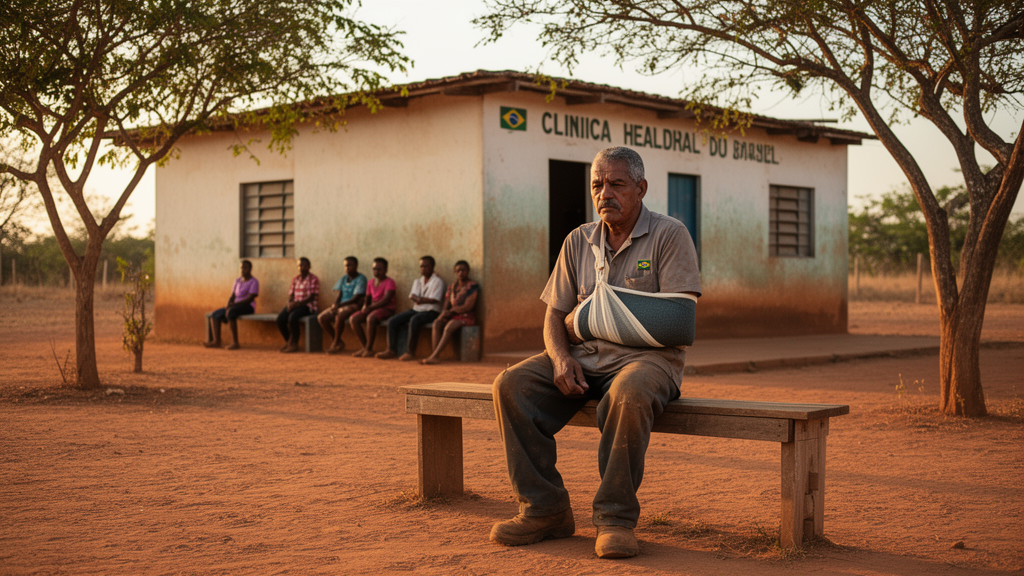
More than one in ten Brazilian workers who suffer occupational accidents wait longer than 24 hours before reaching healthcare services, according to a nationwide cross-sectional study drawing on 477,276 accident cases recorded in 2024 by the Brazilian Notifiable Diseases Information System. The researchers defined delayed healthcare-seeking as accessing care more than a day after the injury occurred, and found an overall prevalence of 12.2 percent. Because delays after occupational injuries raise the risk of complications, disability, and death, the finding points to a measurable gap between the moment of harm and the moment of treatment across a large share of the country’s workforce.
The study went beyond a single national figure by mapping where delays concentrate and by modeling determinants at two levels simultaneously: the individual worker and the municipality. Spatial clustering techniques revealed significant geographic clustering of delayed care across Brazilian municipalities, with hotspots concentrated in the North and Midwest regions. This pattern matters because it suggests the problem is not randomly scattered but tied to place-specific conditions, supporting the authors’ conclusion that geographically targeted occupational health interventions in high-risk municipalities may be needed rather than uniform national measures alone.
The multilevel mixed-effects logistic regression identified several individual-level factors associated with higher odds of delay. Compared with White individuals, Black workers had 11 percent higher odds of delayed care (adjusted odds ratio 1.11; 95% CI: 1.06–1.15) and Brown workers had 13 percent higher odds (AOR 1.13; 95% CI: 1.10–1.16), an association the authors link to social vulnerability. Agricultural workers were more likely to delay care than other occupational groups (AOR 1.20; 95% CI: 1.14–1.25). Timing of injury showed the strongest effect in the model: accidents occurring in the evening were associated with markedly higher odds of delay (AOR 3.62; 95% CI: 3.51–3.75), a pattern consistent with reduced service availability outside standard hours.
Injury characteristics also shaped the likelihood of delay. Workers with lower limb injuries had 51 percent higher odds of delayed care (AOR 1.51), those with trunk or back injuries had roughly double the odds (AOR 2.05), and multiple injuries were associated with 90 percent higher odds (AOR 1.90) compared with the reference categories. At the municipal level, living in municipalities with lower health facility density was associated with an increased likelihood of delaying care, indicating that structural inequalities in healthcare access operate alongside individual social vulnerabilities rather than in isolation from them.
The authors conclude that delays following occupational injuries in Brazil reflect both social vulnerability and structural barriers in service access, and that the pronounced geographic clustering underscores an urgent need for geographically targeted occupational health interventions. Their recommendations center on strengthening healthcare accessibility, extending service availability, and concentrating efforts in the municipalities where hotspots persist. As an observational cross-sectional analysis of surveillance data, the study establishes associations and spatial patterns rather than causal effects, and its findings are specific to occupational accident cases captured in the Brazilian notification system in 2024. Within that scope, it provides national evidence on a topic the authors describe as previously limited, quantifying how often workers delay care and identifying where and among whom those delays are most likely to occur.
Subject of Research: Spatial and multilevel determinants of delayed healthcare-seeking after occupational accidents in Brazil
Article Title: Spatial and multilevel determinants of delayed healthcare access following occupational accidents in Brazil
Article References: Fentaw Ahmed, A., da Silva, E. N., Farias, J. S., Mendonça, A. V. M., de Andrade, N. F., Debalkie Animut, M., & Nogueira Cruvinel, V. R. (2026). Spatial and multilevel determinants of delayed healthcare access following occupational accidents in Brazil. PLOS One, 21(10), e0360805. https://doi.org/10.1371/journal.pone.0360805
Image Credits: AI Generated
DOI: 10.1371/journal.pone.0360805
Keywords: occupational accidents, delayed healthcare-seeking, Brazil, spatial clustering, multilevel analysis, healthcare access, health inequalities, agricultural workers, Notifiable Diseases Information System, cross-sectional study, municipal health facility density, Spatial
Cite Scienmag News
Phoebe Ingram. (October 24, 2026). Delayed Care After Workplace Injuries Clusters in Brazil’s North and Midwest. Scienmag. https://scienmag.com/delayed-care-after-workplace-injuries-clusters-in-brazils-north-and-midwest/
Phoebe Ingram. "Delayed Care After Workplace Injuries Clusters in Brazil’s North and Midwest." Scienmag, 24 October 2026, https://scienmag.com/delayed-care-after-workplace-injuries-clusters-in-brazils-north-and-midwest/. Accessed 24 October 2026.
Phoebe Ingram. "Delayed Care After Workplace Injuries Clusters in Brazil’s North and Midwest." Scienmag. October 24, 2026. https://scienmag.com/delayed-care-after-workplace-injuries-clusters-in-brazils-north-and-midwest/


