


Groundwater is literally the water found beneath the Earth’s surface. It forms when precipitation such as rain and snow seeps into the soil, replenishing rivers and lakes. This resource supplies our drinking water. However, a recent study has alarmed the scientific community by predicting that approximately three million people in currently untapped areas of Korea could face groundwater depletion by 2080.

Credit: POSTECH
Groundwater is literally the water found beneath the Earth’s surface. It forms when precipitation such as rain and snow seeps into the soil, replenishing rivers and lakes. This resource supplies our drinking water. However, a recent study has alarmed the scientific community by predicting that approximately three million people in currently untapped areas of Korea could face groundwater depletion by 2080.
A research team, led by Professor Jonghun Kam from Division of Environmental Science and Engineering and Dr. Chang-Kyun Park from the Institute of Environmental and Energy Technology (currently working for LG Energy Solution) at Pohang University of Science and Technology (POSTECH), used an advanced statistical method, to analyze surface and deep groundwater level data from 2009 to 2020, revealing critical spatiotemporal patterns in groundwater levels. Their findings were published in the international journal “Science of the Total Environment.”
Groundwater is crucial for ecosystems and socioeconomic development, particularly in mountainous regions where water systems are limited. However, recent social and economic activities along with urban development have led to significant groundwater overuse. Additionally, rising land temperatures are altering regional water flows and supplies, necessitating water policies that consider both natural and human impacts to effectively address climate change.
In a recent study, researchers used an advanced statistical method called “cyclostationary empirical orthogonal function analysis (CSEOF)” to analyze water level data from nearly 200 surface and deep groundwater stations in the southern Korean Peninsula from 2009 to 2020. This analysis helped them identify important spatiotemporal patterns in groundwater levels.
The first and second principal components revealed that water level patterns mirrored recurring seasonal changes and droughts. While shallow-level groundwater is more sensitive to the seasonality of precipitation than the drought occurrence, deep-level groundwater is more sensitive to the drought occurrence than seasonality of precipitation. This indicates that both shallow-level and deep-level groundwater are crucial for meeting community water needs and mitigating drought effects.
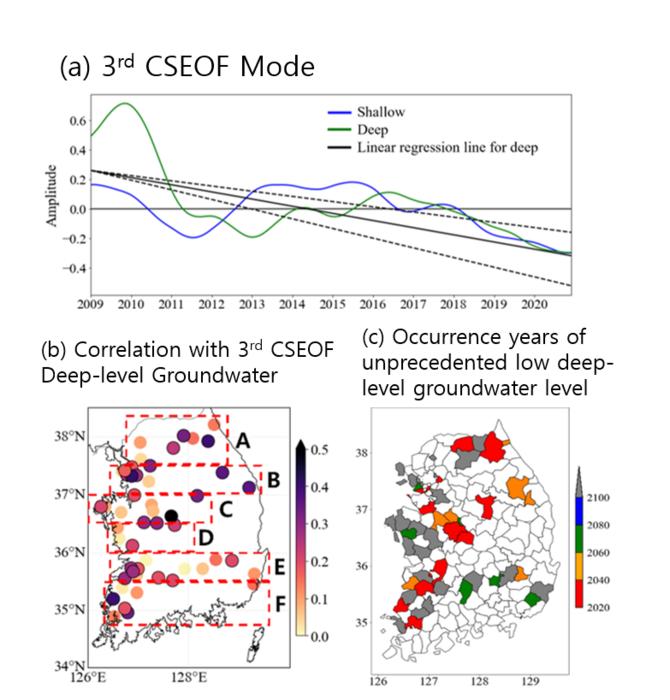
The third principal component highlighted a decline in groundwater levels in the western Korean Peninsula since 2009. The researchers projected that if this decline in deep groundwater continues, at least three million people in untapped or newly developed areas, primarily in the southwestern part of the peninsula, could face unprecedented groundwater level as a new normal (defined as groundwater depletion) by 2080. If the research team’s predictions are correct, the impact would be particularly severe in drought-prone, untapped areas where groundwater is heavily relied upon.
Professor Jonghun Kam of POSTECH stated, “By leveraging long-term, multi-layer groundwater level data on Korea and advanced statistical techniques, we successfully analyzed the changing patterns of deep- and shallow-level groundwater levels and predicted the risk of groundwater depletion.” He added, “An integrated national development plan is essential, one that considers not only regional development plans but also balanced water resource management plans.”
The research was sponsored by the Joint Research and Technology Development Project for Disaster Safety of the Ministry of the Interior and Safety and the Basic Research Program of the National Research Foundation of Korea.
Journal
Science of The Total Environment
Article Title
Spatiotemporal patterns of groundwater over South Korea
Article Publication Date
20-Apr-2024
Cite Scienmag News
Denise Maddox. (May 30, 2024). High groundwater depletion risk in South Korea in 2080s. Scienmag. https://scienmag.com/high-groundwater-depletion-risk-in-south-korea-in-2080s/
Denise Maddox. "High groundwater depletion risk in South Korea in 2080s." Scienmag, 30 May 2024, https://scienmag.com/high-groundwater-depletion-risk-in-south-korea-in-2080s/. Accessed 7 September 2026.
Denise Maddox. "High groundwater depletion risk in South Korea in 2080s." Scienmag. May 30, 2024. https://scienmag.com/high-groundwater-depletion-risk-in-south-korea-in-2080s/

