


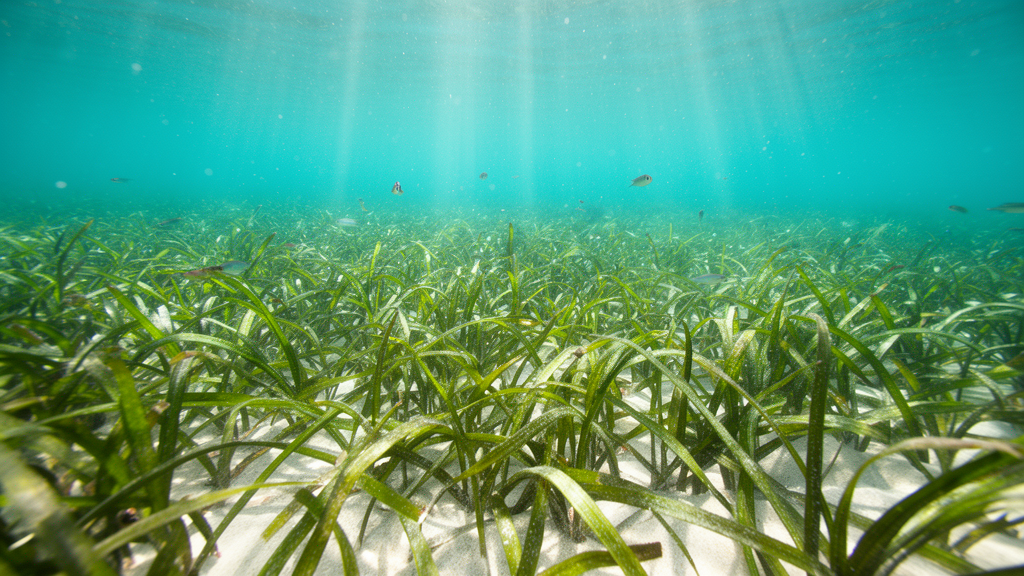
Beneath the surface of China’s coastal waters, the humble seagrass Zostera japonica is hiding one of the ocean’s most intricate microbial mosaics. A team of researchers from the Ocean University of China and the First Institute of Oceanography has now mapped, at unprecedented scale, how bacterial and fungal communities are distributed across the different microhabitats of these seagrass meadows — and what forces shape them. The study, published in the journal Microbiome, is being hailed as the first systematic investigation into the biogeographic patterns of microbes associated with marine macrophytes, a field that has long lagged behind its terrestrial counterparts.
The scale of the undertaking is remarkable. The researchers sequenced microbial communities from four distinct microhabitats within Zostera japonica beds: the surrounding seawater, the phyllosphere (the leaf surfaces of the seagrass), the rhizosphere (the sediment zone teeming around the plant’s roots and rhizomes), and the bulk sediment itself. From ten sampling sites spread along China’s coastline, the team generated 480 amplicon sequencing datasets alongside 40 full metagenomes, creating one of the most comprehensive pictures ever assembled of the microbial life flourishing in and around a single seagrass species across such a broad geographic range.
The findings reveal that these microbial communities are anything but randomly scattered in space. Clear spatial distribution patterns emerged from the data, characterized by distinct latitudinal gradients and so-called distance-decay relationships — the well-documented ecological phenomenon in which two communities become progressively more dissimilar the farther apart they are geographically. In other words, a seagrass bed in the warm southern waters of China harbors a measurably different microbial entourage than one in the cooler north, and neighboring beds share more microbial species in common than distant ones. These patterns mirror classic biogeographic laws first described for plants and animals, now confirmed for the invisible majority living alongside seagrasses.
But patterns are one thing; mechanisms are another. To understand what generates these distributions, the researchers turned to null models — statistical frameworks that predict what community structure would look like if nothing but random chance were at work. Surprisingly, the null model analysis suggested that random processes dominate the construction of microbial communities across the seagrass beds as a whole. Yet when the team applied a more sensitive metric, the normalized stochasticity ratio (NST), a more nuanced picture emerged. In the rhizosphere — the biologically active zone hugging the seagrass roots — bacterial community assembly shifts from predominantly stochastic to increasingly deterministic as latitude increases. This transition suggests that in the north, where environmental pressures may be more intense or variable, specific ecological filters begin to select which microbes can colonize the root zone, overriding the role of chance.
The environment itself appears to act as a selective sculptor, but not uniformly across microbial groups or habitats. Using response ratio analysis and generalized additive models (GAMs), the researchers demonstrated that bacterial and fungal communities respond differently to environmental factors, and that these responses vary across the four microhabitats. This differential sensitivity points to selective regulation: particular environmental drivers — likely including temperature, salinity, and nutrient availability — shape bacteria and fungi in distinct ways depending on whether those organisms live free in the water column, on leaf surfaces, in the root zone, or buried in sediment. It is a reminder that ‘the seagrass microbiome’ is not one entity but at least four, each governed by its own rules.
Perhaps the most striking findings concern function rather than identity. The metagenomic analysis revealed that key genes involved in nitrogen and sulfur metabolism — including nirS and norBC, which participate in the nitrogen cycle, and cysNDCH and cysJI, involved in sulfur assimilation — display both latitudinal gradient changes and microhabitat-specific differences among the annotated microbes. These genes matter far beyond academic curiosity: nitrogen and sulfur cycling are central biogeochemical processes that determine nutrient availability, greenhouse gas production, and overall ecosystem health in coastal waters.
One example illustrates the depth of functional flexibility the team uncovered. The cysC gene, another component of the sulfur assimilation pathway, is carried by entirely different groups of organisms depending on geography. At the northern sampling points, this gene is sourced from Actinomycetota, Bacteroidota, and Cyanobacteriota, whereas in the south it primarily comes from Campylobacterota and Pseudomonadota. Functionally, the seagrass beds in both regions can perform the same biochemical task — but the microbial players who do the work swap out entirely as one travels down the coast. This phenomenon, sometimes described as functional redundancy coupled with taxonomic turnover, highlights the remarkable adaptability of microbial communities to environmental heterogeneity and suggests that seagrass ecosystems may possess a built-in resilience against changing conditions.
The study’s significance extends well beyond seagrass biology. Seagrass beds are among the planet’s most valuable coastal ecosystems, providing nursery habitat for fish, stabilizing sediments, sequestering carbon, and buffering coastlines. Yet they are also among the most threatened, declining globally under the combined pressures of coastal development, water quality degradation, and climate change. Because microbes underpin so much of the nutrient cycling and health of these systems — rhizosphere microbes, for instance, can supply seagrasses with nitrogen and iron — understanding how microbial communities are structured and how they respond to environmental pressures is crucial for assessing the health of seagrass beds, predicting their response to environmental change, and designing effective conservation and management measures grounded in scientific evidence.
Methodologically, the work also establishes a theoretical framework that others can build upon: a dual model of microbial regulation by latitude and microhabitat. The authors argue that this framework offers new insights into the interactions between microbes and seagrasses, as well as the potential for biogeochemical cycling within these systems. The combination of large-scale amplicon sequencing, metagenomics, null modeling, NST analysis, co-occurrence networks, and metagenome-assembled genomes demonstrates the analytical toolkit now available for microbial biogeography — an approach that could readily be extended to other marine foundation species such as kelps, mangroves, and salt marsh plants, where large-scale microbial evidence remains equally scarce.
From chance to determinism, from seawater to root zone, from north to south, the microbial world of Zostera japonica turns out to be governed by overlapping layers of order and contingency. The researchers hope their findings will catalyze further investigation into microbe-seagrass interactions and the adaptive strategies these ecosystems employ under different environmental pressures. For a plant that anchors itself in shifting sediments while the climate and chemistry of its watery world change around it, the seagrass may owe much of its survival to the invisible partners mapped in this study — partners whose distributions, functions, and fates are now, for the first time, coming clearly into view.
Subject of Research: Biogeographical patterns and assembly mechanisms of microbial communities in Zostera japonica seagrass bed microhabitats
Article Title: Exploring the biogeographical patterns and driving mechanisms of microbial communities in four microhabitats of Zostera japonica beds
Article References: Exploring the biogeographical patterns and driving mechanisms of microbial communities in four microhabitats of Zostera japonica beds. (n.d.). https://doi.org/10.1186/s40168-026-02561-z
Image Credits: AI Generated
DOI: 10.1186/s40168-026-02561-z
Keywords: seagrass, Zostera japonica, microbiome, biogeography, microhabitats, rhizosphere, community assembly, nitrogen cycling, sulfur metabolism, metagenomics, latitudinal gradient, coastal ecosystems
Cite Scienmag News
Morgan Morrow. (October 15, 2026). Hidden Worlds in Seagrass Beds: Microbes Follow Latitude and Habitat, Landmark Study Finds. Scienmag. https://scienmag.com/hidden-worlds-in-seagrass-beds-microbes-follow-latitude-and-habitat-landmark-study-finds/
Morgan Morrow. "Hidden Worlds in Seagrass Beds: Microbes Follow Latitude and Habitat, Landmark Study Finds." Scienmag, 15 October 2026, https://scienmag.com/hidden-worlds-in-seagrass-beds-microbes-follow-latitude-and-habitat-landmark-study-finds/. Accessed 15 October 2026.
Morgan Morrow. "Hidden Worlds in Seagrass Beds: Microbes Follow Latitude and Habitat, Landmark Study Finds." Scienmag. October 15, 2026. https://scienmag.com/hidden-worlds-in-seagrass-beds-microbes-follow-latitude-and-habitat-landmark-study-finds/


