


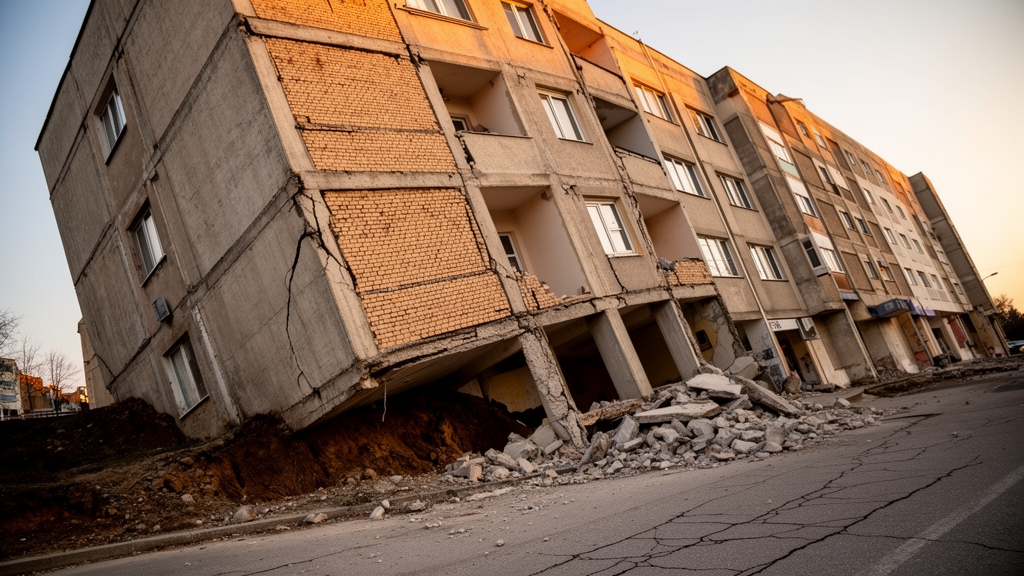
When a large earthquake strikes, the…
The distinction between ductile and limited-ductility reinforced concrete frames lies at the heart of why this line of research matters for earthquake engineering practice. Ductile frames are detailed with close transverse reinforcement spacing, robust confinement of column cores, and capacity-design principles that steer inelastic action into flexural plastic hinges where energy can be dissipated stably through many cycles of deformation. Limited-ductility frames, by contrast, are typically designed and constructed with minimal seismic detailing, often in regions of moderate seismicity or in older building stocks designed under earlier code generations such as the Uniform Building Code provisions referenced in the study. Because their members receive less transverse confinement, these structures are prone to shear-critical behavior, in which diagonal cracking and degradation of the concrete compression zone can precipitate brittle failure before the substantial deformation capacity associated with flexural yielding is ever mobilized. Capturing this behavior in analysis therefore requires models that couple flexural and shear response rather than treating them independently.
The flexure–shear interaction modeling approach adopted in the OpenSees numerical models reflects a significant evolution in nonlinear simulation capability. Earlier generations of frame models relied on lumped or distributed plastic hinges governed purely by moment–rotation relationships, which implicitly assumed that shear strength remained intact throughout the analysis. For shear-critical members, that assumption can be dangerously unconservative, because shear capacity degrades as displacement ductility demand increases, and axial load carrying capacity can follow. Modeling frameworks that track the interaction between flexural yielding and shear degradation, drawing on the deformation capacity formulations developed for members with continuous or lap-spliced reinforcement, allow the analyst to reproduce the gradual loss of lateral strength and the eventual axial failure modes observed in laboratory tests of poorly detailed columns. For limited-ductility frames, this modeling fidelity is not a refinement but a necessity, since the governing failure mechanism is precisely the one such models are designed to capture.
Masonry infill walls introduce a further layer of complexity that has been studied extensively for frames of intermediate and high ductility but far less thoroughly for limited-ductility systems. Infills interact with their surrounding frames through a diagonal compression strut mechanism once the wall-frame interface separates and cracking localizes the contact region. At low levels of ground shaking, infills stiffen the structure substantially, shortening the fundamental period and raising the lateral strength of the building. This stiffening effect can be beneficial, reducing displacement demands, but it also redistributes internal forces, potentially inducing shear failures in columns trapped between stiff walls, a phenomenon widely documented in past earthquake reconnaissance. Equivalent strut macromodels, which represent the infill as one or more diagonal compression elements with nonlinear cyclic behavior, have become the standard practical approach for capturing these effects in frame analysis, and their state of development has been reviewed extensively in the literature on infilled frame modeling.
The finding that infills raise seismic capacity by up to fifty percent at lower performance levels but contribute progressively less near collapse is consistent with the known mechanics of infill behavior. At minor and moderate damage states, the walls act as effective lateral load-resisting elements, sharing demand with the frame and limiting drift. As shaking intensifies, however, the infill panels crack, lose their diagonal compression capacity, and may fail in out-of-plane modes or slide along bed joints, effectively removing themselves from the lateral system. What remains is the bare frame, now potentially compromised by the earlier interaction effects, such as local column shear damage caused by the strut action of the walls. Near collapse, therefore, the structure behaves increasingly like a bare frame with accumulated damage, which explains why the beneficial contribution of the infills diminishes precisely where it would matter most for life safety.
Soil–structure interaction adds the third coupled phenomenon examined in the study. When a structure is founded on flexible soil rather than a rigid base, the foundation itself deforms, introducing rocking and translational flexibility that lengthens the effective period of the combined soil-foundation-structure system and adds radiation damping as well as hysteretic energy dissipation in the soil. The classical expectation, rooted in period lengthening, has often been that SSI is beneficial, reducing the spectral accelerations experienced by flexible structures. However, the roughly twenty percent reduction in seismic capacity reported here, together with amplified displacement demands under both mainshock and aftershock excitation, illustrates the counterintuitive side of SSI for this class of buildings. Period lengthening can move a structure closer to a site period where spectral amplification is greater, and the additional flexibility concentrates displacement demand at the foundation level, increasing drifts in the superstructure and potentially aggravating P-delta effects. Nonlinear constitutive models for the soil, including the widely used material formulations for shallow foundation response developed through the Pacific Earthquake Engineering Research Center, allow these effects to be captured rather than idealized away through a fixed-base assumption.
The treatment of mainshock–aftershock sequences addresses a dimension of seismic hazard that conventional design practice largely ignores. Design codes typically assess structures against a single design-level event, yet real earthquake sequences frequently deliver multiple strong shocks, and damaged structures must withstand the aftershocks in a degraded state. Research on inelastic displacement ratios under repeated earthquakes has shown that residual deformations, accumulated damage, and the reduced stiffness of a structure after a mainshock can all conspire to produce aftershock demands that exceed what an intact structure would experience under the same level of shaking. For limited-ductility frames, whose members degrade with each cycle of deformation, the vulnerability to aftershocks is particularly acute because the shear-critical failure modes are progressive in nature: cracking and strength loss from the mainshock lower the threshold at which brittle failure can be triggered by subsequent shaking.
The quantitative relationships reported between mainshock and aftershock demands offer a useful empirical picture of this degraded-state response. On average, roof displacement demands during aftershocks reach approximately half of the corresponding mainshock values, while inter-story drift demands reach sixty-five to seventy-five percent, indicating that the structure does not simply re-experience its mainshock response. The asymmetry between these two ratios is itself informative: roof displacement reflects the global, first-mode-dominated response of the damaged system, whereas inter-story drift is more sensitive to local stiffness concentrations and damage patterns. The observation that several ground-motion sequences produced aftershock drift demands exceeding the corresponding mainshock demands by up to one hundred seven percent is a striking reminder that aftershocks are not merely weaker copies of the mainshock. Depending on the frequency content, duration, and phasing of the aftershock relative to the damaged configuration of the structure, the second shock can be more damaging than the first.
The fragility methodology underlying the study connects these nonlinear response results to probabilistic statements about damage. Incremental Dynamic Analysis scales each of the twenty selected mainshock–aftershock ground-motion sequences across a range of intensities, producing a population of response trajectories from which the probability of exceeding defined damage states can be estimated. Mapping structural response quantities onto the HAZUS damage state definitions provides a standardized vocabulary for damage, aligned with the loss-estimation framework widely used in earthquake consequence modeling. Fragility curves constructed in this way express, for any given ground-motion intensity, the likelihood that a building will reach or exceed each damage state, from minor cracking through complete structural damage. This probabilistic framing, which builds on the performance assessment philosophy articulated in foundational work on seismic performance evaluation, is what allows the relative influence of infills, SSI, and sequence effects to be compared on a common scale.
The choice of two-, and four-story archetype buildings designed under the Uniform Building Code gives the results a concrete anchor in a recognizable class of existing construction. Low- and mid-rise frames of this type are ubiquitous in seismically active regions worldwide, and many were designed before modern capacity-design and ductility detailing requirements took hold. The two-story configuration represents the short-period end of the building population, where infill stiffening effects are proportionally largest and where period lengthening from SSI can shift the response into more demanding spectral regions. The four-story configuration introduces greater flexibility and higher drift demands, making it more sensitive to P-delta amplification and to the concentration of drift in lower stories where infill interaction and foundation flexibility effects converge. Studying both heights therefore brackets a meaningful range of behavior for the limited-ductility building stock.
The implications for performance-based assessment and retrofit are considerable. If fragility estimates for infilled, flexibly based, limited-ductility frames are made using fixed-base bare-frame models, the analysis may simultaneously overestimate capacity by crediting a rigid base that does not exist and underestimate the stiffening benefit of infills at lower damage states, while missing the near-collapse degradation of both. Retrofit strategies that add strength without addressing shear-critical member behavior, or that stiffen the structure without accounting for foundation flexibility, could fail to deliver the intended improvement in reliability. The study’s demonstration that the coupled effects of infills, nonlinear SSI, and aftershock sequences significantly alter the computed vulnerability profile argues for assessment workflows that represent all three phenomena explicitly, particularly for the large inventory of limited-ductility RC buildings whose seismic safety remains governed by brittle failure modes.
More broadly, the work sits within a growing body of research that treats seismic vulnerability as an emergent property of interacting subsystems rather than a property of the frame alone. Recent studies of infilled frames under mainshock–aftershock sequences, of SSI effects on the damage states of infilled structures considering both in-plane and out-of-plane wall behavior, and of modeling uncertainties in residual drift assessment under sequences all point toward the same conclusion: the most consequential aspects of seismic performance arise at the interfaces between structural, non-structural, and geotechnical components. For limited-ductility construction, where the margin between serviceable response and brittle failure is inherently narrow, resolving those interfaces in analysis is not an academic exercise but a prerequisite for credible risk assessment and for prioritizing the retrofit investments that follow from it.
Subject of Research: Probabilistic seismic fragility assessment of limited-ductility infilled RC frames with nonlinear soil–structure interaction under mainshock–aftershock sequences
Article Title: Probabilistic seismic fragility assessment of flexibly based infilled limited-ductility RC frames under earthquake sequences
Article References: Probabilistic seismic fragility assessment of flexibly based infilled limited-ductility RC frames under earthquake sequences. (n.d.). https://doi.org/10.1007/s10518-026-02716-1
Image Credits: AI Generated
DOI: 10.1007/s10518-026-02716-1
Keywords: seismic fragility, limited-ductility RC frames, masonry infill walls, soil–structure interaction, mainshock–aftershock sequences, incremental dynamic analysis, OpenSees, HAZUS damage states, flexure–shear interaction, performance-based seismic assessment, earthquake engineering, retrofit
Cite Scienmag News
Violet Maxwell. (October 16, 2026). Hidden Weaknesses: How Infill Walls and Soft Soil Shape Earthquake Damage in Older RC Buildings. Scienmag. https://scienmag.com/hidden-weaknesses-how-infill-walls-and-soft-soil-shape-earthquake-damage-in-older-rc-buildings/
Violet Maxwell. "Hidden Weaknesses: How Infill Walls and Soft Soil Shape Earthquake Damage in Older RC Buildings." Scienmag, 16 October 2026, https://scienmag.com/hidden-weaknesses-how-infill-walls-and-soft-soil-shape-earthquake-damage-in-older-rc-buildings/. Accessed 16 October 2026.
Violet Maxwell. "Hidden Weaknesses: How Infill Walls and Soft Soil Shape Earthquake Damage in Older RC Buildings." Scienmag. October 16, 2026. https://scienmag.com/hidden-weaknesses-how-infill-walls-and-soft-soil-shape-earthquake-damage-in-older-rc-buildings/


