


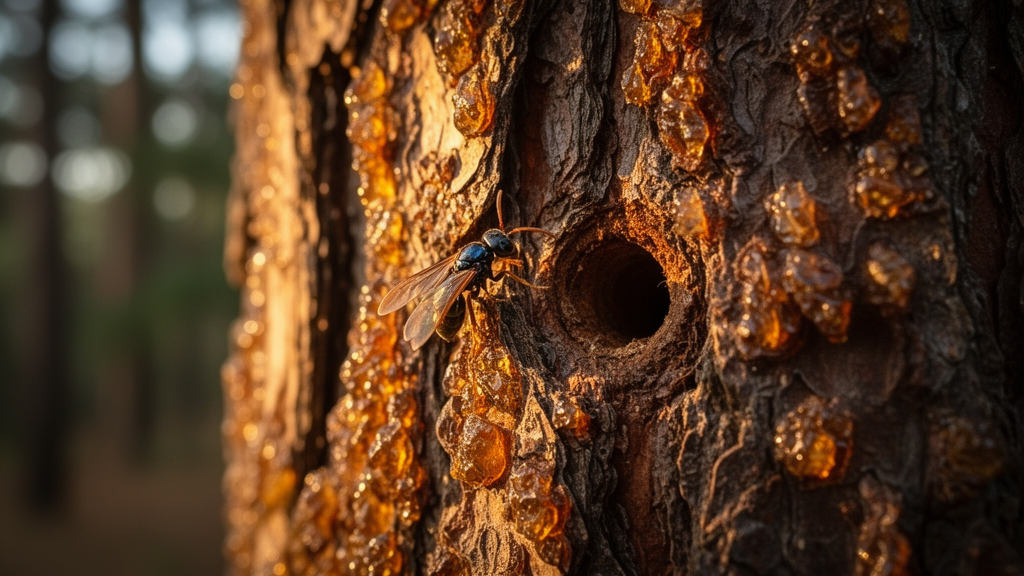
Deep inside the branches of Japanese red pine trees in South Korea, a microscopic battle has been unfolding largely unnoticed. Scientists studying the pine bark beetle Cryphalus fulvus, a tiny ambrosia-style scolytine that tunnels through conifer wood, have uncovered a hidden entourage of parasitoid wasps that attack its larvae. The survey, published in the Journal of Hymenoptera Research, documents seven wasp species from three hymenopteran families living at the beetle’s expense, and in doing so describes two species entirely new to science while recording three genera for the first time from the Korean Peninsula.
The study focused on beetle outbreaks in Gyeongsangnam-do province, where researchers cut infected pine logs of at least 40 centimetres from the forest and prepared them for insect rearing in remarkably practical fashion. To stop the logs drying out and killing the developing insects inside, the ends were sealed with plasticine before the wood was placed into dark bags fitted with transparent plastic collection cylinders. Each cylinder acted as a light trap: as adult insects emerged from the wood, they crawled or flew toward the light and could be collected alive, pinned onto entomological cards and identified morphologically. Larvae and pupae were also maintained in the laboratory at a steady 26 degrees Celsius and 60 to 70 percent relative humidity, conditions that allowed parasitoids to complete their development and emerge alongside their hosts.
That patient husbandry paid off. Among the insects reared from beetle-infested wood were females and males of an unfamiliar eulophid wasp, now formally named Aprostocetus tselikhae in honour of the Russian hymenopterist Dr Ekaterina V. Tselikh, an expert on Pteromalidae and the main collector of the type specimens. Measuring a mere 1.63 to 1.88 millimetres as an adult female, the new species is a textbook example of how much diagnostic detail can be packed into a nearly invisible body. Its description rests on precise ratios of antennal segments, the arrangement of sensilla on the funicle, the visibility of articulations between claval segments, the position of setae on the scutellum, and the proportions of the fore wing veins and gaster, each of which separates it from its closest relative, A. crypturgus.
The species is an ectoparasitoid, meaning its larvae develop on the outside of bark beetle larvae rather than inside them. This life strategy is common among chalcidoid wasps associated with scolytines: a female wasp locates a beetle gallery beneath the bark, evaluates the host larvae through the wood, and lays her eggs beside them. The wasp offspring then feed externally, eventually killing the beetle grub. Because bark beetle larvae are concealed within galleries that they never leave, parasitoids face the challenge of detecting and reaching hosts hidden inside solid wood, which makes the discovery of such a rich natural enemy community all the more striking.
A second new species joined the catalogue: Allocricellius minutus, a pteromalid wasp whose species name derives from the Latin minutus, or small, a nod to the modest 1.17 to 1.9 millimetre body of the female. Described by Tselikh, Ku and Lee from material reared at several sites across Gyeongsangnam-do, including Geochang-gun and Sancheong-gun, the species carries metallic blue-green coloration on its head and mesosoma and dark brown hind femora with a metallic sheen. Like its eulophid counterpart, its differentiation from the similar A. armandii depends on fine measurements: the ratio of the posterior ocellar line to the ocello-ocular line, the relative lengths of the marginal and stigmal veins of the fore wing, and the coloration of the hind legs. The genus Allocricellius had never before been recorded from Korea.
Two further pteromalid genera, Rhaphitelus and Sigynia, are also new additions to the Korean fauna. The rearing of Rhaphitelus maculatus from Cryphalus fulvus larvae marks the first time this widespread species, known from dozens of countries across Europe, Asia, Africa, Oceania and the Americas, has been documented attacking this particular bark beetle. Even more intriguing is Sigynia ernobii, a rare monotypic genus previously known only from the Czech Republic and Sweden, where it was described in 1974 from the anobiid beetle Ernobius mollis. The Korean material represents the first record of the genus from the East Palaearctic, a substantial extension of its known range, and the first association of S. ernobii with a scolytine host at all.
Because the original 1974 description of Sigynia was incomplete and lacked high-quality illustrations, the authors took the opportunity to redescribe the species and genus in detail, examining the holotype female held in the Swedish Museum of Natural History in Stockholm. Their updated diagnosis highlights characters such as the absence of an occipital carina, the shallow scrobes, the incomplete notauli of the mesoscutum, the reticulate propodeum with a median carina and plicae, and the fore wing with a closed speculum and marginal vein longer than both the stigmal and postmarginal veins. Only females are known; no male of S. ernobii has ever been described, a reminder of how little we still know about even formally named species.
In total, the parasitoid complex of C. fulvus now comprises seven species across Braconidae, Eulophidae and Pteromalidae. Previously, only the braconid Sycosoter hattorii and the pteromalid Roptrocerus xylophagorum were known as primary ectoparasitoids of the beetle’s larvae. The new work adds Pediobius moldavicus, a eulophid previously recorded from Moldova, Poland, Japan and Russia, and confirms Rhaphitelus maculatus and Sigynia ernobii as natural enemies of the beetle, bringing the documented host-parasitoid network to a level of complexity no one had suspected for this insect.
Why does this matter beyond the taxonomy? Bark beetles are among the most economically and ecologically consequential forest insects in the world, capable of killing vast stretches of pine forest during outbreaks. Cryphalus fulvus itself is distributed across north-eastern China, Taiwan, Japan and the Korean Peninsula and develops on Pinus densiflora, an ecologically important pine. Understanding which parasitoids naturally regulate such pests is a prerequisite for any biological control or integrated pest management strategy, and the discovery that at least seven wasp species attack C. fulvus in Korea suggests a richer regulatory community than earlier literature implied. Some of these parasitoids, such as R. xylophagorum, are globally distributed generalists of scolytines, while others, like Sigynia, appear highly specialized and geographically restricted, raising questions about how such disparate enemies coexist on the same host.
The study also demonstrates the enduring value of careful morphological taxonomy combined with patient rearing work. Every new species, range extension and host record emerged not from molecular screening but from cutting logs, sealing them with plasticine, and waiting for tiny wasps to walk into plastic cylinders. The type specimens are now deposited in institutions including the National Institute of Biological Resources in Incheon, the Science Museum of the Natural Enemies in Geochang, Hokkaido University Museum in Sapporo, the Swedish Museum of Natural History in Stockholm and the Zoological Institute of the Russian Academy of Sciences in St Petersburg, securing the physical evidence for future researchers. As bark beetle dynamics shift with climate and global trade, baseline knowledge of who eats whom in forest insect communities becomes ever more valuable, and the Korean parasitoid fauna has just taken a large step out of the shadows.
Subject of Research: Parasitoid wasp diversity associated with the pine bark beetle Cryphalus fulvus in South Korea
Article Title: The hymenopteran parasitoid complex ( Hymenoptera , Braconidae , Eulophidae , Pteromalidae ) of the pine bark beetle Cryphalus fulvus Niisima, 1908 ( Curculionidae , Scolytinae ) in South Korea
Article References: Tselikh, E. V., Kosheleva, O. V., Ku, D.-S., Lee, J., & Belokobylskij, S. A. (2025). The hymenopteran parasitoid complex (Hymenoptera, Braconidae, Eulophidae, Pteromalidae) of the pine bark beetle Cryphalus fulvus Niisima, 1908 (Curculionidae, Scolytinae) in South Korea. Journal of Hymenoptera Research, 98, 637-652. https://doi.org/10.3897/jhr.98.155465
Image Credits: AI Generated
Keywords: parasitoid wasps, bark beetles, Hymenoptera, Pteromalidae, Eulophidae, Braconidae, new species, South Korea, Pinus densiflora, forest entomology, taxonomy, biological control
Cite Scienmag News
Gavin Prescott. (October 19, 2026). Hidden wasps of the pine bark beetle: two new species revealed in South Korea. Scienmag. https://scienmag.com/hidden-wasps-of-the-pine-bark-beetle-two-new-species-revealed-in-south-korea/
Gavin Prescott. "Hidden wasps of the pine bark beetle: two new species revealed in South Korea." Scienmag, 19 October 2026, https://scienmag.com/hidden-wasps-of-the-pine-bark-beetle-two-new-species-revealed-in-south-korea/. Accessed 19 October 2026.
Gavin Prescott. "Hidden wasps of the pine bark beetle: two new species revealed in South Korea." Scienmag. October 19, 2026. https://scienmag.com/hidden-wasps-of-the-pine-bark-beetle-two-new-species-revealed-in-south-korea/

