


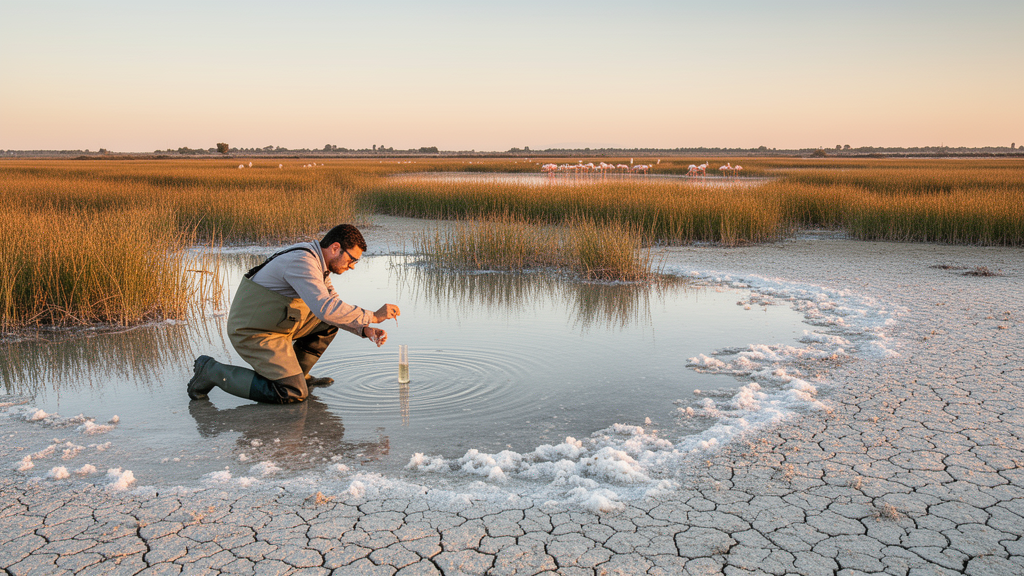
Deep beneath the surface of one of Europe’s most threatened wetlands, an enormous hidden ecosystem of bacteria and archaea has just been catalogued in unprecedented detail. Scientists have released a new 16S rRNA amplicon dataset from Las Tablas de Daimiel National Park in central Spain, revealing nearly 22,000 distinct microbial lineages, many of which have never been described before. The findings, published in the journal Metabarcoding and Metagenomics, offer a powerful new baseline for monitoring the health of a wetland that has lost much of its water to decades of groundwater pumping, pollution, and agricultural runoff.
Las Tablas de Daimiel National Park is no ordinary nature reserve. Covering roughly 20 square kilometers in the floodplain of the Cigüela and Guadiana rivers, it represents one of the last river floodplains in southern Europe. The park sits at the heart of the UNESCO-designated La Mancha Húmeda Biosphere Reserve and is also a Ramsar wetland site of international importance. Yet despite these protections, the ecosystem has been under siege. Until the mid-1980s, the wetland functioned as the natural groundwater discharge of the Western La Mancha Aquifer, which is now severely overexploited due to intensive extraction for irrigated agriculture. Combined with high organic inputs from untreated wastewater and agricultural runoff, this has transformed the park into a hydrologically fluctuating, hypertrophic system with elevated concentrations of toxic trace elements in its sediments.
Wetlands around the world are in similar trouble. These ecosystems cover approximately 13.4 percent of the global land area outside Antarctica and serve as critical biodiversity shelters, hosting everything from migratory birds to rare and endangered plants. But recent estimates suggest that more than half of the world’s original wetland area has already been lost, driven primarily by urbanization, agricultural expansion, and cumulative water pollution. As these landscapes decline, microbial communities have emerged as one of the most sensitive and accurate indicators of ecosystem health, responding rapidly to anthropogenic impacts across freshwater bodies worldwide.
Against this backdrop, the research team set out to provide a comprehensive snapshot of the prokaryotic life at Las Tablas de Daimiel. On May 30, 2023, they collected six samples across four different stations within the park: Entradilla, Casilla de Benito, Puente Navarro, and El Tablazo. At each location, they gathered samples from both the water column and the sediments, with El Tablazo being completely dry at the time of sampling. Water was collected in acid-washed polyethylene bottles from the surface of the ponds, while sediment samples were extracted by hand using a core sampler. Alongside the biological sampling, the team measured a full suite of environmental parameters in situ, including temperature, dissolved oxygen, pH, conductivity, major cations, nutrients, and carbon fractions.
Back in the laboratory, DNA was extracted from all samples using a DNeasy PowerSoil kit, and the material was sent to the FISABIO Sequencing and Bioinformatics Service in Valencia, Spain. There, two amplicon libraries per sample were created through PCR amplification, one targeting the bacterial V3-V4 region of the 16S rRNA gene and the other targeting the archaeal V3-V5 region. Specific primer pairs were used for each domain, and the resulting libraries were sequenced on an Illumina Nextseq2000 P1 platform using paired-end sequencing at 2×300 base pairs. The raw reads were then processed through the DADA2 pipeline in R, where trimming, chimera removal, and taxonomic classification against the SILVA rRNA database were performed to generate a final table of Amplicon Sequence Variants, or ASVs.
The results are striking. After quality control and the removal of contamination and potential chimeras, the dataset totals 19,855 bacterial ASVs grouped into 64 phyla and 1,766 archaeal ASVs grouped into 11 phyla. The prokaryotic diversity captured in this study surpasses that of previous amplicon surveys at the park, underscoring the scope of the analysis. Only 106 bacterial ASVs are common to all six samples, spanning 12 different phyla including Proteobacteria, Firmicutes, Actinobacteriota, Cyanobacteria, and Planctomycetota. For Archaea, just two ASVs classified to the phylum Crenarchaeota are shared across all stations. The lowest number of ASVs was detected in the Entradilla water sample, with 2,000 total, while the largest number, 12,107, came from the Casilla de Benito sediment sample.
Perhaps the most remarkable finding is the sheer proportion of unknown microbial life at the park. Up to 59.83 percent of the bacterial genera, representing 11,879 ASVs, remain undescribed, while this proportion reaches an extraordinary 88.56 percent of the archaeal genera, or 1,564 ASVs. These values are consistent with previous surveys showing that the uncultured microbial majority can represent up to 81 percent of microbial genera across ecosystems. Furthermore, 421 bacterial ASVs and 255 archaeal ASVs could not even be classified at the phylum level, suggesting that Las Tablas de Daimiel may host a relatively large collection of entirely unknown microbial taxa waiting to be discovered.
The study also reveals a clear taxonomic split between the microbial communities living in the water column and those in the sediments. For Archaea, the water column is dominated by the class Nanoarchaeia, mainly the order Woesearchaeales, along with various unclassified archaeal ASVs, while the sediments are characterized by Bathyarchaeia, Halobacteria, Nitrososphaeria, and Thermoplasmata. Bacterial differences are less pronounced but still noticeable: the water column is dominated by Actinobacteria, Bacteroidia, Cyanobacteriia, and Gammaproteobacteria, while the sediments harbor Alphaproteobacteria and Cyanobacteriia belonging primarily to the orders Phormidesmiales and Cyanobacteriales. Non-metric multidimensional scaling analysis confirmed that benthic samples cluster separately from pelagic samples for both domains, and Shannon and Simpson diversity indices showed higher bacterial richness in the benthic communities than in the pelagic ones.
The release of this dataset marks a significant step forward for the long-term environmental monitoring of Las Tablas de Daimiel National Park. By expanding the known benthic and pelagic diversity of both Archaea and Bacteria at the site, and by documenting the apparent taxonomic differentiation between these two habitats, the study provides a robust reference point against which future changes can be measured. As climate change, water extraction, and pollution continue to pressure wetlands across the globe, tools like 16S rRNA amplicon sequencing will become increasingly essential for tracking the invisible microbial communities that underpin ecosystem function. For this unique Spanish wetland, the newly published data offers a valuable resource for future conservation efforts aimed at improving the health and survival of one of Europe’s last great floodplain ecosystems.
Subject of Research: A 16S rRNA amplicon dataset of Las Tablas de Daimiel National Park, Spain
Article Title: A 16S rRNA amplicon dataset of Las Tablas de Daimiel National Park, Spain
Article References: Rodríguez-Gijón, A., López-Maroto, V., Mestre, M., Sánchez-Carrillo, S., & Laso-Pérez, R. (2026). A 16S rRNA amplicon dataset of Las Tablas de Daimiel National Park, Spain. Metabarcoding and Metagenomics, 10, Article e173083. https://doi.org/10.3897/mbmg.10.173083
Image Credits: AI Generated
Keywords: rRNA, amplicon, dataset, Tablas, Daimiel, National, Park, Spain, scientific research
Cite Scienmag News
Morgan Morrow. (October 17, 2026). Hidden Microbial World Revealed in Spain’s Fading Wetland National Park. Scienmag. https://scienmag.com/hidden-microbial-world-revealed-in-spains-fading-wetland-national-park/
Morgan Morrow. "Hidden Microbial World Revealed in Spain’s Fading Wetland National Park." Scienmag, 17 October 2026, https://scienmag.com/hidden-microbial-world-revealed-in-spains-fading-wetland-national-park/. Accessed 17 October 2026.
Morgan Morrow. "Hidden Microbial World Revealed in Spain’s Fading Wetland National Park." Scienmag. October 17, 2026. https://scienmag.com/hidden-microbial-world-revealed-in-spains-fading-wetland-national-park/


