


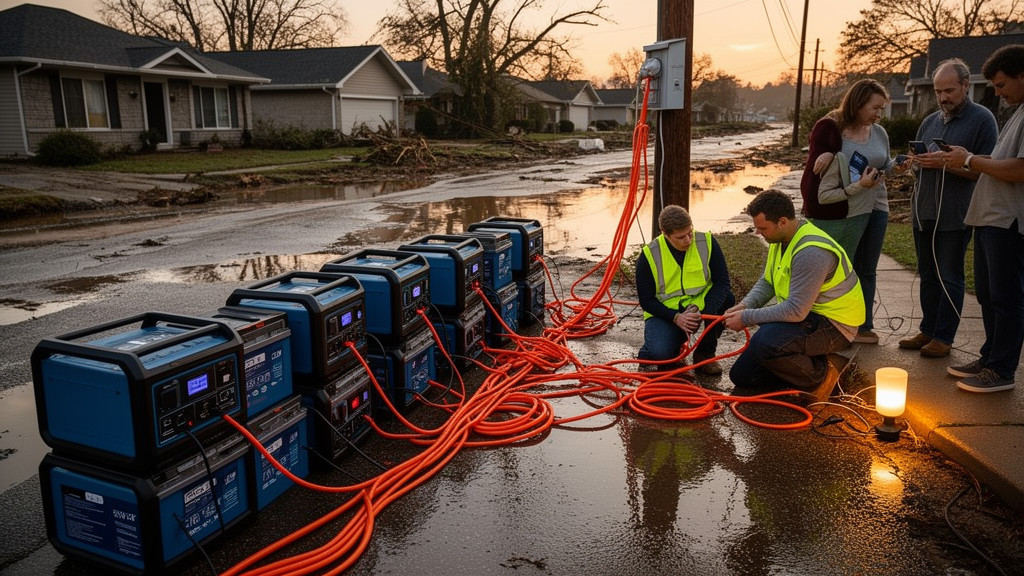
When hurricanes, ice storms, or floods knock out a distribution network, the difference between a brief inconvenience and a prolonged blackout often comes down to how quickly power can be rerouted to critical loads. A research team from State Grid Hubei Electric Power Research Institute and partner laboratories in Wuhan, China, now proposes a method that treats mobile energy storage not as an afterthought but as a pre-positioned, grid-forming lifeline. Writing in Scientific Reports, Lei Su, Mingjiang Wei, Wanli Feng, Kan Cao, Ziya Chen, and Ruoshi Gu describe a framework that plans where grid-forming mobile energy storage units should be stationed before a disaster strikes and then dynamically reschedules them as conditions evolve after impact. Simulations on a modified IEEE 69-bus distribution network show the approach can measurably improve resilience, offering a blueprint for utilities grappling with increasingly volatile weather.
The core innovation lies in the phrase grid-forming. Conventional battery systems are grid-following: they inject power but rely on the surrounding network to set voltage and frequency, which is useless when the network itself has collapsed. Grid-forming converters, by contrast, can establish their own voltage and frequency reference, behaving like miniature virtual power plants that can black-start isolated sections of a feeder. The Hubei team’s mobile energy storage units combine this capability with wheels, meaning they can be dispatched to wherever the grid is weakest. Because these units can regulate frequency and provide inertia response, they do more than supply energy; they stabilize the electrical dynamics of an islanded fragment of the network in the critical seconds after separation from the main grid.
The method is organized around a two-phase framework: pre-disaster defense and post-disaster recovery. In the defense phase, the researchers formulate a two-stage robust optimization model that accounts for uncertainty in photovoltaic output, since solar generation is notoriously difficult to predict during storm conditions when cloud cover shifts rapidly. The first stage of this optimization determines investment decisions, specifically how many mobile energy storage units to procure and where to pre-layout them. The second stage captures operational consequences, including load curtailment costs when supply falls short. The objective balances the unit cost of pre-configuring the mobile units against the curtailment cost of unserved load, with a conservatism adjustment coefficient allowing planners to tune how pessimistic the model should be about worst-case PV shortfalls.
Solving such a robust optimization is computationally demanding because the model must remain feasible across an entire uncertainty set rather than a single forecast. The team employs the Column-and-Constraint Generation algorithm, an iterative decomposition technique that has become a workhorse for two-stage robust optimization in power systems. The master problem proposes initial deployment plans, while a subproblem searches for the worst-case PV output realization that maximizes load curtailment. Dual variables from the subproblem generate feasibility cuts that refine the master problem, and the process iterates until the gap between the best deployment plan and the worst-case outcome converges. This ensures the resulting pre-layout plan is robust against a bounded but adversarial range of solar uncertainty rather than a single optimistic scenario.
Once the disaster has struck, the framework shifts into recovery mode. Here the researchers develop a power supply recovery model that coordinates the mobile energy storage fleet with electric vehicle stations, which can act as distributed energy reservoirs scattered across the network. Crucially, the model integrates changes in the operational status of the traffic network, recognizing that roads themselves may be congested, damaged, or closed in a disaster scenario. A congestion degree parameter modifies the nominal travel speed of the mobile units, and an equivalent travel distance is computed for each candidate relocation. This coupling between the electrical and transportation networks is what makes the scheduling genuinely dynamic rather than static, allowing the optimizer to weigh whether moving a unit is worth the travel time under degraded road conditions.
Mathematically, the recovery model is formulated as a mixed-integer second-order cone problem, a class of convex optimization that can handle the nonlinear power flow constraints of the distribution network while retaining binary decisions such as whether a mobile unit is connected to a particular node or whether an electric vehicle station is charging or discharging. Second-order cone relaxation of the branch flow equations ensures the solution respects voltage limits and power balance across the feeder. The model also captures the frequency dynamics of the grid-forming units, including their optimizable inertia, primary frequency regulation capacity reservation, ramp time, and the acceptable bounds on system frequency deviation from the rated value. By reserving primary frequency regulation capacity, the mobile units can respond to sudden power imbalances without violating frequency stability constraints.
The interplay between energy scheduling and frequency stability is one of the more technically elegant aspects of the work. When a section of the network is islanded, the power imbalance within the system drives a change in frequency at a rate determined by the total inertia available. Grid-forming mobile energy storage contributes synthetic inertia, and the model explicitly limits how much of this inertia can be optimized so that the peak frequency change rate remains within acceptable bounds. Charging and discharging efficiencies of both the mobile units and the electric vehicle stations are included, along with capacity limits that prevent the optimizer from over-discharging batteries needed for sustained support. The result is a schedule that is not only energy-adequate but also dynamically stable.
The researchers validate the framework through simulations on a modified IEEE 69-bus distribution network, a standard benchmark feeder widely used in power systems research. The test system incorporates distributed generation, photovoltaic connections, tie-lines, and electric vehicle stations, with fault time intervals defining when the network is under stress. Results indicate that the proposed method effectively improves the resilience of the distribution network, meaning that less load is curtailed and recovery proceeds more smoothly under the disaster scenarios examined. The two-stage robust optimization ensures the pre-layout plan is cost-effective while remaining defensive against adverse PV uncertainty, and the mixed-integer second-order cone recovery model produces implementable schedules that respect both electrical and transportation constraints.
What makes this work resonate beyond the academic literature is its timing. Extreme weather events have repeatedly exposed the fragility of distribution networks, which were historically designed for reliability under ordinary faults rather than resilience against catastrophic, widespread outages. Mobile energy storage offers a fundamentally different paradigm: rather than hardening every line, utilities can maintain a flexible fleet that rushes to where it is needed most. The Hubei team’s contribution is to show that this flexibility can be planned rigorously, accounting for uncertainty in renewable generation, the physics of frequency stability, and the realities of disaster-degraded roads. As climate volatility intensifies and battery costs continue to fall, frameworks like this one may well become standard practice in the utilities of the coming decade.
The research also highlights a broader trend in power systems engineering: the convergence of optimization theory, transportation logistics, and power electronics into unified resilience frameworks. By treating the traffic network and the electrical network as coupled systems, the method acknowledges that restoring power is not just an electrical problem but a logistical one. The open-access publication in Scientific Reports means utilities, regulators, and researchers worldwide can examine the model in detail, adapt it to their own feeders, and build on the mathematical machinery the team has established. For a field racing to keep the lights on under increasingly hostile conditions, that kind of transparency is itself a form of resilience.
Subject of Research: Engineering
Article Title: A robust resilience improvement method for distribution network based on pre-layout and dynamic scheduling of grid-forming mobile energy storage
Article References: Su, L., Wei, M., Feng, W., Cao, K., Chen, Z., & Gu, R. (2026). A robust resilience improvement method for distribution network based on pre-layout and dynamic scheduling of grid-forming mobile energy storage. Scientific Reports. https://doi.org/10.1038/s41598-026-63199-3
Image Credits: AI Generated
DOI: 10.1038/s41598-026-63199-3
Keywords: robust, resilience, improvement, method, distribution, network, based, pre-layout, dynamic, scheduling, grid-forming, mobile
Cite Scienmag News
Faith Mcneil. (October 17, 2026). Mobile Batteries That Form Their Own Grid Could Rescue Power Networks After Disasters. Scienmag. https://scienmag.com/mobile-batteries-that-form-their-own-grid-could-rescue-power-networks-after-disasters/
Faith Mcneil. "Mobile Batteries That Form Their Own Grid Could Rescue Power Networks After Disasters." Scienmag, 17 October 2026, https://scienmag.com/mobile-batteries-that-form-their-own-grid-could-rescue-power-networks-after-disasters/. Accessed 17 October 2026.
Faith Mcneil. "Mobile Batteries That Form Their Own Grid Could Rescue Power Networks After Disasters." Scienmag. October 17, 2026. https://scienmag.com/mobile-batteries-that-form-their-own-grid-could-rescue-power-networks-after-disasters/


