


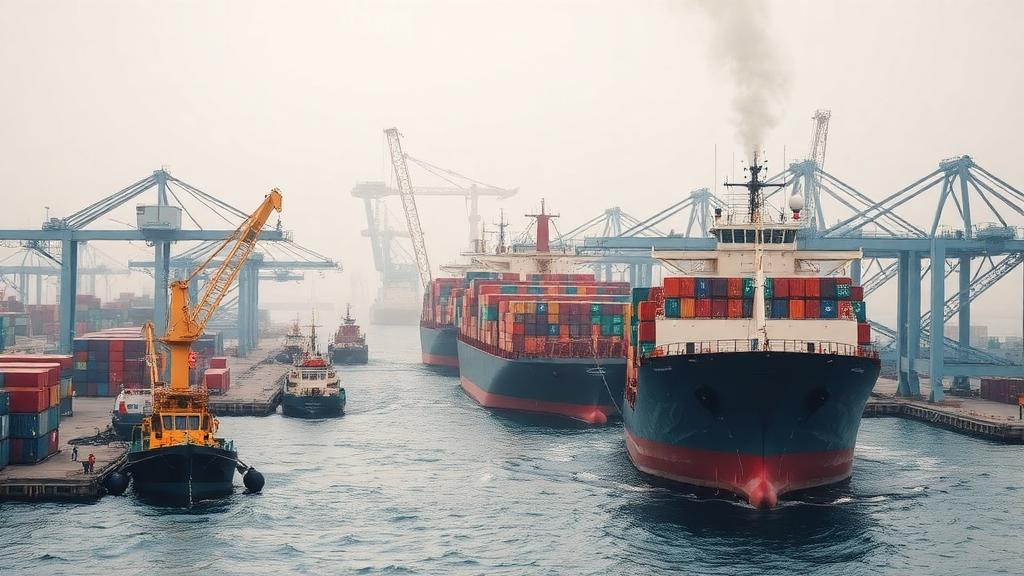
Beneath the busy quays of Adabiya Port, where cargo cranes and shipyard operations dominate the northern Gulf of Suez, the seafloor has been quietly keeping a record of industrial activity. A new study published in Environmental Monitoring and Assessment has now read that record in detail, providing the first baseline assessment of trace-metal contamination in the port’s surface sediments. The findings paint a picture of a harbor where certain toxic metals have accumulated to levels far above natural background, driven primarily by maritime operations and industrial discharges rather than by the geology of the surrounding coastline.
The research team, led by Ibrahem M. Abdallah of the National Institute of Oceanography and Fisheries in Cairo, together with colleagues from Suez Canal University, collected twenty-four sediment samples from the upper ten centimeters of the harbor floor in a single field campaign. Alongside measurements of eight potentially toxic elements—iron, manganese, zinc, copper, nickel, lead, cadmium, and cobalt—the team analyzed grain size, total organic matter, and calcium carbonate content. These supporting parameters matter because the physical and chemical makeup of sediment strongly influences how metals bind to particles, how mobile they are, and ultimately how much risk they pose to bottom-dwelling organisms and the wider marine food web.
The results revealed pronounced spatial heterogeneity across the port, with contamination hotspots concentrated in the northern and central sectors. This pattern is significant because it suggests that pollution is not uniformly distributed by currents or sediment mixing but instead tracks the locations of the most intensive human activity. Cargo handling zones, berthing areas, and industrial outfalls leave distinct chemical signatures in the sediment, and the study’s mapping of these zones provides port managers with a precise target for intervention rather than a blanket diagnosis.
Three metals stood out dramatically. Zinc reached concentrations up to 10.2 times the shale background value, lead up to 9.0 times, and cadmium up to 11.7 times. These elevations are not marginal; they represent order-of-magnitude departures from what natural weathering of regional rocks would produce. In contrast, the lithogenic elements—iron, manganese, nickel, and cobalt—remained close to background levels, indicating that the port’s sediments still largely reflect their geological origin for these metals. The split between enriched anthropogenic metals and near-background natural ones is one of the clearest signals in the dataset.
Cadmium emerged as the priority element of concern. Its enrichment factor climbed as high as 10.9, and its individual ecological risk value exceeded 80 at fourteen of the sampled stations, a threshold that signals considerable potential harm to aquatic life. At one station, the risk value surpassed 320, placing it in the highest category of ecological concern. Cadmium is particularly troubling in marine environments because it bioaccumulates in organisms, persists indefinitely, and can be transferred through food chains, meaning that contamination locked in harbor sediment today can ripple outward through ecosystems for decades.
To translate raw concentrations into ecological meaning, the researchers applied a suite of established contamination indices, including the contamination factor, the geoaccumulation index, and the enrichment factor, all benchmarked against average shale values from the classical geochemical literature. They then computed the potential ecological risk index, a framework originally developed by Lars Hakanson in 1980 that weights each metal’s toxicity alongside its concentration. The pollution load index exceeded unity at 75 percent of the stations, indicating widespread deterioration of sediment quality. The overall ecological risk assessment classified 75 percent of stations as low risk, 17 percent as moderate, and 8 percent as high—a distribution that underscores both the localized severity of the problem and the fact that much of the port remains comparatively unimpacted.
Perhaps the most technically ambitious part of the study was its source apportionment. The team combined principal component analysis and hierarchical clustering with a receptor modeling technique known as APCS-MLR, or absolute principal component scores with multiple linear regression. This approach, originally developed for atmospheric pollution studies, allows researchers to quantitatively partition the measured metal concentrations among contributing sources. The results were unambiguous: between 56 and 77 percent of the zinc, lead, and cadmium in the sediments could be attributed to an anthropogenic source, while 75 to 85 percent of the iron, manganese, nickel, and cobalt traced back to lithogenic, or rock-derived, origins.
That statistical separation carries real-world weight. It points directly to shipping operations, cargo handling, antifouling paints, and industrial effluents as the principal drivers of the toxic metal burden in the port. Lead and zinc are classic markers of harbor activity, appearing in fuels, paints, machinery wear, and runoff from industrial facilities. Cadmium, often associated with metal plating, batteries, and phosphate-related industries, adds a sharper edge to the picture. The fact that the natural elements remained dominated by geogenic sources confirms that the analytical methods were distinguishing real signals rather than artifacts.
Why does this matter beyond the boundaries of one Egyptian port? The Gulf of Suez is a critical corridor connecting the Red Sea to the Suez Canal, one of the world’s busiest shipping arteries. Sediments in such environments act as both sinks and potential sources of pollution: metals can remain bound to particles for years, but changes in water chemistry, dredging, or bioturbation can remobilize them into the water column, where they become available to fish, shellfish, and ultimately humans. Ports along this corridor are also expanding rapidly under Egypt’s Suez Canal Economic Zone development plans, making the timing of this baseline study particularly consequential.
The authors emphasize that their dataset establishes an essential reference point for future monitoring and management in the Gulf of Suez. Without a baseline, it is impossible to know whether contamination is worsening, stabilizing, or improving, and impossible to hold specific activities accountable. By documenting exactly which metals are elevated, where the hotspots lie, and what fraction of the burden comes from human activity, the study gives regulators and port authorities the tools to design targeted monitoring programs, prioritize remediation zones, and evaluate the effectiveness of future pollution controls. For a waterway that connects two oceans and carries a substantial share of global trade, understanding what settles into its harbor muds is not a parochial concern—it is a matter of guarding the environmental health of one of the planet’s most strategically important marine corridors.
Subject of Research: Trace-metal contamination and ecological risk assessment of surface sediments in Adabiya Port, Gulf of Suez
Article Title: Trace-metal contamination and ecological risk assessment in surface sediments of Adabiya Port, Gulf of Suez: spatial distribution, source apportionment, and baseline characterization
Article References: Abdallah, I. M., Dar, M. A., Soliman, F. A., & Algendy, A. R. (2026). Trace-metal contamination and ecological risk assessment in surface sediments of Adabiya Port, Gulf of Suez: spatial distribution, source apportionment, and baseline characterization. Environmental Monitoring and Assessment, 198(10), Article 1136. https://doi.org/10.1007/s10661-026-15943-5
Image Credits: AI Generated
DOI: 10.1007/s10661-026-15943-5
Keywords: trace metals, sediment contamination, Adabiya Port, Gulf of Suez, cadmium, ecological risk, source apportionment, APCS-MLR, enrichment factor, marine pollution, shipping, baseline study
Cite Scienmag News
Violet Maxwell. (October 1, 2026). Hidden Metals in a Red Sea Port Reveal a Toxic Fingerprint of Shipping. Scienmag. https://scienmag.com/hidden-metals-in-a-red-sea-port-reveal-a-toxic-fingerprint-of-shipping/
Violet Maxwell. "Hidden Metals in a Red Sea Port Reveal a Toxic Fingerprint of Shipping." Scienmag, 1 October 2026, https://scienmag.com/hidden-metals-in-a-red-sea-port-reveal-a-toxic-fingerprint-of-shipping/. Accessed 4 October 2026.
Violet Maxwell. "Hidden Metals in a Red Sea Port Reveal a Toxic Fingerprint of Shipping." Scienmag. October 1, 2026. https://scienmag.com/hidden-metals-in-a-red-sea-port-reveal-a-toxic-fingerprint-of-shipping/


