


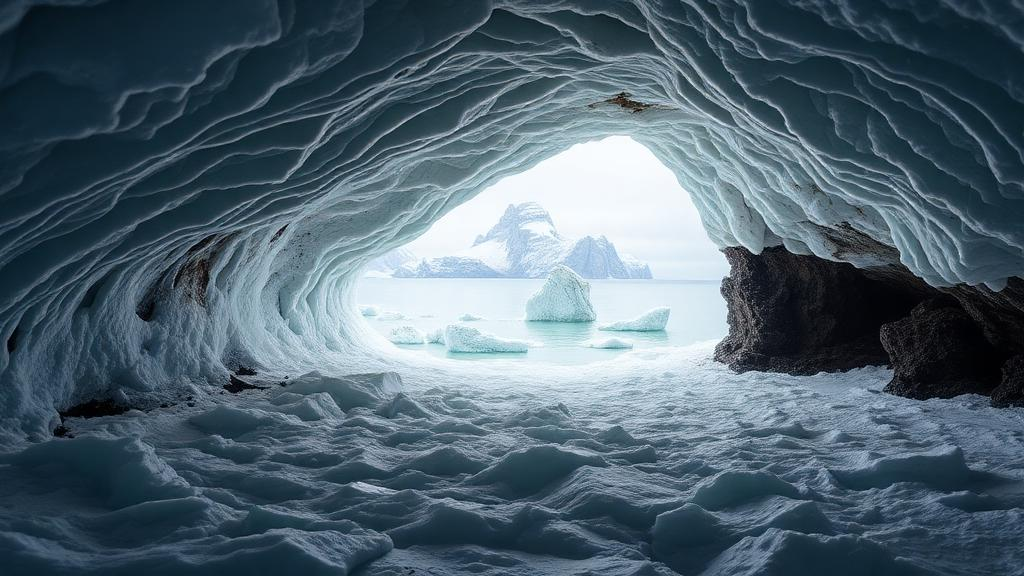
Deep beneath the summit of Mount Melbourne, a 2,732-metre active volcano rising from the coast of Northern Victoria Land, Antarctica, warm volcanic gases have been quietly carving tunnels through the ice for thousands of years. These fumarolic ice caves, sustained by geothermal heat that melts cavities into the summit ice cap, have long fascinated scientists studying cave morphology, gas chemistry, and extremophile microbial communities. But a new study has revealed that the floors of these surreal caves hold something even more valuable: an archive of volcanic ash and pumice that records explosive eruptions which would otherwise remain completely invisible beneath the Antarctic ice.
An international team of Italian researchers, led by volcanologists from the Istituto Nazionale di Geofisica e Vulcanologia in Pisa and the University of Perugia, has published the first integrated textural, petrological, and geochemical characterisation of 21 tephra samples collected from three summit ice caves at Mount Melbourne, known as MC1-Aurora, MC3, and MC4. The work, reported in Communications Earth & Environment, combines high-resolution electron microscopy and microanalysis with machine-learning-style statistical clustering to reconstruct the volcano’s hidden eruptive history. The results suggest that at least one previously unrecognised Holocene eruption occurred at Mount Melbourne, and that the ice-cave deposits can be matched to ash layers found in marine sediments and englacial ice hundreds of kilometres away.
The significance of this archive lies in the peculiar scarcity of volcanic evidence across Antarctica. Most eruptions from Antarctic volcanoes are buried beneath thick snow and ice, reworked by glaciers, or preserved only as sparse cryptotephra, invisible ash grains dispersed in distant marine cores and ice layers. Proximal deposits, material erupted and deposited close to the vent, are therefore extremely rare across the continent. Fumarolic ice caves offer a loophole: because volcanic heat melts and maintains open cavities within the ice, unconsolidated pyroclastic material from past explosive activity is accessible to researchers who would otherwise need to drill through the ice cap. During the XXXVII Italian Antarctic expedition in 2021, the team gained access to three of the eleven recognised fumarolic ice caves at Mount Melbourne, a volcano that today is quiescent but thermally active, with persistent fumaroles, steam emissions, and ice towers dotting its summit.
The caves themselves are dramatic environments. MC1-Aurora, at the base of the Geothermal Slope, is marked by a prominent ice tower whose entrance is a five-metre fissure leading to a thermally eroded tunnel and chamber. MC3, located beneath the Cryptogam Ridge geothermal area, is the largest known fumarolic cave in Antarctica, with more than a kilometre of mapped passages and a vertical extent exceeding fifty metres, including a cavern called the crater hall sculpted into characteristic erosional forms and ice speleothems. MC4, on the northwestern flank of the caldera above Campbell Glacier, opens from the top of a large fumarolic tower and descends into sandy, scoriaceous chambers where temperatures locally exceed 40 degrees Celsius. The researchers were careful not to assume that ash found within a single cave belonged to a single eruption, since accumulations inside these dynamic cavities are not stratigraphically constrained. Each sample was therefore treated as an independent record throughout the analysis.
Back in the laboratory, the team mounted the samples in epoxy, polished them, and examined them with a scanning electron microscope, revealing juvenile glass fragments spanning two textural end-members: highly vesicular, glassy pumice with sparse plagioclase and clinopyroxene phenocrysts, and denser, more crystal-rich scoria. Electron probe microanalysis of the glass then provided major-element compositions, while laser ablation inductively coupled plasma mass spectrometry delivered trace-element data on individual shards. The glass compositions fell mostly in the trachyte field, with silica dioxide contents ranging from 57.4 to 66.1 weight percent and alkalis between 8.1 and 12.3 weight percent. Importantly, backscattered electron imaging showed no corrosion textures, dissolution features, or silica-enriched rims from volcanic gas alteration, confirming that the original glass compositions had survived intact despite the hostile fumarolic environment.
The analytical centrepiece of the study was a multivariate statistical workflow applied to a combined dataset of 465 new glass analyses plus 720 published compositions from Mount Melbourne products preserved in englacial ice, marine sediment cores, and proximal outcrops. Because geochemical data are compositional, summing to a fixed total, the researchers applied log-ratio transformations from the framework of compositional data analysis before running hierarchical clustering, principal component analysis, and t-distributed stochastic neighbour embedding, using the open-source Orange data-mining platform with its volcanology-specific extension. Ward’s linkage and Euclidean distance grouped geochemically similar analyses, and the optimal partition was validated across independent methods. The result was eight well-defined geochemical clusters, C1 through C8, distributed along the magmatic differentiation trend of the Melbourne system, from primitive basaltic compositions to the most evolved trachytic melts. The ice-cave tephras occupied four of these clusters, C3, C4, C5, and C8.
One cluster stands out as genuinely new. Cluster C3, composed mainly of material from the MC1-Aurora and MC3 caves, has no clear compositional equivalent among any previously known proximal or distal Mount Melbourne tephra record. The published samples contributing minor, statistically insignificant amounts to this cluster are represented by single-point analyses that cannot support a robust correlation. The researchers conclude that this signature may represent one or more explosive eruptions that remain entirely absent from the current tephrostratigraphic framework of the volcano, a striking demonstration that a Holocene eruption could have gone completely unnoticed in one of the most intensively studied volcanic regions of Antarctica.
The other clusters tell stories of connection across archives. Cluster C4 is dominated by the englacial deposits DPT 1 and DPT 2 together with MC3 material, and cluster C5 links DPT 3, MC3 samples, and the proximal Eruption 4 unit, suggesting these deposits capture multiple closely spaced explosive eruptions recording the internal evolution of a shared magma reservoir. Cluster C8 contains all the MC4 samples and corresponds to the most evolved trachytic domain, matching Eruption 2 dated to 13.5 plus or minus 4.3 thousand years, the BRH3 englacial layer dated to roughly 1.6 to 1.7 thousand years, and the TR17 cryptotephra found in marine sediments. Textural evidence helped discriminate among these links: MC4 and Eruption 2 share highly vesicular, phenocryst-rich pumiceous textures, whereas BRH3, despite identical chemistry, is texturally distinct, indicating that chemical similarity alone does not prove a shared eruptive origin. Trace-element patterns, with enrichments of roughly ten to three hundred times primitive mantle values, light rare earth element enrichment, and pronounced negative strontium and titanium anomalies, independently confirmed each grouping.
Beyond rewriting Mount Melbourne’s eruptive record, the work has implications that extend well beyond volcanology. Tephra layers in ice cores and marine sediments serve as critical chronological markers for glaciology, paleoclimate reconstruction, and studies of Antarctic microbial ecosystems, where robust temporal constraints are notoriously scarce. By correlating cave deposits with englacial sequences, marine cryptotephras, and dated eruptions, the team has established a new tephrostratigraphic framework that tightens the chronology of the last thirteen and a half thousand years of activity at the volcano. Because MC3 samples fall into three distinct chemical and textural clusters, the researchers also showed that a single ice cave can preserve material from multiple eruptions, meaning these archives may be far richer than their disorganised appearance suggests.
The study also demonstrates a methodological advance that other researchers can adopt. Machine-assisted clustering of large compositional datasets, combined with textural observation and independent age constraints, offers an objective and reproducible screening tool for identifying correlations among tephras preserved in radically different environments, from englacial ice to seafloor mud. For an entire continent where the volcanic record is largely hidden beneath ice, the approach promises to reveal more hidden eruptions at other glacio-volcanic systems such as Mount Erebus and Mount Rittmann. As the authors note, sub-ice volcanic archives preserve evidence of interactions between volcanism and the cryosphere that would otherwise remain entirely invisible, and every ice cave explored brings a piece of that hidden eruptive history to light.
Subject of Research: Tephrostratigraphy and geochemical fingerprinting of volcanic ash preserved in fumarolic ice caves at Mount Melbourne, Antarctica
Article Title: Geochemical clustering reveals cryptic eruptions and tephra correlations from Antarctic fumarolic ice-cave archives
Article References: Geochemical clustering reveals cryptic eruptions and tephra correlations from Antarctic fumarolic ice-cave archives. (n.d.). https://doi.org/10.1038/s43247-026-04105-7
Image Credits: AI Generated
DOI: 10.1038/s43247-026-04105-7
Keywords: Antarctica, Mount Melbourne, fumarolic ice caves, tephra, volcanology, geochemistry, cryptotephra, Holocene eruptions, machine learning, trachyte, volcanic hazard, ice caves
Cite Scienmag News
Violet Maxwell. (October 14, 2026). Hidden eruptions emerge from Antarctic ice caves as geochemical fingerprints reveal a secret volcanic past. Scienmag. https://scienmag.com/hidden-eruptions-emerge-from-antarctic-ice-caves-as-geochemical-fingerprints-reveal-a-secret-volcanic-past/
Violet Maxwell. "Hidden eruptions emerge from Antarctic ice caves as geochemical fingerprints reveal a secret volcanic past." Scienmag, 14 October 2026, https://scienmag.com/hidden-eruptions-emerge-from-antarctic-ice-caves-as-geochemical-fingerprints-reveal-a-secret-volcanic-past/. Accessed 14 October 2026.
Violet Maxwell. "Hidden eruptions emerge from Antarctic ice caves as geochemical fingerprints reveal a secret volcanic past." Scienmag. October 14, 2026. https://scienmag.com/hidden-eruptions-emerge-from-antarctic-ice-caves-as-geochemical-fingerprints-reveal-a-secret-volcanic-past/


