


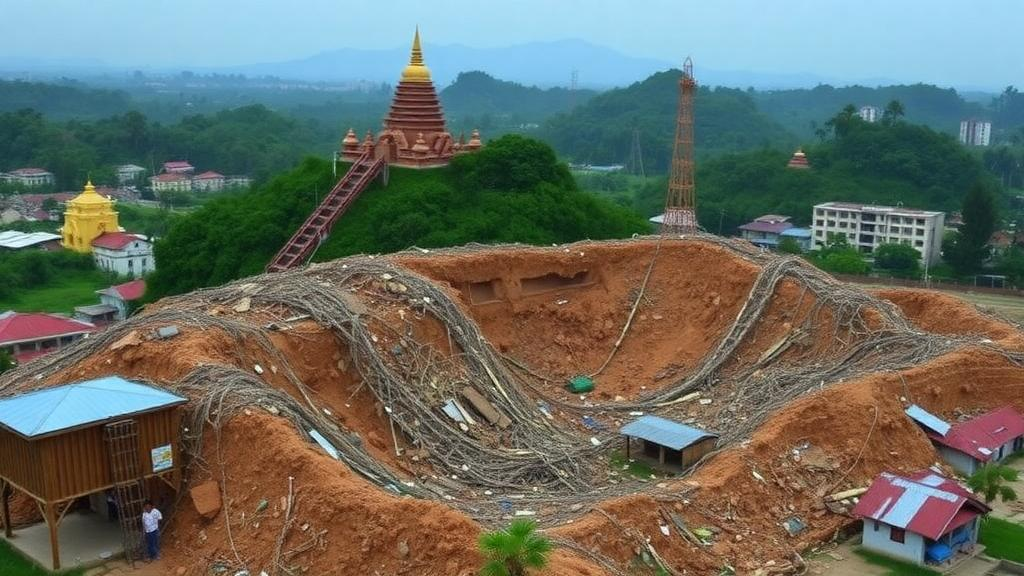
When a magnitude 7.8 earthquake tore through Myanmar on 28 March 2025, it ruptured roughly 480 kilometers of the Sagaing Fault, producing one of the longest strike-slip ruptures ever documented and devastating densely populated cities including Mandalay and Naypyidaw, where shaking reached intensity IX and more than 3000 people lost their lives. A new study published in Nature Communications now argues that several defining features of this catastrophic event, including the shape of the fault at depth, the distribution of slip, and even the extraordinary speed of the rupture, could have been anticipated from data collected before the earthquake struck. The finding challenges the long-standing assumption that large earthquakes are entirely beyond deterministic anticipation and offers a blueprint for hazard assessment in other poorly instrumented regions.
The research team, led by Thomas Ulrich of Ludwig-Maximilians-Universität München and Xiaoyu Zou of the Scripps Institution of Oceanography, combined satellite radar measurements, optical image correlations, seismic recordings, and even security camera footage with an unprecedented ensemble of physics-based computer simulations. Their central conclusion is that the Sagaing Fault, one of the most mature and geometrically simple strike-slip faults on Earth, behaves in ways that pre-event observations had already hinted at, provided scientists know how to read the signals.
The first surprise came from the geometry of the fault itself. Although the Sagaing Fault appears as a smooth, nearly vertical line at the surface, the pattern of ground deformation recorded by satellites told a different story. The horizontal displacements measured by the Sentinel-1A and ALOS-2 radar satellites and the Sentinel-2 optical instrument were strikingly asymmetric across the fault trace, with larger movements on the eastern side in the north of the rupture and the opposite pattern toward the south. The researchers systematically tested competing explanations, including contrasts in rock stiffness across the fault and variations in fault strike, but neither could reproduce the observed asymmetry. Instead, the data pointed to a fault plane that is not vertical at all but tilted, dipping eastward at roughly 70 to 80 degrees in the north before rotating through vertical to a westward dip of about 80 degrees at the southern end. Assuming these transitions occur gradually, the fault follows a helix-shaped, corkscrew geometry as it descends through the crust, a configuration the authors note resembles independent evidence for the San Andreas Fault in California.
This helical geometry mattered for the earthquake’s behavior. When the team inverted the full suite of geodetic observations for the distribution of slip on their curved, three-dimensional fault model, the fit was excellent, achieving a 96 percent variance reduction and matching independent optical data not used in the inversion. The model revealed predominantly right-lateral strike-slip motion with a peak slip of about 5.5 meters near the hypocenter, and an equivalent moment magnitude of 7.81. Critically, inversions that assumed a vertical fault left systematic residuals of about half a meter near the rupture, further confirming the dipping geometry. The model also showed remarkably little shallow slip deficit, meaning slip at the surface was nearly as large as slip at depth, a hallmark of very large, mature strike-slip ruptures.
The second major finding concerns how much the fault moved compared with how much strain had accumulated since its last major ruptures. By comparing the average coseismic slip on each fault segment with the slip deficit, calculated as the geodetic slip rate of roughly 16 to 24 millimeters per year multiplied by the time since the penultimate earthquake, the researchers found a striking pattern. Segments south of the epicenter that had been locked since the 1839 earthquake, part of the so-called Meiktila seismic gap, released slip in good agreement with the accumulated deficit. But the two northern segments that had already ruptured in 1946 and 1956 produced more slip than had accumulated since those events, an overshoot. This mirrors the behavior of the 2023 magnitude 7.8 and 7.7 Kahramanmaraş earthquake doublet in Türkiye, which was described as loosely slip-predictable. The authors propose the term minimally slip-predictable: very large, multi-segment ruptures tend to release at least the accumulated slip deficit, and sometimes more, by tapping residual stresses left over from earlier events.
To understand the dynamics of the rupture itself, the team turned to high-performance computing. Using the open-source SeisSol software, they generated an ensemble of 180 three-dimensional dynamic rupture simulations, each starting from the geodetically derived fault geometry and slip distribution but varying three fault-wide parameters that control prestress heterogeneity, fracture energy, and the ratio of stress drop to frictional strength drop. The simulations were then ranked against independent observations the static model had never seen: the moment rate function from teleseismic data, a strong-motion record from the near-fault station NPW, slip rates and a curved slip trajectory extracted from CCTV footage that captured the rupture passing a roadside camera, and rupture speeds imaged by teleseismic back-projection using seismic arrays in Alaska, Australia, and Europe.
The preferred scenario is remarkable. The rupture begins bilaterally, propagating in both directions from the hypocenter, but after about 25 seconds it transitions to predominantly unilateral southward propagation that races along at supershear speeds, faster than the shear wave velocity of the surrounding rock, before the earthquake finally terminates roughly 90 seconds after nucleation. This transition to supershear rupture occurred almost immediately at depth, within a deep, high-slip, high-prestress band, while the shallow portion of the fault remained subshear over a 150-kilometer section south of the hypocenter. The result is a strongly curved rupture front, with slow, shallow slip persistently catching up as it is driven by stresses radiated from the faster deep pulse. This depth-dependent behavior elegantly reconciles three seemingly contradictory observations: the subshear, pulse-like phase recorded by the CCTV camera, the rapid average rupture speed of about 4.9 kilometers per second implied by the arrival of the main pulse at station NPW, and the high-frequency radiation patterns imaged by back-projection, which resolved about 20 seconds of northward rupture at 2.5 kilometers per second and southward speeds accelerating to roughly 6 kilometers per second.
The physics behind this behavior points to a structurally mature fault zone. The best-fitting model requires unusually low fracture energy, about 0.83 megajoules per square meter, and low effective normal stress, both consistent with the weak, fine-grained materials documented along the Sagaing system, including clay-rich gouge and phyllosilicate-bearing serpentinites containing talc and chlorite. Such minerals can promote dynamic weakening and strain localization, and low-permeability gouge can develop fluid overpressure that further reduces effective normal stress. The team also tested whether a bimaterial contrast, the fault juxtaposing the slower Central Myanmar Basin against the faster Shan-Thai Block, could explain the north-south asymmetry in rupture speed. A second ensemble of 180 simulations with elastic properties perturbed by 10 percent across the fault did qualitatively reproduce the observed contrast, with transient unclamping ahead of the southward rupture tip promoting supershear transition. However, no bimaterial model fit the CCTV slip-rate data as well as the reference ensemble, and the modeled ruptures arrived at station NPW 13 seconds too late, suggesting bimaterial effects contribute but are not the sole control.
The implications extend well beyond Myanmar. The authors argue that for other mature strike-slip faults believed to be late in their earthquake cycles, such as the Istanbul-Marmara section of the North Anatolian Fault and the Southern San Andreas Fault, asymmetric interseismic deformation patterns already recorded by geodesy may reveal dipping, helix-shaped fault geometries before the next big rupture. Because ground shaking is expected to be significantly stronger on the hanging wall side of a dipping strike-slip fault, constraining this geometry in advance is directly relevant to predicting ground motion. Moreover, if very long ruptures are indeed minimally slip-predictable, the interseismically accumulated slip deficit provides a reasonable lower bound on the slip a maximum-size earthquake could deliver, implying that hazard estimates based on limited historical and paleoseismic records may significantly underpredict the true danger. The study demonstrates that even for sparsely instrumented fault systems, combining interseismic deformation measurements with dynamic rupture modeling offers a practical pathway toward physics-based forecasts of how the next great earthquake will unfold.
Subject of Research: Rupture dynamics and slip predictability of the 2025 M7.8 Mandalay earthquake on the Sagaing Fault
Article Title: On predictability of slip, rupture geometry, and speed of the 2025 M7.8 Mandalay, Myanmar, earthquake
Article References: On predictability of slip, rupture geometry, and speed of the 2025 M7.8 Mandalay, Myanmar, earthquake. (n.d.). https://doi.org/10.1038/s41467-026-77203-x
Image Credits: AI Generated
DOI: 10.1038/s41467-026-77203-x
Keywords: Mandalay earthquake, Sagaing Fault, supershear rupture, slip predictability, fault geometry, dynamic rupture modeling, space geodesy, seismic hazard, Myanmar, strike-slip fault, fracture energy, back-projection
Cite Scienmag News
Violet Maxwell. (October 14, 2026). Myanmar’s Giant 2025 Earthquake Was Partly Predictable, New Study Finds. Scienmag. https://scienmag.com/myanmars-giant-2025-earthquake-was-partly-predictable-new-study-finds/
Violet Maxwell. "Myanmar’s Giant 2025 Earthquake Was Partly Predictable, New Study Finds." Scienmag, 14 October 2026, https://scienmag.com/myanmars-giant-2025-earthquake-was-partly-predictable-new-study-finds/. Accessed 14 October 2026.
Violet Maxwell. "Myanmar’s Giant 2025 Earthquake Was Partly Predictable, New Study Finds." Scienmag. October 14, 2026. https://scienmag.com/myanmars-giant-2025-earthquake-was-partly-predictable-new-study-finds/


