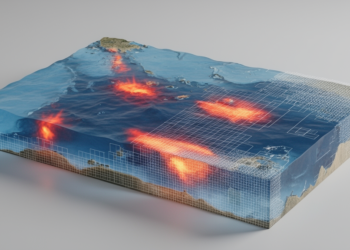
Deep beneath the surface of the Ross Sea, the daily rise and fall of the tide is doing far more than sloshing water back and forth. A new high-resolution modeling study reveals that the jagged topography of the Antarctic continental slope sculpts the tides into three giant, rotating eddy-like structures that dominate the exchange of water and heat between the deep ocean and the continental shelf. Those hidden swirls, the researchers find, drive a net onshore heat transport of roughly 12 terawatts, a flux with direct consequences for the stability of the Ross Ice Shelf and, ultimately, global sea level.
The study, published in the journal Ocean Science, was led by Yue Xia of Sun Yat-sen University and the Southern Marine Science and Engineering Guangdong Laboratory in Zhuhai, together with colleagues in China and New Zealand. The team used a regional coupled ocean-sea ice-ice shelf model called ROSIM, built on the MIT general circulation model, with a quasi-uniform horizontal resolution of 5 kilometers and 70 vertical layers. The model domain spans the Ross Sea, its ice shelves, and the surrounding open ocean, and it was forced at the open boundaries with tidal currents from the Circum-Antarctic Tidal Simulation, known as CATS2008, which includes ten major tidal constituents.
Before trusting the model’s tides, the team put it through a demanding validation exercise. They compared simulated tidal currents against velocity records from 17 mooring stations deployed at the mouth of the Drygalski Trough as part of the AnSlope project, spanning March 2003 to March 2004. Because strong currents can drag moorings out of position and contaminate measurements, the researchers relied on the deepest instruments, those closest to the anchors and least affected by line motion. The simulated tidal time series and power spectra matched the observations well, reproducing the phase of the predominantly diurnal currents and the spring-neap cycle, although the model slightly underestimated tidal amplitudes, particularly for the fortnightly Mf constituent. The model also captured the depth-averaged mean flow at most stations, lending indirect support to the tidal simulation.
The central discovery concerns how the continental slope reshapes the diurnal tide. The researchers decomposed the barotropic tide into two components: a surface mode, essentially the familiar Kelvin wave associated with sea surface height variations, and a topographic mode that carries the relative vorticity of the flow. When the surface-mode tidal current meets the sloping topography, it converges during flood tide and diverges during ebb tide, producing three distinct extremes in sea surface height along the slope. Crucially, these sea level anomalies persist for about six hours, longer than the roughly two-hour timescale required for geostrophic adjustment. That mismatch allows rotating, geostrophically balanced flows to develop around the anomalies, manifesting as three eddy-like structures in the topographic mode that reverse direction between flood and ebb.
Semi-diurnal tides, by contrast, never produce such structures. Their currents are much weaker, their surface mode generates negligible divergence over the slope, and their flood-ebb period is too short for geostrophic adjustment to organize the flow. The result is a Ross Sea slope governed almost entirely by the diurnal topographic mode, which the analysis shows is the primary driver of local instantaneous cross-slope transport of both volume and heat. Integrated along the 700-meter isobath, the topographic mode’s volume transport nearly cancels out, but its heat transport does not. Because warmer open-ocean water is carried onshore during flood tide and mixes irreversibly with colder shelf water before receding, each tidal cycle leaves a net surplus of heat on the shelf, amounting to roughly 12 terawatts directed toward the Ross Ice Shelf.
The energy bookkeeping behind this exchange proved equally revealing. Energy conversion between the surface and topographic modes is concentrated over topographic features and reaches magnitudes of about 1 watt per square meter, expressed as alternating positive and negative patches along the slope where the eddy-like structures are alternately aligned with or against the surface-mode flow. By comparison, the conversion of barotropic tidal energy into baroclinic, or internal, tides is only about 0.01 watts per square meter, an order of magnitude weaker than values reported for regions such as Monterey Bay or the Luzon Ridge. The baroclinic tidal energy in the Ross Sea is therefore an order of magnitude smaller than the barotropic energy, and the topographic mode, not the surface mode, supplies most of what little internal tide energy is generated.
Those internal tides take an unusual form. Because most of the Ross Sea lies poleward of the critical latitudes for both diurnal and semi-diurnal constituents, roughly 30 degrees south and 74.5 degrees south respectively, the internal waves cannot propagate freely. Instead they appear as bottom-trapped waves, with baroclinic kinetic energy and vertical shear intensified within the bottom tens of meters over the slope, banks, and troughs. The researchers quantified this bottom intensification with a diagnostic ratio comparing kinetic energy in the lowest 100 meters to the column average, finding values exceeding one over the slope and major topographic features. The trapped waves drive vertical water displacements of up to several meters, far smaller than the hundred-meter excursions of freely propagating internal tides elsewhere, and their near-bottom shear layer swells during spring tides and nearly vanishes during neap tides.
The dissipation picture is equally lopsided. Total tidal energy dissipation is strongest along the continental slope, particularly west of Cape Adare, and near the southwestern grounding line of the Ross Ice Shelf, reaching about 0.1 watts per square meter. Because the barotropic-to-baroclinic conversion is an order of magnitude smaller than the total dissipation, the authors conclude that barotropic tides dominate the regional energy sink, with the weak internal tides contributing little. The barotropic energy flux is carried mainly by pressure work, while the baroclinic fluxes from pressure work and advection are comparable in magnitude, a signature of significant nonlinearity, and both peak near the Drygalski Trough and Iselin Bank in a disorganized pattern shaped by overlapping waves generated at irregular topographic sites.
The implications reach well beyond tidal physics. Tides are known to accelerate the Antarctic Slope Current, sharpen the Antarctic Slope Front, enhance mixing at the shelf break where dense shelf water meets Circumpolar Deep Water, and promote the formation of Antarctic Bottom Water, the cold dense mass that helps drive the global thermohaline circulation. The eddy-like topographic mode identified here may also help explain the spatially uneven acceleration of the Antarctic Slope Current, and the tidally driven onshore heat flux could influence basal melting of the Ross Ice Shelf. In winter, the same structures may redistribute sea ice, feeding back into momentum input and upper-ocean stratification.
The authors are candid about the study’s limits. The Ross Sea’s small Rossby radius of deformation would demand horizontal grids finer than 1 kilometer to fully resolve mesoscale eddies, which means the model may overestimate tidal heat transport across the slope, since eddies would otherwise share that job. The 30-meter vertical resolution at 500-meter depth is also too coarse to fully capture the near-bottom velocity enhancement of the trapped internal tides, potentially underestimating baroclinic dissipation. Still, the core message stands: the shape of the seafloor quietly converts the rhythm of the tide into rotating structures and trapped waves that ferry heat toward Antarctica’s largest ice shelf. Capturing that mechanism in future models, the researchers argue, is fundamental for predicting how Antarctic ice shelves will respond as the climate warms, and how much the sea will rise.
Subject of Research: Tide-topography interactions, eddy-like tidal structures, and cross-slope heat transport in the Ross Sea, Antarctica
Article Title: Topographic control of tides in the Ross Sea: eddy-like structures, bottom-trapped waves, and energetics
Article References: Xia, Y., Leng, H., Wang, Z., Stevens, C., Liu, C., Yan, L., Han, X., & Chen, D. (2026). Topographic control of tides in the Ross Sea: eddy-like structures, bottom-trapped waves, and energetics. Ocean Science, 22(5), 3145-3164. https://doi.org/10.5194/os-22-3145-2026
Image Credits: AI Generated
Keywords: Ross Sea, tides, continental slope, topographic mode, eddy-like structures, bottom-trapped waves, internal tides, heat transport, Ross Ice Shelf, Antarctic Bottom Water, ocean modeling, tidal energetics
Cite Scienmag News
Violet Maxwell. (October 13, 2026). Hidden Eddies in Antarctic Tides Push Heat Toward the Ross Ice Shelf. Scienmag. https://scienmag.com/hidden-eddies-in-antarctic-tides-push-heat-toward-the-ross-ice-shelf/
Violet Maxwell. "Hidden Eddies in Antarctic Tides Push Heat Toward the Ross Ice Shelf." Scienmag, 13 October 2026, https://scienmag.com/hidden-eddies-in-antarctic-tides-push-heat-toward-the-ross-ice-shelf/. Accessed 13 October 2026.
Violet Maxwell. "Hidden Eddies in Antarctic Tides Push Heat Toward the Ross Ice Shelf." Scienmag. October 13, 2026. https://scienmag.com/hidden-eddies-in-antarctic-tides-push-heat-toward-the-ross-ice-shelf/