

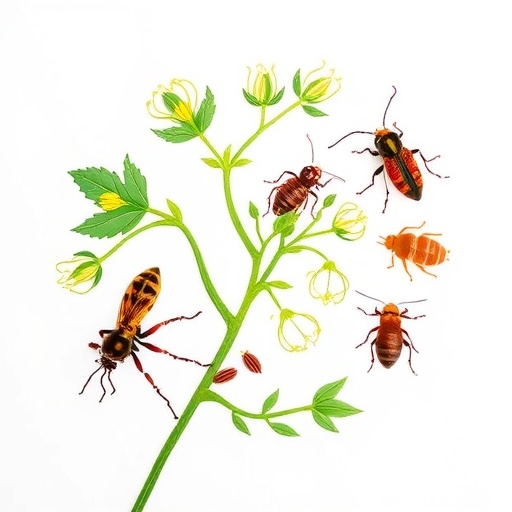
In a groundbreaking study set to transform our understanding of ecological interactions, researchers Wang, Albert, Seifert, and colleagues have uncovered profound links between herbivore community dynamics and the diversity of their host plants. Published in the prestigious journal Nature Communications in 2026, this research elucidates how asynchrony and functional diversity within herbivore populations are intimately connected to the complexity of plant communities they inhabit. These findings could redefine conservation strategies and enhance ecosystem management practices worldwide.
At the heart of this investigation lies a pressing ecological question: how does the diversity of plants influence the abundance, composition, and interactions of herbivores that depend on them? Herbivores are indispensable components of terrestrial ecosystems, driving plant population dynamics, nutrient cycling, and food web stability. However, the mechanisms by which plant species richness cascades to influence herbivore communities have remained elusive, complicated by the asynchronous life cycles and varied ecological roles of herbivorous species.
The researchers tackled this problem by integrating long-term observational data and sophisticated modeling approaches across multiple biomes. Their work centered on quantifying the asynchrony in herbivore population fluctuations, which refers to the degree to which species in a community experience peaks and troughs in abundance at different times. Asynchrony creates temporal niches, reducing direct competition and promoting coexistence. This temporal decoupling, when combined with functional diversity—differences in traits that affect ecosystem functioning—shapes how herbivores collectively respond to host plant diversity.
Detailed analyses revealed that herbivore populations exhibit complex asynchronous dynamics that are closely linked to the structural diversity of plant hosts. In ecosystems with high plant species richness, herbivore species showed less synchronized population cycles, allowing for more stable and resilient consumer communities. The temporal staggering of herbivore peaks minimizes the risk of simultaneous resource overexploitation, thereby stabilizing herbivore populations and maintaining herbivory pressure across time.
Functional diversity emerged as a vital factor reinforcing this relationship. Herbivores differ substantially in feeding strategies, mobility, phenology, and physiological adaptations. These traits influence how herbivores exploit varied host plants and avoid direct interspecific competition. The study found that greater functional trait diversity within herbivore assemblages enhanced their capacity to partition resources temporally and spatially, thereby strengthening asynchronous population patterns and linking herbivore dynamics to the heterogeneity of plant hosts.
Critically, the researchers employed cutting-edge data collection techniques, including remote sensing and molecular gut content analysis, to accurately identify plant-herbivore interactions with unprecedented resolution. This allowed for precise mapping of herbivore dietary breadths across diverse landscapes and seasons, providing a detailed picture of community-level specialization and generalism. Results indicated that diverse plant communities supported a wider array of herbivore feeding strategies, reinforcing system complexity and functional redundancy.
The implications of this research extend beyond theoretical ecology, offering actionable insights for biodiversity conservation and ecosystem management. As global biodiversity faces unprecedented threats from habitat loss, climate change, and invasive species, understanding the links between plant and herbivore diversity becomes essential for predicting ecosystem responses and designing resilient landscapes. This work suggests that preserving or restoring plant diversity can buffer herbivore populations against environmental fluctuations, potentially mitigating cascading effects on higher trophic levels.
Moreover, these findings challenge the prevailing paradigm that synchrony in consumer populations is a hallmark of ecosystem stability. Instead, the study posits that asynchrony, fostered by functional diversity and host plant richness, underpins dynamic equilibrium within herbivore communities. This dynamic equilibrium ensures continuous herbivory without catastrophic population crashes or resource depletion, thus maintaining ecological balance over temporal scales.
The research sheds light also on the role of temporal niche differentiation as a driver of biodiversity maintenance. By staggering reproductive cycles, developmental stages, and foraging periods, herbivores reduce interspecific competition and coexist alongside a diversity of plants. This temporal niche partitioning mirrors spatial niche theory but emphasizes the importance of time as a fundamental axis of ecological organization, a perspective gaining momentum in contemporary ecology.
Furthermore, this integrative framework highlights feedback loops between plants and herbivores. Diverse herbivore communities influence selective pressures on plants, potentially promoting plant diversity through differential herbivory and induced defense mechanisms. Conversely, spatial and temporal variation in plant traits shape herbivore behavior and community assembly, illustrating a complex web of mutual influences that sustain biodiversity.
The methodological innovations of the study also deserve recognition. By combining population modeling with trait-based ecology and empirical data, the researchers established a powerful paradigm for dissecting complex multi-trophic interactions. This approach enables predictions about ecosystem responses to perturbations such as climate extremes, monoculture expansion, or species loss, transcending limitations of single-species or short-term studies.
In light of the ongoing biodiversity crisis, such predictive capacity is invaluable. The study advocates for conservation initiatives that prioritize functional and temporal diversity alongside species richness, creating ecosystems capable of withstanding environmental volatility. It also suggests that monocultures and simplified landscapes, which reduce host plant diversity, may foster synchronous herbivore outbreaks and destabilize consumer communities, exacerbating pest problems.
Researchers emphasize that stakeholder engagement and adaptive management will be critical in implementing these insights. Agricultural landscapes, urban green spaces, and natural reserves alike could benefit from strategies that foster plant diversity and support asynchronous herbivore dynamics, ultimately enhancing ecosystem services such as pollination, pest control, and nutrient cycling.
This landmark study thus redefines ecological resilience, moving beyond static measures to embrace dynamic, temporal complexity as a cornerstone of stable and vibrant ecosystems. Its multidisciplinary approach and far-reaching implications are anticipated to catalyze further research and cross-sector collaborations, shaping the future of biodiversity science.
Ultimately, Wang, Albert, Seifert, and colleagues offer a compelling narrative of nature’s complexity, revealing how the interplay of asynchrony and functional diversity intricately couples herbivore communities to host plant diversity. This new lens challenges scientists and environmental practitioners alike to deepen their appreciation for the temporal rhythms and functional nuances that sustain life on Earth.
Subject of Research:
The coupling between herbivore community dynamics and host plant diversity, focusing on the roles of asynchrony and functional diversity in shaping ecological stability and biodiversity.
Article Title:
Asynchrony and functional diversity couple herbivore community dynamics to host plant diversity.
Article References:
Wang, MQ., Albert, G., Seifert, C.L. et al. Asynchrony and functional diversity couple herbivore community dynamics to host plant diversity.
Nat Commun (2026). https://doi.org/10.1038/s41467-025-67990-0
Image Credits: AI Generated


