


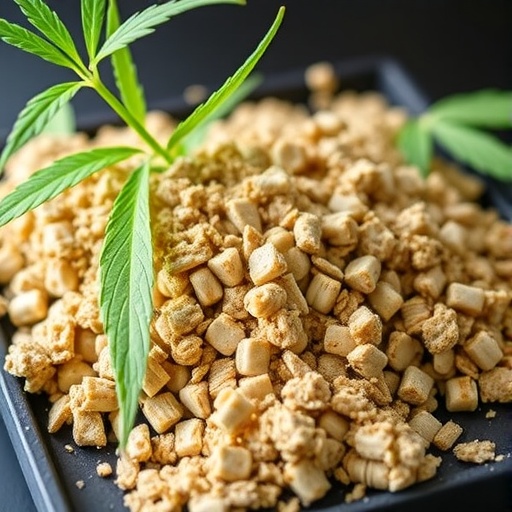
In a world increasingly burdened by plastic pollution and the environmental consequences tied to fossil-fuel dependence, innovative alternatives are urgently sought. Recent scientific exploration reveals a promising avenue in the form of hemp hurd-based biocomposites, underscoring the potential of this underutilized agricultural residue. Hemp, historically prized for its robust fibers, has mostly left its woody core—the hurd—out of mainstream material applications. However, emerging research demonstrates that hemp hurd not only offers a cost-effective, biodegradable raw material but also holds remarkable mechanical and environmental advantages when transformed into bioplastic composites for packaging and agricultural films.
Plastic production has surged exponentially over recent decades, with global output reaching nearly 400 million metric tons in 2022. This prolific growth underpins the material’s critical role in sectors such as packaging, agriculture, and consumer goods. Yet, the environmental toll from petrochemical feedstocks extraction and the accumulation of plastic waste jeopardizes ecological stability and public health. Against this backdrop, plant-based biocomposites are gaining traction as feasible, sustainable alternatives, with hemp emerging as a standout candidate due to its rapid growth rate, carbon sequestration capability, and inherent biodegradability.
While hemp fiber has attracted attention for industrial uses, the hurd—the inner woody core constituting almost half of the hemp plant’s biomass—has historically been undervalued. Typically relegated to low-value uses or waste streams, hemp hurd represents an untapped resource rich in cellulose and lignocellulosic content, which could be mechanically processed into high-performance microfibers. Such valorization not only improves resource efficiency but also aligns with circular economy principles by integrating agricultural residues into material supply chains without disrupting fiber markets.
In a groundbreaking study published in the Journal of Bioresources and Bioproducts, a team of researchers from the Korea Research Institute of Chemical Technology embarked on a comprehensive investigation of hemp hurd-based microfiber biocomposites. Employing both dry and wet milling techniques coupled with micro-fibrillation processes, they isolated refined hemp hurd fibers and integrated them into two prototype bioplastic products: packaging films incorporating polylactic acid (PLA) and agricultural mulch films blended with starch-based thermoplastics (TPS) and poly(butylene adipate-co-terephthalate) (PBAT). Mechanical characterization revealed that hemp microfiber inclusion enhanced tensile strength by approximately 20% in packaging films and an impressive 33% in mulch films relative to conventional materials, indicating robust reinforcement effects.
Crucially, the environmental implications of these biocomposites were evaluated through a rigorous cradle-to-grave Life Cycle Assessment (LCA), extending beyond mere production to encompass hemp cultivation, fiber processing, composite fabrication, transport logistics, consumer usage, and end-of-life treatment. The study contextualized its findings within South Korea’s national waste management framework, analyzing four disposal scenarios: incineration with energy recovery, incineration without energy recovery, industrial composting, and anaerobic digestion, juxtaposed against landfill disposal as the baseline.
Among these pathways, anaerobic digestion emerged as the superior end-of-life treatment, exhibiting the lowest global warming potential due to its capacity to convert biogas into electrical energy, thereby offsetting fossil energy use. Furthermore, the residual digestate presents value as an organic soil conditioner, closing nutrient loops and fostering sustainable agriculture. Quantitatively, this method achieved a substantial reduction in CO₂ emissions, approximately 6.1 kilograms per kilogram of mulch film processed, showcasing the tangible climate benefits of integrating biological waste-to-energy systems.
In contrast, industrial composting, while environmentally progressive compared to incineration, incurred higher direct carbon emissions linked to the energy-intensive nature of thermal treatments—even when accounting for electricity recovered from combustion. Notably, incineration without power recovery manifested as an environmentally unfavorable option, and conventional landfilling displayed the poorest environmental performance attributable to methane emissions and insufficient gas capture, buttressing South Korea’s strategic emphasis on minimizing landfill reliance.
The study also articulated optimization strategies within composite manufacturing—specifically advocating increased hemp microfiber content coupled with elevated biopolyester proportions to maximize carbon sequestration and emissions savings. Projections indicated potential reductions reaching 4.25 kilograms of CO₂ per kilogram of mulch film in optimized formulations, signifying considerable advancements in ecological footprint minimization achievable through material engineering.
Manufacturing methodologies further influenced environmental outcomes, as highlighted by the drying stage of microfiber production. Oven drying demonstrated lower environmental impacts relative to spray drying, mainly because the latter’s reliance on coal combustion and elevated electricity demand inflated associated carbon emissions. This finding underscores the critical role of process design choices in attaining sustainable material production and substantiates the importance of integrating clean energy solutions throughout manufacturing supply chains.
Beyond emission reductions, the research addresses broader systemic issues tied to circular economies and agricultural waste valorization. Utilizing hemp hurd for biocomposite fabrication sidesteps the extraction pressures on hemp fiber markets, ensuring that fiber availability for conventional applications remains unaffected while simultaneously converting a former waste stream into high-value products. This strategy epitomizes sustainable resource management, fostering enhanced economic and environmental resilience.
Ultimately, the study’s authors conclude that hemp hurd-based biocomposites, when synergized with appropriate disposal technologies like anaerobic digestion, present not only a technically feasible but also environmentally advantageous alternative to conventional fossil-derived plastics. As global energy infrastructures advance toward decarbonization and biological waste management infrastructure expands, such bio-based materials are poised to become integral components of sustainable packaging and agriculture, offering scalable solutions to some of the most pressing environmental challenges of our era.
This research represents an important stride toward closing material loops and reimagining biomass residues as critical inputs in bioeconomies. The multidisciplinary approach combining mechanical innovation with lifecycle environmental evaluation exemplifies the pathways required to transition toward truly sustainable plastic alternatives, blending scientific rigor with actionable societal impact. As demand for resilient and eco-friendly material solutions escalates worldwide, hemp hurd biocomposites stand out as a compelling candidate capable of mitigating climate change while promoting circular bioeconomy principles.
News Publication Date: 25-Apr-2026
Web References: http://dx.doi.org/10.1016/j.jobab.2026.100264
Cite Scienmag News
Courtney Benton. (April 28, 2026). Hemp Waste Biocomposites: A Sustainable Low-Carbon Solution for Packaging and Agricultural Films. Scienmag. https://scienmag.com/hemp-waste-biocomposites-a-sustainable-low-carbon-solution-for-packaging-and-agricultural-films/
Courtney Benton. "Hemp Waste Biocomposites: A Sustainable Low-Carbon Solution for Packaging and Agricultural Films." Scienmag, 28 April 2026, https://scienmag.com/hemp-waste-biocomposites-a-sustainable-low-carbon-solution-for-packaging-and-agricultural-films/. Accessed 3 September 2026.
Courtney Benton. "Hemp Waste Biocomposites: A Sustainable Low-Carbon Solution for Packaging and Agricultural Films." Scienmag. April 28, 2026. https://scienmag.com/hemp-waste-biocomposites-a-sustainable-low-carbon-solution-for-packaging-and-agricultural-films/


