


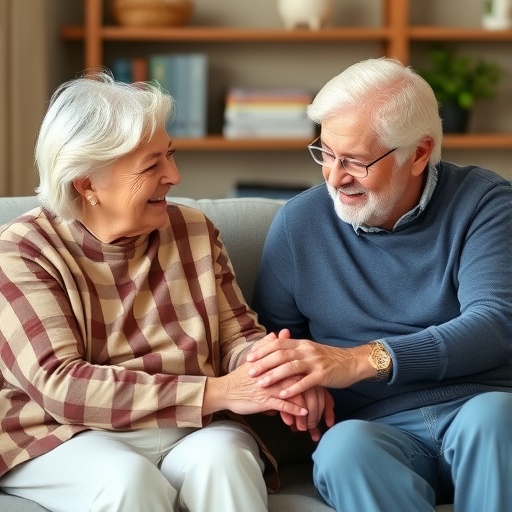
New insights from the University of Michigan elucidate how acts of support among older adults significantly influence their emotional well-being, with striking distinctions observed between genders. The study, recently published in Research on Aging, highlights that offering practical help to close friends—such as running errands, cooking meals, or assisting with household tasks—not only benefits recipients but can also enhance the provider’s mood in daily life. This dynamic illustrates the intricate interplay of social engagement and psychological health during later life stages, where social networks often play a pivotal role in sustaining mental and emotional vitality.
Delving into the nuances of social interactions, researchers underscored that the nature of friendships, as well as the type of support exchanged, varies substantially between men and women. Women tend to cultivate friendships grounded in emotional intimacy and conversational depth. Consequently, they frequently offer emotional support to close friends, a behavior deeply entrenched in societal and gender norms. Conversely, men’s friendships are predominantly activity-focused, revolving around shared tasks or outings rather than explicit emotional exchanges, reflecting traditional masculine social scripts.
Intriguingly, the research uncovered a paradoxical emotional toll for older men providing emotional support. Unlike their female counterparts, older men who engaged in emotional caregiving reported a decrease in positive mood on those days. Crystal Ng, a lead researcher at U-M’s Survey Research Center, suggests that this pattern may stem from emotional expression conflicting with conventional masculine identity constructs, possibly generating psychological discomfort or strain in older male caregivers. The findings underscore the psychological complexity and gendered experience embedded within social support systems.
The study involved a robust methodology of experience sampling, where 180 older adults from the Greater Austin area in Texas documented their emotional states and support behaviors every three hours throughout a 5-6 day period. With an average participant age of 74, this granular data collection enabled a detailed examination of the daily fluctuations in mood relative to social support provision. Through this dynamic lens, the researchers could infer real-time emotional impacts, thus overcoming limitations inherent in retrospective self-reports and cross-sectional surveys.
Consistent with societal expectations, emotional support emerged as the predominant form of aid provided by older adults to close friends, closely followed by advice-sharing and practical assistance. This detection challenges stereotypes that older adults are mostly passive recipients of care due to frailty; rather, it affirms their active roles as social contributors and nurturers within their communities. The voluntary nature of friend-based support—as opposed to obligatory familial caregiving—highlights an important dimension of aging defined by choice, autonomy, and reciprocal social engagement.
The implications of these findings extend to the design of interventions aimed at enhancing well-being among America’s rapidly aging populations. Practical, hands-on support activities foster a sense of purpose and agency, bolstering older adults’ self-worth and perceived usefulness—factors increasingly recognized as vital to psychological resilience and longevity. Particularly for older men, interventions that promote active, task-oriented social roles may hold promise in sustaining emotional health without imposing the burdens associated with emotional caregiving.
Ng proposes that aging-related social programs should diversify the forms of engagement they promote. Given the potential emotional cost emotional support can exert on older men, alternative pathways for meaningful social involvement—such as cooperative activities and community projects—may offer protective effects. Moreover, facilitating constructive meaning-making around emotional support exchanges could mitigate distress and cultivate emotional benefits, thereby optimizing psychological outcomes across genders.
This research also pioneers the examination of day-to-day social support within community-dwelling older adults, addressing a knowledge gap in understanding how micro-level social interactions influence mental states over short timeframes. The focus on close friendships represents a novel approach, distinguishing itself from the extensive literature concentrated on familial caregiving dynamics. By emphasizing friend-based interactions, the study recontextualizes aging as an active, socially engaged process shaped by voluntary relationships rather than mere dependency.
Looking ahead, the research team aims to expand inquiry into friendship-based giving beyond emotional and practical supports. Future investigations will explore the motivations underlying caregiving behaviors among older friends and delineate how these relationships contribute to broader caregiving networks. Such research promises to refine theories of social support by incorporating the nuances of peer caregiving and its differentiated impacts on health and well-being.
Ultimately, this study offers compelling evidence that social support in later life is a multifaceted phenomenon with distinct psychological consequences for men and women. It challenges monolithic narratives about aging and caregiving by illustrating that older adults actively shape their social worlds in diverse ways, which in turn reciprocally shape their emotional landscapes. Understanding these gendered patterns is essential for crafting equitable, effective strategies that promote emotional wellness in older adulthood.
The findings resonate beyond academia, urging policymakers, healthcare providers, and community leaders to recognize the heterogeneity of social needs and experiences among older populations. By valuing both practical help and emotional intimacy—while respecting gendered preferences and challenges—societies can better foster inclusivity, dignity, and joy in the golden years. This nuanced perspective paves the way for interventions that truly resonate with lived experiences, enhancing the quality of life for an increasingly diverse aging demographic.
In sum, the University of Michigan’s research illuminates the vital role friendships and the nature of giving support play in shaping emotional well-being among older adults. The gender-specific effects underscore the need for tailored approaches, especially for older men, to maintain positive mood and social connectedness. As aging populations grow globally, such insights become invaluable for designing socially and psychologically astute frameworks that nurture healthy aging across genders.
Web References:
- https://journals.sagepub.com/doi/10.1177/01640275251383546
- http://dx.doi.org/10.1177/01640275251383546
References:
Ng, C. et al. (2024). Daily Support to Close Friends and Mood Among Older Men and Women. Research on Aging. DOI: 10.1177/01640275251383546
Cite Scienmag News
Courtney Benton. (October 15, 2025). Helping Close Friends Enhances Daily Mood in Older Adults. Scienmag. https://scienmag.com/helping-close-friends-enhances-daily-mood-in-older-adults/
Courtney Benton. "Helping Close Friends Enhances Daily Mood in Older Adults." Scienmag, 15 October 2025, https://scienmag.com/helping-close-friends-enhances-daily-mood-in-older-adults/. Accessed 4 September 2026.
Courtney Benton. "Helping Close Friends Enhances Daily Mood in Older Adults." Scienmag. October 15, 2025. https://scienmag.com/helping-close-friends-enhances-daily-mood-in-older-adults/


