


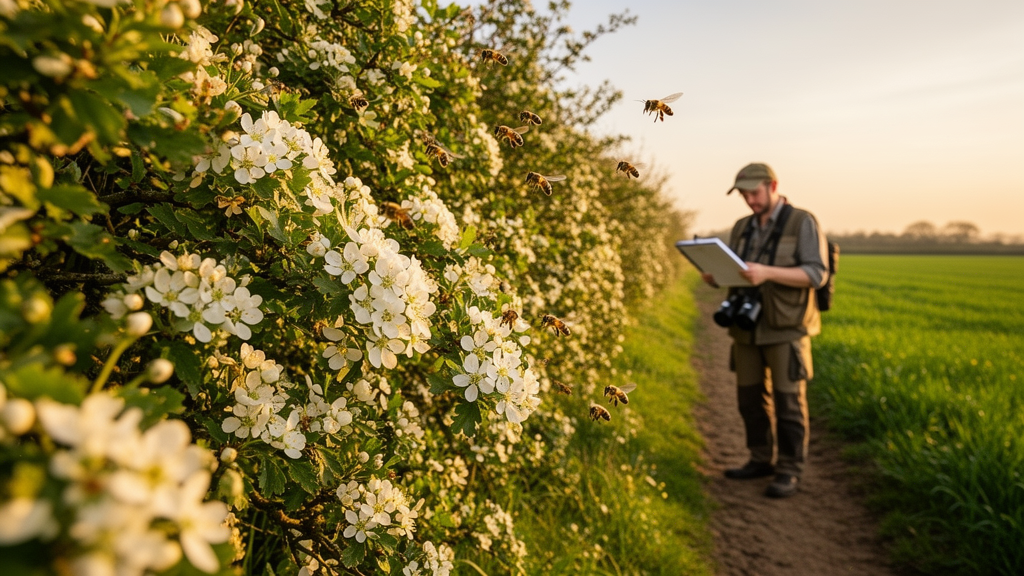
Hedgerows, tree rows and field copses have long been treated as the wallpaper of European farmland — pleasant to look at, but too small and too scattered to matter in official green infrastructure planning. A new modelling study from northern Germany argues that this oversight has been quietly undervaluing some of the hardest-working structures in the agricultural landscape. When researchers at the Bornhöved Lakes District in Schleswig-Holstein re-ran ecosystem service models with these linear semi-natural elements included, the modelled landscape became measurably more multifunctional, with pollination and nutrient regulation showing the strongest gains.
The study, published in the open-access journal One Ecosystem, used the InVEST (Integrated Valuation of Ecosystem Services and Trade-offs) geospatial model suite to simulate two versions of the same 147-square-kilometre landscape. In the first scenario, the terrain was mapped exactly as official land-cover datasets record it — dominated by non-irrigated arable land and pastures, with hedgerows and similar features folded invisibly into those categories. In the second scenario, the researchers overlaid a high-quality federal dataset of officially mapped linear elements, which together cover roughly five per cent of the study region, so that hedgerows, wooded strips, isolated trees and field copses appeared as distinct habitat features in their own right.
The contrast between the two maps was striking for two of the four services tested. Mean pollinator abundance across the entire study region rose by 21.4 per cent once the linear elements were counted, and the share of land classified as having very high pollinator supply jumped from 20 per cent to 38 per cent. Nutrient export, the model’s measure of nitrogen and phosphorus losses from land to water, fell by 25 per cent on average — equivalent to a substantial rise in the landscape’s capacity to keep fertiliser runoff out of ground- and surface waters. By comparison, water flow regulation shifted only marginally, and erosion regulation barely responded at all.
What makes the pollination result particularly compelling is its spatial fingerprint. The benefit was not confined to the hedgerows themselves: pollinator abundance rose by 37 per cent within 50 metres of the linear elements and was still elevated by 27 per cent at 100 metres. Avoided nutrient export followed the same gradient, climbing 36 per cent next to the features and 30 per cent at 100 metres. In other words, a thin ribbon of semi-natural vegetation acts as a service-dispensing engine whose influence spills well out into the adjacent cropland — precisely the area where farmers need wild bees to visit their flowers and where nutrient losses are most damaging.
The mechanism behind the pollination effect is well understood from field ecology. Hedgerows supply nectar throughout the season, along with nesting sites and overwintering habitat for wild bees and other insects. Because the vegetation is permanent, unlike a crop that is harvested and tilled under, these structures act as stable reservoirs from which pollinators disperse into surrounding fields. Previous work has shown that hedgerows can function as net exporters of native bees into adjacent crops, and that landscapes rich in hedgerows enhance flower visitation and seed set regardless of the quality of local field margins. The new modelling results are consistent with that body of evidence, and with an earlier hierarchical assessment of pollination potential in the same study area.
The muted response of erosion and water flow regulation is more surprising, because hedgerows are famous for exactly those functions. Planted perpendicular to a slope, they shorten the effective slope length over which runoff water can accelerate, reduce wind speed and evaporation, and trap soil that would otherwise wash downhill. Field studies in northern Germany have even uncovered colluvial deposits built up behind historic hedgerow lines. The authors point to a likely explanation hidden in the geography: in the Bornhöved Lakes District, the steepest ground is largely under forest or grassland rather than cropland, and the linear elements are scarcest precisely in the hillier north where erosion risk is highest. A hedgerow can only interrupt runoff where there is runoff to interrupt.
There is also a technical caveat worth taking seriously. The InVEST models are transparent and widely used, but their outputs depend heavily on input data quality, resolution and minimum mapping unit. Narrow linear features are especially vulnerable: the official dataset records them as polylines, which had to be rasterised for the analysis, introducing some loss of precision. If a model cannot fully resolve a feature only metres wide, it risks underestimating the services that feature provides — which is, in a sense, the very bias the study set out to expose. The researchers mitigated this by comparing only relative changes between the two scenarios of the same landscape, classifying outputs into five quantile supply classes and removing statistical outliers before evaluation.
The policy implications reach directly into how the European Union builds its green infrastructure. EU strategy explicitly recognises that the network’s environmental features operate on very different scales, from small streams, ponds and hedgerows up to entire functional ecosystems. Yet in practice, national green infrastructure inventories — including Germany’s — typically exclude linear semi-natural elements on the grounds that they lack the critical mass and connectivity to contribute meaningfully. This study quantifies what that exclusion costs: five per cent of the landscape, properly accounted for, lifted pollination supply on agricultural land by 15.4 per cent and avoided nutrient export there by 22.9 per cent, with smaller gains in avoided quickflow.
For farmers, the arithmetic is unusually favourable. Planting or retaining a hedgerow occupies a sliver of land, yet the modelled returns — more pollinators visiting crops, less fertiliser bleeding into waterways, a more resilient soil base — accrue to the neighbouring fields that remain in production. The gains are largest within 50 metres of the feature, which gives land managers a concrete design rule: distribute linear elements so that no large block of cropland sits far from one. The regional biodiversity strategy of Schleswig-Holstein already praises structurally rich historic hedgerow landscapes; this study supplies the quantitative backing for treating those ribbons of wildness as infrastructure in the full, engineered sense of the word.
The authors are careful about the limits of a single model test. Four regulating services were assessed; cultural services, habitat provision and the condition of the elements themselves were not. Future work, they suggest, should layer in additional services, alternative models of higher hydrological complexity, and field data on the actual state of the hedgerows, since a degraded hedge supplies fewer services than a thriving one. But the central message survives every caveat: the thin green lines stitched through Europe’s farmland are not decoration. They are functional components of the landscape’s service infrastructure, and planning systems that cannot see them are managing some of the continent’s most valuable ecological assets as if they were not there.
Subject of Research: Effects of linear semi-natural landscape elements on regulating ecosystem services in agricultural landscapes
Article Title: As green infrastructure, linear semi-natural habitats boost regulating ecosystem services supply in agriculturally-dominated landscapes
Article References: Lange, S., Mockford, A., Burkhard, B., Müller, F., & Diekötter, T. (2023). As green infrastructure, linear semi-natural habitats boost regulating ecosystem services supply in agriculturally-dominated landscapes. One Ecosystem, 8, Article e108540. https://doi.org/10.3897/oneeco.8.e108540
Image Credits: AI Generated
Keywords: hedgerows, green infrastructure, ecosystem services, pollination, nutrient regulation, agricultural landscapes, InVEST, Schleswig-Holstein, landscape ecology, soil erosion, water flow regulation, biodiversity
Cite Scienmag News
Gavin Prescott. (October 19, 2026). Hedgerows, counted at last, supercharge pollination and nutrient regulation in farmland. Scienmag. https://scienmag.com/hedgerows-counted-at-last-supercharge-pollination-and-nutrient-regulation-in-farmland/
Gavin Prescott. "Hedgerows, counted at last, supercharge pollination and nutrient regulation in farmland." Scienmag, 19 October 2026, https://scienmag.com/hedgerows-counted-at-last-supercharge-pollination-and-nutrient-regulation-in-farmland/. Accessed 19 October 2026.
Gavin Prescott. "Hedgerows, counted at last, supercharge pollination and nutrient regulation in farmland." Scienmag. October 19, 2026. https://scienmag.com/hedgerows-counted-at-last-supercharge-pollination-and-nutrient-regulation-in-farmland/


