


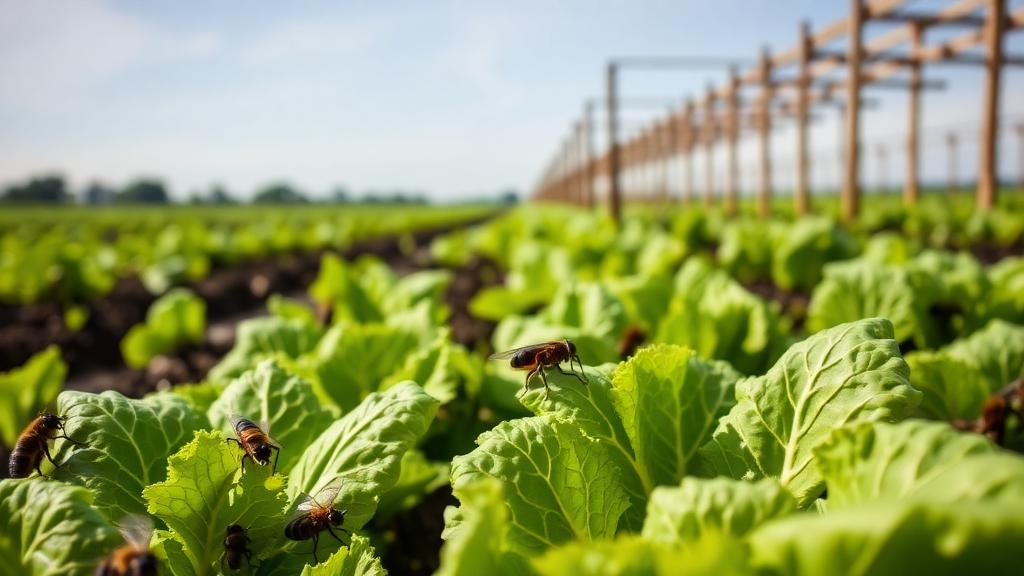
Intensive pesticide spraying is supposed to make life miserable for crop pests, but a new study from Chile suggests it may be doing the opposite. Researchers monitoring lettuce farms in the Coquimbo Region found that fields managed with frequent, calendar-based insecticide applications harbored fewer insect families overall yet significantly more pest-associated insects than farms using a reduced-spray, threshold-based approach known as Integrated Pest Management, or IPM. The findings, published in the Journal of Agriculture and Food Research, add a striking ecological twist to the global debate over agricultural chemical dependence: the very tools deployed to suppress pests may be dismantling the diverse insect communities that naturally keep them in check.
The research team, led by scientists including Rodrigo de O. Araujo and Cristian Villagra, focused on the Pan de Azúcar horticultural area, a rural locality often called the vegetable belt of the Coquimbo Region. Lettuce dominates the local landscape, accounting for roughly 39.5 percent of Chile’s national cultivated area for the crop, and nearly all of it is grown conventionally. Across the country, conventional lettuce production typically involves six to ten insecticide applications per cycle, relying heavily on broad-spectrum compounds from chemical classes such as neonicotinoids, pyrethroids, and carbamates to combat aphids, thrips, and caterpillars. These chemicals are effective at killing target insects, but they also strike non-target organisms, including the parasitoid wasps, predators, and pollinators that underpin essential ecosystem services.
To compare the two management philosophies under real-world conditions, the researchers sampled seven lettuce farms: three following IPM protocols developed by Chile’s Instituto de Investigaciones Agropecuarias (INIA), and four under conventional management. The contrast in chemical intensity was dramatic. IPM farms applied only two to three insecticide treatments per cycle, and only when pest populations exceeded defined thresholds, supplementing chemical control with habitat management such as flower strips, cultural practices, and selective products like neem-derived azadirachtin. Conventional farms sprayed seven to nine times per cycle on a fixed schedule, using pyrethroids such as lambda-cyhalothrin, carbamates such as pirimicarb, and other synthetic insecticides regardless of whether pests had reached damaging levels.
The sampling design was deliberately rigorous. Over 14 sampling events spaced roughly a month apart, the team deployed yellow pan traps, bright yellow bowls filled with propylene glycol that passively attract flying insects, at two standardized locations within each farm: one near the field edge and one about 100 meters inside the crop. Captures from each site and date were pooled into single community samples to avoid pseudo-replication, and the resulting specimens were identified to family, with pest taxa resolved to species level. In total, the traps yielded specimens from 98 insect families, including the principal lettuce pest groups Aphididae, Thripidae, Agromyzidae, Noctuidae, and Aleyrodidae, along with a suite of occasional pests such as leafhoppers, stink bugs, and mealybugs.
The statistical analysis, built on generalized linear mixed models with site as a random effect, revealed a pattern that inverts the intuitive expectation. Total insect family richness was significantly lower under conventional management than under IPM, while total insect abundance was significantly higher on the heavily sprayed conventional farms. Pest-associated insect abundance followed the same pattern, being markedly greater under conventional management, even though the number of pest families did not differ between the two systems. In other words, intensive spraying did not reduce the diversity of pests present; it simply coincided with more insects overall and more pest individuals, alongside a depauperate community dominated by a few tolerant families.
Temporal dynamics added another layer of nuance. Both abundance and richness followed significant nonlinear trajectories across the sampling period, with cubic terms in the models indicating pronounced fluctuations, including peaks during the austral summer and troughs in winter. Crucially, however, the interactions between time and management were not significant for any response variable, meaning the two systems followed broadly similar temporal paths. The average gap between conventional and IPM farms, higher pest abundance and lower richness on the sprayed fields, persisted throughout the year rather than emerging only during high-activity seasons.
Community composition told a complementary story. Non-metric multidimensional scaling of Bray-Curtis dissimilarities showed substantial heterogeneity among the seven farms, with partial visual separation between the two management types. Interestingly, IPM sites located geographically close to conventional horticultural crops, such as the Mario Yáñez and Pan de Azúcar farms, resembled conventional sites more closely than the more isolated Rafael La Paz farm, which recorded the highest observed and rarefied family richness of any site. Diversity metrics reinforced the picture: Simpson diversity and Pielou’s evenness differed strongly among sites, with IPM farms showing more balanced abundance distributions, while the conventional site Dos Marías exhibited the lowest richness and a community skewed toward one or a few dominant families.
The authors are careful to frame these as management-associated patterns rather than proven causal effects. The study was observational, included only seven independent farms, and did not control for landscape context, field size, management history, or microclimate, all of which could contribute to the observed differences. Yellow pan traps also bias captures toward visually attracted flying insects such as flies, wasps, and true bugs, potentially underrepresenting ground-dwelling or nocturnal species, and may sample dispersing individuals moving through the landscape rather than insects actually feeding or breeding in the crop. Previous work in the same region, however, has documented pesticide residues within local insects and linked land-use composition around lettuce fields to insect abundance and pest incidence, lending ecological plausibility to the management signal.
The broader context makes the findings resonate well beyond Chilean lettuce fields. Chile’s pesticide sales grew approximately 300 percent between 2001 and 2009 alongside industrial agricultural expansion, and monitoring by the country’s food alert network has found residues exceeding maximum limits in 24 percent of fruit and a startling 71.3 percent of leafy vegetable samples. In the Coquimbo Region specifically, chronic pesticide exposure has been linked to respiratory failure, neuropsychiatric disorders, cognitive impairment, and potential carcinogenic and teratogenic effects in agricultural workers and nearby residents. Against this backdrop, the ecological evidence that intensive spraying coincides with reduced biodiversity and elevated pest abundance strengthens the case for alternatives.
IPM offers a tested path forward. Early adopters of INIA’s standardized protocols have cut pesticide application intensity by 67 to 83 percent, achieving pest control with just one to three targeted sprays per cycle, and the Coquimbo Region already shows one of Chile’s most balanced adoption rates, with roughly 55 percent of leafy vegetable production under integrated management. The study’s authors argue that strengthening pest monitoring, applying insecticides only when economic thresholds are exceeded, promoting biological control, and maintaining field margins and vegetation strips could simultaneously reduce chemical inputs and support the diverse insect communities that provide pollination, nutrient cycling, and natural pest suppression. In the longer term, wider IPM adoption, farmer training, and Good Agricultural Practices certification, currently absent from Chilean lettuce production largely because of pesticide intensity, could help reconcile productivity with biodiversity. If pesticide-heavy management continues to dominate, the researchers warn, conserving semi-natural habitats at the landscape scale will be essential to preserve the ecosystem services on which agriculture itself depends.
Subject of Research: Effects of conventional versus integrated pest management on insect community diversity and pest abundance in Chilean lettuce crops
Article Title: Reduced Biodiversity and Higher Pest Abundance: Contrasting Patterns under Intensive Pesticide Management in Lettuce Crops
Article References: de O. Araujo, R., Rios, R. S., Maltés, M., Valencia, A., Salas, C., de Melo e Silva-Neto, C., Muñoz-Quezada, M. T., & Villagra, C. (2026). Reduced Biodiversity and Higher Pest Abundance: Contrasting Patterns under Intensive Pesticide Management in Lettuce Crops. Journal of Agriculture and Food Research, Article 103362. https://doi.org/10.1016/j.jafr.2026.103362
Image Credits: AI Generated
DOI: Not provided
Keywords: integrated pest management, pesticides, lettuce, insect biodiversity, agroecosystems, Chile, Coquimbo Region, insect communities, agricultural intensification, ecosystem services, pan traps, sustainable agriculture
Cite Scienmag News
Gavin Prescott. (October 10, 2026). Heavy Pesticide Use Strips Insect Diversity but Boosts Pests in Lettuce Fields. Scienmag. https://scienmag.com/heavy-pesticide-use-strips-insect-diversity-but-boosts-pests-in-lettuce-fields/
Gavin Prescott. "Heavy Pesticide Use Strips Insect Diversity but Boosts Pests in Lettuce Fields." Scienmag, 10 October 2026, https://scienmag.com/heavy-pesticide-use-strips-insect-diversity-but-boosts-pests-in-lettuce-fields/. Accessed 10 October 2026.
Gavin Prescott. "Heavy Pesticide Use Strips Insect Diversity but Boosts Pests in Lettuce Fields." Scienmag. October 10, 2026. https://scienmag.com/heavy-pesticide-use-strips-insect-diversity-but-boosts-pests-in-lettuce-fields/


