


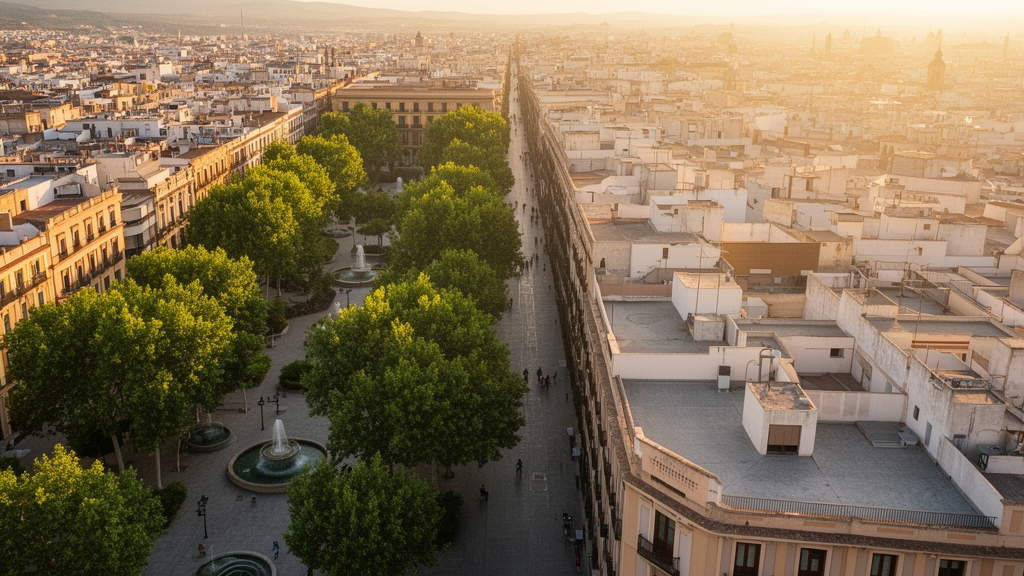
When a heatwave settles over a city, the danger it poses is not distributed evenly across the urban landscape. New research from the University of the Basque Country has produced some of the most detailed evidence yet that vulnerability to extreme heat can differ dramatically from one building to the next, and even between neighbouring blocks in the same district. The study, carried out by the SAREN (Sustainable And Resilient built ENvironment) research group and published in the journal Cities, applied a multiscale, multicriteria methodology to three Spanish cities—Bilbao, Madrid and Cáceres—each located in a different climate zone. The results show that socioeconomic conditions and the physical characteristics of the urban fabric exert a decisive influence on which places and people suffer most when temperatures soar, and they provide city authorities with a practical tool for deciding exactly where adaptation measures should be deployed first.
The work forms part of the OLADAPT project, funded by Spain’s Ministry of Science, Innovation and Universities, and is being conducted in collaboration with the Polytechnic University of Madrid, the University of Extremadura and the UNESCO Chair in Sustainable Development and Environmental Education at the EHU. The researchers aligned their approach with the guidelines of the Intergovernmental Panel on Climate Change, which frame climate risk as the product of hazard, exposure and vulnerability. In the case of urban heat, that framing matters enormously, because the hazard itself—the temperature a given area experiences—is only one ingredient in the equation. How a city is built, which areas are hardest hit by high temperatures, and how many people are exposed and how little protection they have, all combine to determine the real risk to human health, thermal comfort and the liveability of urban spaces.
“We are looking at how to conduct a multi-dimensional and multi-scale assessment of the risk posed by heatwaves in urban areas. The risk posed by heatwaves is not measured solely by temperature; it has multiple dimensions,” explains Irantzu Álvarez, a researcher in the SAREN group, which is led by Leire Garmendia. That multidimensional perspective is what distinguishes the new methodology from coarser city-level assessments. Rather than treating a municipality as a single unit of analysis, the team measured vulnerability at the level of individual buildings and open public spaces, generating fine-grained vulnerability maps that reveal hotspots of risk that would otherwise remain invisible in aggregate statistics.
Building the maps required assembling a large volume of data drawn from a variety of sources. The researchers incorporated socioeconomic variables describing the people who live and work in each location, detailed characteristics of the buildings themselves, and environmental variables capturing the conditions of the surrounding urban environment. This combination is crucial, because sensitivity to heat depends on both the physical fabric and the human context. “A building may be sensitive to heat, but its residents may have the financial means to protect their home from it,” the researchers explain. In other words, a thermally poor building occupied by wealthy residents may pose less of a welfare problem than a marginally better building occupied by people with no means to install cooling, improve insulation or otherwise shield themselves from extreme temperatures.
The study’s most consistent finding across all three cities is the weight of socioeconomic variables in determining vulnerability. “People on low incomes, older people, etc. are far more vulnerable,” the research group states. This pattern held in Bilbao, Madrid and Cáceres despite their very different climates, suggesting that the social gradient of heat risk is a structural feature of Spanish cities rather than an artefact of any particular climate zone. Just as importantly, the analysis showed that vulnerability is not uniform within a city, and may even vary substantially within a single neighbourhood. It is therefore not enough, the researchers argue, to declare one city more vulnerable than another; detailed, building-by-building analysis is needed to locate the specific hotspots where intervention will save the most people from harm.
The choice of the individual building as the unit of analysis is what gives the methodology its practical power for municipal decision-making. “This methodology shows which buildings or types of buildings should be renovated or adapted first,” say Álvarez and Laura Quesada, the two researchers who spearheaded the analysis. Quesada is an architect specialising in the restoration and conservation of historic heritage and works at the Vitoria-Gasteiz School of Engineering, while Álvarez is a Technical Engineer in Surveying with a degree in Geography, based at the Bilbao School of Engineering; both lecture on the Master’s Degree in Construction Engineering at the Bilbao School of Engineering. Their combined expertise reflects the interdisciplinary character of the work, which spans building physics, urban geography and social science.
A second layer of the methodology links the vulnerability of buildings to that of the open public spaces around them. The researchers measured the impact of the surrounding environment on each building, capturing factors such as green cover and shade. “Buildings may be highly vulnerable but have plenty of green areas and shade around them. Taking all of this into account means that adaptation measures can be implemented in different ways,” the team explains. A vulnerable building in a leafy, shaded street may call for a different response than an equally vulnerable building on a hot, exposed plaza. By treating buildings and open spaces as an interconnected system rather than as separate problems, the maps allow planners to design adaptation strategies that operate at the scale of the streetscape as well as the individual structure.
The practical output of the methodology is a set of urban vulnerability maps that clearly indicate where priority action should be taken to tackle heatwaves. “Adaptation measures can be implemented much more effectively with this type of study,” the researchers say. For municipalities operating under tight budgets, this kind of prioritisation is invaluable: rather than spreading resources thinly across an entire city, officials can target renovation programmes, shading installations, green infrastructure and social support towards the buildings and neighbourhoods where the combination of physical exposure and social vulnerability is greatest. The maps thus translate abstract climate risk assessments into concrete, spatially explicit guidance.
Demonstrating the approach in three cities with distinct climates also served as a test of its transferability. “The methodology is fully replicable; it can be used anywhere. This makes the methodology more robust. It is a genuinely useful tool for municipalities and cities,” the group states. The successful application in Bilbao, Madrid and Cáceres suggests that the framework could be adopted by other cities facing intensifying heat risk, both in Spain and further afield, provided comparable socioeconomic, building and environmental data are available.
The broader context for this research is the steady escalation of extreme weather under climate change. Heatwaves are becoming more frequent and more severe, with direct consequences for public health, thermal comfort and the overall liveability of cities. Because urban populations are concentrated and much of the built fabric is long-lived, the decisions cities make now about which buildings to retrofit and which public spaces to green will shape heat resilience for decades. By demonstrating that vulnerability is a local, block-by-block phenomenon shaped jointly by poverty, age, building quality and the surrounding environment, the SAREN team’s work offers city governments a rigorous, replicable way to direct adaptation resources where they will matter most—and a reminder that the people least able to protect themselves from extreme heat are often concentrated in the very places that need help first.
Subject of Research: Multiscale GIS-based assessment of urban heatwave vulnerability in Spanish cities
Article Title: Vulnerability to heatwaves varies greatly from one area to another within cities
Article References: Vulnerability to heatwaves varies greatly from one area to another within cities. (n.d.). Original publication
Image Credits: AI Generated
DOI: Not provided
Keywords: heatwaves, urban vulnerability, climate adaptation, socioeconomic factors, buildings, public spaces, GIS mapping, Bilbao, Madrid, Cáceres, IPCC, urban resilience
Cite Scienmag News
Courtney Benton. (October 8, 2026). Heatwave Vulnerability Varies Block by Block, Spanish City Study Finds. Scienmag. https://scienmag.com/heatwave-vulnerability-varies-block-by-block-spanish-city-study-finds/
Courtney Benton. "Heatwave Vulnerability Varies Block by Block, Spanish City Study Finds." Scienmag, 8 October 2026, https://scienmag.com/heatwave-vulnerability-varies-block-by-block-spanish-city-study-finds/. Accessed 8 October 2026.
Courtney Benton. "Heatwave Vulnerability Varies Block by Block, Spanish City Study Finds." Scienmag. October 8, 2026. https://scienmag.com/heatwave-vulnerability-varies-block-by-block-spanish-city-study-finds/


