


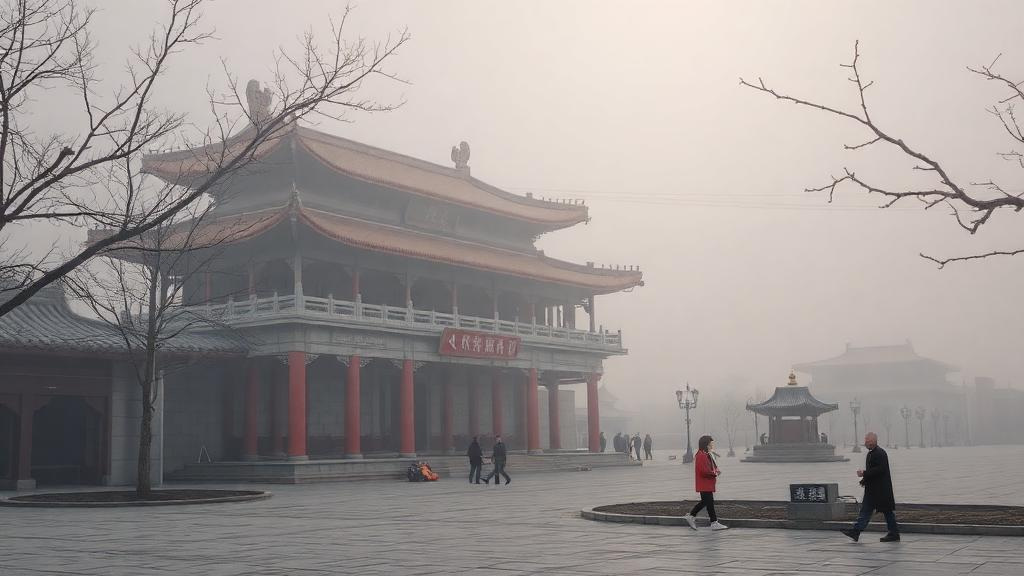
When China imposed coronavirus lockdowns in the winter of 2021 and 2022, cities fell unusually quiet. Traffic thinned, factories slowed, and scientists around the world seized the moment as a rare natural experiment in urban carbon emissions. Yet a new study from Xi’an, a sprawling metropolis in northwestern China, shows that reading the atmosphere during such an event is far trickier than simply watching concentrations fall. According to research published in Environmental Chemistry Letters, haze episodes during the lockdown drove concentrations of fossil fuel carbon dioxide up by 159 percent compared with well-ventilated, non-haze days, even as actual emissions collapsed. The finding is a stark warning that weather can masquerade as emissions, potentially skewing the top-down assessments that cities and nations rely on to verify their carbon accounts.
The research team, led by Jiaqi Zhang and Zhenchuan Niu of the Institute of Earth Environment at the Chinese Academy of Sciences, sampled air at an urban site in Xi’an’s High-Tech Zone every day from December 23, 2021, to January 23, 2022, a window covering the city’s strict pandemic confinement. Rather than relying on total carbon dioxide readings, which mix natural and human sources, the researchers turned to isotopic forensics. Fossil fuels contain no carbon-14, the radioactive isotope of carbon that decays over tens of thousands of years, so carbon derived from coal, oil, and natural gas is distinctly radiocarbon-free. By measuring the carbon-14 composition of atmospheric carbon dioxide, the team could isolate the fossil component with precision, a technique long championed for monitoring megacity emissions.
The isotopic measurements were complemented by analysis of carbon-13, the stable heavy isotope of carbon. Different carbon sources carry different carbon-13 signatures: vehicle exhaust, coal combustion, and natural gas each leave a characteristic fingerprint in the carbon dioxide they release. By combining the two isotope systems, the researchers could not only quantify how much fossil carbon dioxide was in the air but also apportion it among its sources. This dual-isotope approach, normalized against a ventilation coefficient, formed the analytical backbone of the study and allowed the team to separate genuine changes in emissions from changes in how the atmosphere diluted them.
That ventilation correction proved to be the crux of the work. The ventilation coefficient, a classical concept in air pollution meteorology dating back to the work of Holzworth in the 1960s, combines the depth of the atmospheric mixing layer with the near-surface wind speed. When the mixing layer is shallow and winds are calm, pollutants emitted at the surface accumulate rapidly; when the boundary layer is deep and winds are brisk, the same emissions are swept away. Winter haze episodes in northern Chinese cities are typically triggered by exactly such stagnant conditions, with temperature inversions capping the boundary layer and trapping everything from fine particulate matter to greenhouse gases near the ground.
The Xi’an data captured this dynamic in dramatic fashion. During haze periods within the lockdown, fossil carbon dioxide concentrations were 159 percent, give or take 48 percent, higher than during non-haze periods, despite the fact that human activity, and presumably emissions, were suppressed throughout. In other words, the atmosphere itself, not the sources, was responsible for a large share of the variation observed at the sampling site. Without accounting for this meteorological amplification, an observer relying on concentration data alone would have dramatically misjudged how emissions were changing during the lockdown.
Once the team normalized the measurements with the ventilation coefficient, the true emissions signal emerged. Compared with the period after the lockdown ended, fossil carbon dioxide concentrations during well-ventilated, non-haze lockdown days fell by 63.0 percent, with an uncertainty of 10.6 percent. Averaged across the entire lockdown period, including hazy days, the ventilation-normalized decline was 48.8 percent, plus or minus 12.2 percent. These figures align with the substantial reductions in traffic and economic activity that characterized the confinement, and they demonstrate how powerful the isotope-based method can be when meteorological variability is properly handled.
The carbon-13 source apportionment added a second layer of insight into which activities drove the decline. Vehicle emissions dropped by 84.6 percent, with a relatively tight uncertainty of 4.7 percent, reflecting the near-standstill of urban traffic during confinement. Coal burning emissions, by contrast, decreased by only 31.2 percent, though with a much larger uncertainty of 20.3 percent. The asymmetry makes physical sense: private and commercial transport can be switched off almost entirely by lockdown orders, whereas residential and industrial coal combustion for heating continues through the frigid Shaanxi winter regardless of pandemic restrictions. Xi’an, like much of northern China, still depends significantly on coal for winter heating, and that dependence cushioned the overall emissions decline.
The study’s implications reach well beyond one city or one lockdown. Since the pandemic began, researchers have used atmospheric observations to estimate emissions changes from the COVID-19 confinement in locations from California to Hungary, and global datasets such as the Carbon Monitor have tracked near-real-time emission shifts worldwide. Many of these assessments rely on top-down approaches, in which measured atmospheric concentrations are converted into emission estimates using atmospheric transport models. The Xi’an results show that meteorological effects, particularly haze-induced stagnation, can substantially bias such top-down assessments if not explicitly corrected. A city might appear to have slashed its emissions when in fact stagnant air was simply concentrating them, or vice versa.
The methodological lesson is that concentration is not emission, and the gap between the two is governed by the vagaries of weather. For urban carbon monitoring networks being built to verify climate pledges, the Xi’an study suggests that radiocarbon measurements, paired with careful boundary-layer and wind observations, offer a robust path forward. The ventilation coefficient normalization used here is simple enough to be applied broadly, yet it transformed a potentially misleading haze signal into a clean measurement of a 63 percent emissions drop. As cities worldwide deploy increasingly dense greenhouse gas sensing networks, incorporating such meteorological corrections will be essential to distinguish real mitigation progress from atmospheric illusion.
There is also a human story embedded in the dataset. The authors acknowledge an e-bike courier who assisted with sample collection during the pandemic, a reminder that the daily air samples underpinning these isotope measurements were gathered under difficult confinement conditions. The work was supported by the National Natural Science Foundation of China, the Natural Science Basic Research Program of Shaanxi, and the Strategic Priority Research Program of the Chinese Academy of Sciences. Published on September 29, 2026, the study stands as both a detailed case study of a locked-down megacity and a methodological caution: when the air stagnates, the atmosphere can tell a story about emissions that is dramatically at odds with reality, and only isotope forensics combined with meteorological insight can set the record straight.
Subject of Research: Isotopic quantification of fossil fuel carbon dioxide emissions and meteorological haze effects during the COVID-19 lockdown in Xi'an
Article Title: Substantial increase of fossil carbon dioxide concentrations in haze time periods versus ventilated non-haze periods during the coronavirus lockdown in Xi’an
Article References: Zhang, J., Liang, D., Niu, Z., Zhou, W., Wang, P., Feng, X., Wu, S., Wang, G., Lyu, M., Lu, X., & Kong, X. (2026). Substantial increase of fossil carbon dioxide concentrations in haze time periods versus ventilated non-haze periods during the coronavirus lockdown in Xi’an. Environmental Chemistry Letters. https://doi.org/10.1007/s10311-026-01927-x
Image Credits: AI Generated
DOI: 10.1007/s10311-026-01927-x
Keywords: COVID-19 lockdown, fossil fuel CO2, carbon-14, carbon-13, haze, ventilation coefficient, source apportionment, urban emissions, Xi'an, meteorology, radiocarbon, air pollution
Cite Scienmag News
Russell Cooper. (September 30, 2026). Haze Trapped Fossil CO2 During Xi’an Lockdown, Isotope Study Reveals. Scienmag. https://scienmag.com/haze-trapped-fossil-co2-during-xian-lockdown-isotope-study-reveals/
Russell Cooper. "Haze Trapped Fossil CO2 During Xi’an Lockdown, Isotope Study Reveals." Scienmag, 30 September 2026, https://scienmag.com/haze-trapped-fossil-co2-during-xian-lockdown-isotope-study-reveals/. Accessed 4 October 2026.
Russell Cooper. "Haze Trapped Fossil CO2 During Xi’an Lockdown, Isotope Study Reveals." Scienmag. September 30, 2026. https://scienmag.com/haze-trapped-fossil-co2-during-xian-lockdown-isotope-study-reveals/


