


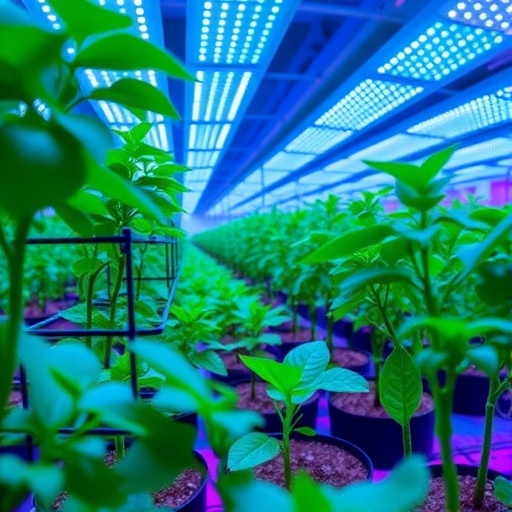
In a groundbreaking leap for controlled environment agriculture (CEA), researchers have unveiled a pioneering smart lighting system that dynamically tunes itself to the precise needs of crops, promising to revolutionize the energy demands and output of indoor vertical farming. Spearheaded by Professor Tracy Lawson, formerly of the University of Essex and now at the University of Illinois Urbana-Champaign, this innovation harnesses the real-time physiological signals emitted by plants to optimize LED lighting — a development that could put large-scale vertical farming within reach more efficiently than ever before.
Vertical farming, a method of producing crops within enclosed, multi-layered facilities, offers a tantalizing escape from the vulnerabilities of traditional agriculture—pest damage, erratic weather, and escalating water use. While LED lighting has enabled controlling photosynthetic conditions, the energy costs associated with maintaining continuous light cycles remain a barrier to scaling indoor farms economically. Lawson’s team recognized that though LEDs provide near-perfect control over light intensity and spectrum, most existing systems operate on static schedules, switching lights on and off irrespective of plant feedback.
Delving into the plants’ natural physiological processes, the research exploits chlorophyll fluorescence—a phenomenon where chlorophyll molecules emit a small amount of light when absorbing more photons than can be used in photosynthesis. By continuously monitoring this fluorescence, which serves as a real-time indicator of photosynthetic efficiency, the system deciphers when the plant is receiving excess light and adjusts illumination accordingly. This feedback loop functions as a form of intelligent “conversation” with the plants, letting them “tell” the system when to dial down or ramp up light intensity.
The core of the experiment involved cultivating basil under these responsive lighting conditions within a commercial-standard vertical farm housed in the University of Essex’s STEPS lab. Using artificial intelligence algorithms paired with sophisticated chlorophyll fluorescence measurements, the lights were modulated in real time based on the plant’s photosynthetic activity. Up to six hours into the photoperiod, light intensity increased, helping plants achieve peak carbon fixation. As the day wore on and photosynthetic rates declined, the system tapered light exposure, conserving energy and minimizing photodamage.
This nuanced approach revealed intriguing insights into plant physiology under artificial light. The decline in photosynthetic activity toward the latter half of the day’s cycle suggests an innate feedback mechanism within plants, potentially linked to carbohydrate accumulation signaling an energetic “full state.” By aligning light provision with these internal cues, the system limits superfluous energy expenditure and photoinhibition—the damaging overexposure to light that can impair plant health.
The results speak volumes not only on energy conservation—with a 6% drop in lighting power consumption—but also in production efficiency, yielding a nearly 13% increase in basil biomass when compared to traditional square-wave lighting schedules. Such improvements strike a critical balance that could tip the scales in favor of vertical farming becoming an economically viable option for food security at scale.
Moreover, the implementation complexity is surprisingly low; growers can integrate these intelligent light regimes into their current setups with relatively modest investment. This adaptability paves the way for wide-scale adoption across various indoor farming operations, offering bespoke lighting schedules sensitive to the unique needs of different crops and growth phases.
Looking ahead, Lawson’s research agenda extends beyond basil and energy consumption to explore how light color spectra influence plant metabolism and secondary metabolite production. Fine-tuning LED spectra could enable indoor farms to increase antioxidant content or trigger beneficial leaf morphology changes just before harvest, enhancing nutritional quality and visual appeal. Such tailored spectral modulation opens exciting possibilities for “designer crops” grown entirely within vertical farms.
The combination of real-time chlorophyll fluorescence monitoring and AI-infused lighting control represents a paradigm shift in CEA practices, blending plant biology with cutting-edge technology to create a more sustainable and efficient future for crop production. By leveraging the plants’ own signals rather than preset schedules, the system achieves an elegant synchronization between biological needs and technological provision.
This research marks a significant milestone toward overcoming two of vertical farming’s biggest hurdles—energy intensity and yield optimization—thereby advancing the sector’s potential as a resilient, urban-friendly food source. As global populations surge and arable land dwindles, innovations like this smart lighting feedback system could redefine how humanity grows its sustenance within tighter spaces and environmental constraints.
Backed by funding from the Leverhulme Trust, the Biotechnology and Biological Sciences Research Council, and university innovation grants, the research is charting new scientific territory. It promises that future indoor farms will not only be more eco-conscious but also more responsive to the living organisms they cultivate.
In conclusion, this novel integration of intelligent lighting with plant feedback mechanisms ushers in a new era of precision horticulture. By listening to plants’ chlorophyll fluorescence, vertical farms can optimize photosynthesis, boost crop yields, reduce operational costs, and set new standards for sustainable agriculture worldwide.
Cite Scienmag News
Alan Morgan. (February 23, 2026). Harnessing Fluorescence Insights to Boost Indoor Farming Efficiency: Tracking Plant Light Use Cuts Energy Costs. Scienmag. https://scienmag.com/harnessing-fluorescence-insights-to-boost-indoor-farming-efficiency-tracking-plant-light-use-cuts-energy-costs/
Alan Morgan. "Harnessing Fluorescence Insights to Boost Indoor Farming Efficiency: Tracking Plant Light Use Cuts Energy Costs." Scienmag, 23 February 2026, https://scienmag.com/harnessing-fluorescence-insights-to-boost-indoor-farming-efficiency-tracking-plant-light-use-cuts-energy-costs/. Accessed 3 September 2026.
Alan Morgan. "Harnessing Fluorescence Insights to Boost Indoor Farming Efficiency: Tracking Plant Light Use Cuts Energy Costs." Scienmag. February 23, 2026. https://scienmag.com/harnessing-fluorescence-insights-to-boost-indoor-farming-efficiency-tracking-plant-light-use-cuts-energy-costs/


