


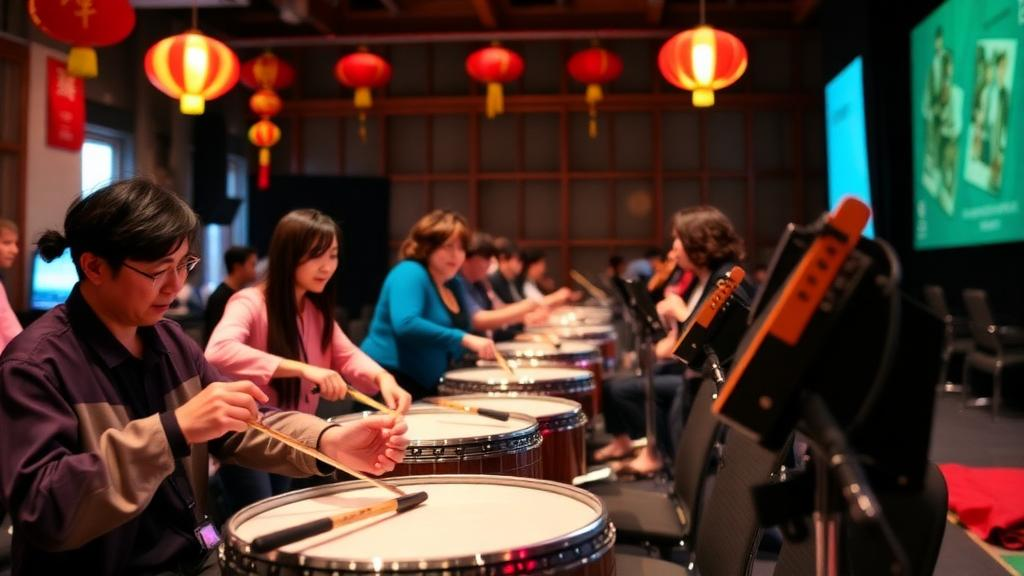
A centuries-old tradition of wind and percussion music from China’s Chaohua region has become the testing ground for a question that reaches far beyond one village square: how do you make a young, digitally saturated audience genuinely care about intangible cultural heritage? A new randomized experiment published in Humanities and Social Sciences Communications suggests that the answer may lie less in how beautifully a tradition is presented and more in whether people are allowed to pick up the instruments themselves. The study, led by Wei Li and Ming Ma of City University of Macau together with Li Song of City University of Macau and Zhongyuan University of Technology, draws on flow theory and embodied cognition to argue that the psychological distance separating modern viewers from traditional performance can be narrowed by active, body-involving participation.
Intangible cultural heritage, unlike a monument or a museum object, lives only in practice. It survives when skills, repertoires, and performance customs are transmitted from one generation of practitioners to the next, and it fades when the chain of engagement breaks. Chaohua Wind and Percussion Music, a traditional ensemble form, faces the same structural problem as countless other living traditions: contemporary audiences typically encounter it as spectators, watching or listening to something that was never meant to be consumed passively. The researchers framed this gap as a problem of psychological distance, the sense that a cultural practice belongs to another time, another place, and other people, and asked whether different formats of presentation could close that gap.
The theoretical backbone of the study is flow theory, the influential account of optimal experience developed by psychologist Mihaly Csikszentmihalyi. Flow describes the absorbing state that arises when a person’s skills are well matched to the demands of a challenging activity, when goals are clear, and when feedback is immediate. Musicians, athletes, and craftspeople often describe flow as the reason they return to their practice again and again. If heritage engagement could be engineered to trigger flow, the authors reasoned, then a brief encounter with a tradition might seed the kind of satisfaction that sustains longer-term interest. The study pairs this idea with embodied cognition, the view that cognition is grounded in the body’s sensorimotor engagement with the world, which predicts that handling an instrument should produce a qualitatively different experience than reading about one.
To test these ideas, the team ran a randomized experiment with 150 participants, assigning them to one of three conditions that differed in how they encountered the music. In the text-image condition, participants engaged with written and pictorial material about Chaohua Wind and Percussion Music. In the audiovisual condition, they watched and listened to the tradition in motion. In the interactive instrumental-performance condition, they were given the chance to perform with the instruments themselves, translating what they saw and heard into their own bodily action. The design therefore isolated a single variable, the degree of active embodiment, while holding the cultural content constant across groups.
The results followed a clear ordering. The interactive condition produced the highest levels of both flow experience and experience satisfaction, the audiovisual condition came second, and the text-image condition came last. Because the data showed unequal variances across groups, the researchers used Welch tests and Games-Howell post hoc comparisons, statistical procedures that remain reliable when the assumption of equal variability is violated. The ordered pattern survived these robust checks, indicating that the advantage of interactive engagement was not an artifact of a few extreme scores or of the specific test chosen.
Flow experience and experience satisfaction were strongly associated in the pooled sample, but the authors were careful not to overstate what that association means. Diagnostic checks for common-method bias and conceptual overlap between the two measures revealed that the correlation contained substantial structure between conditions alongside residual covariation within conditions, and that its strength was not uniform across the three groups. In plain terms, people who felt absorbed also tended to feel satisfied, but how much those two things traveled together depended on which format they had experienced. This nuance matters for anyone hoping to design heritage programs, because it suggests flow is not a simple dial that can be turned to guarantee satisfaction in every setting.
The mediation analysis added a further layer of caution and sophistication. For the two contrasts that involved the text-image condition, significant treatment-by-flow interactions emerged, meaning the effect of flow on the outcome differed depending on whether participants had been in the passive format or a more engaging one. Standard mediation assumptions break down in that situation, so the team used interaction-aware natural-effect decompositions. The total natural indirect effects excluded zero, providing evidence consistent with a flow-mediated pathway, whereas the pure natural indirect effects did not. For the contrast between the audiovisual and interactive conditions, a significant ordinary indirect effect was retained. Taken together, the authors conclude that flow experience functions as a condition-dependent proximal psychological pathway rather than a uniform or causally identified mechanism, a formulation that is precise about the limits of a single-session experiment.
Those limits are worth spelling out, because the study’s practical promise is easy to overread. The experiment measured immediate responses to brief heritage experiences, not whether participants later attended performances, joined ensembles, or encouraged others to learn. The authors are explicit that implications for sustained participation require longitudinal and field-based evaluation, ideally following people over weeks or months in real heritage settings rather than controlled sessions. Still, the pattern is consistent with a growing body of work in psychology and education suggesting that passive exposure, however polished, rarely produces the deep engagement that active practice does, and that the body is not a peripheral player in how we come to value culture.
The study was conducted in accordance with the Declaration of Helsinki, with ethical approval from the Faculty Ethics Committee of the Faculty of Humanities and Social Sciences at City University of Macau, granted on 20 May 2025 under reference number FHSS250044. Verbal informed consent was obtained from all participants under an approved waiver of written consent, and no identifiable personal information appears in the manuscript. The work is open access, published under a Creative Commons license that permits sharing with attribution, which should help the findings reach the heritage practitioners and cultural policymakers who might act on them.
For the field of heritage studies, the significance of the experiment lies in its methodological honesty as much as its headline result. Many studies in this area report a single correlation and leap to grand claims about saving dying traditions. Here, the statistical machinery, from Welch tests to interaction-aware decompositions, is deployed to show exactly where the evidence is strong and where it remains suggestive. The actionable takeaway is modest but concrete: if the goal is to spark absorption and satisfaction in a first encounter with intangible cultural heritage, formats that invite people to embody the tradition, even briefly, appear to outperform formats that ask them only to look or listen. Whether that first spark can be fanned into the sustained participation that traditions like Chaohua Wind and Percussion Music need to survive is the question the authors, and the field, must now take into the field itself.
Subject of Research: Flow theory and embodied cognition in the transmission of intangible cultural heritage
Article Title: Fostering sustainable engagement with intangible cultural heritage: a flow theory perspective on Chaohua Wind and Percussion Music
Article References: Fostering sustainable engagement with intangible cultural heritage: a flow theory perspective on Chaohua Wind and Percussion Music. (n.d.). https://doi.org/10.1038/s41599-026-09318-x
Image Credits: AI Generated
DOI: 10.1038/s41599-026-09318-x
Keywords: intangible cultural heritage, flow theory, embodied cognition, Chaohua Wind and Percussion Music, randomized experiment, experience satisfaction, psychological distance, heritage transmission, mediation analysis, audience engagement, cultural psychology, traditional music
Cite Scienmag News
Courtney Benton. (October 12, 2026). Hands-On Music Experience Pulls Audiences Into Flow, Study of Chinese Heritage Finds. Scienmag. https://scienmag.com/hands-on-music-experience-pulls-audiences-into-flow-study-of-chinese-heritage-finds/
Courtney Benton. "Hands-On Music Experience Pulls Audiences Into Flow, Study of Chinese Heritage Finds." Scienmag, 12 October 2026, https://scienmag.com/hands-on-music-experience-pulls-audiences-into-flow-study-of-chinese-heritage-finds/. Accessed 12 October 2026.
Courtney Benton. "Hands-On Music Experience Pulls Audiences Into Flow, Study of Chinese Heritage Finds." Scienmag. October 12, 2026. https://scienmag.com/hands-on-music-experience-pulls-audiences-into-flow-study-of-chinese-heritage-finds/


