


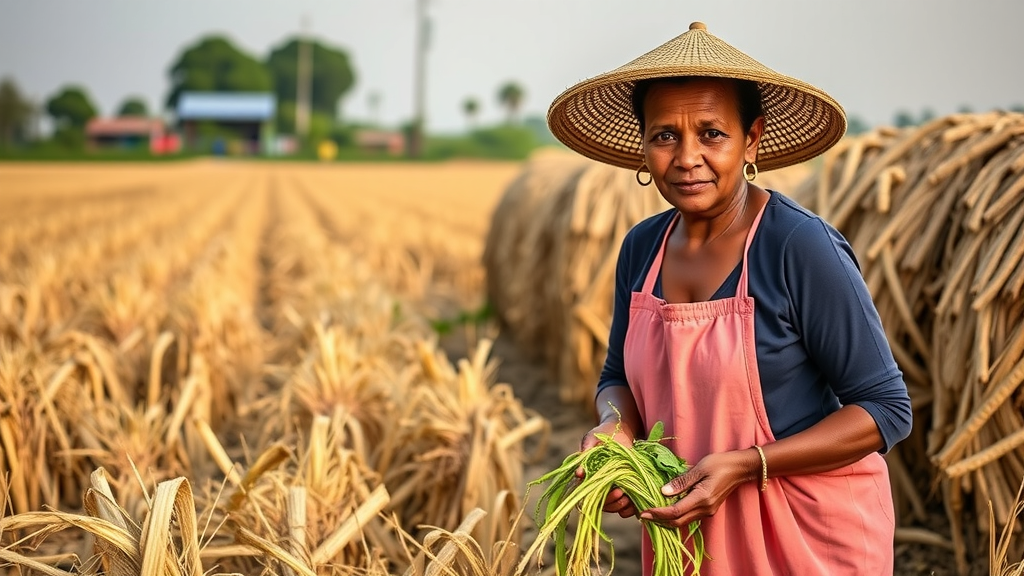
Roughly 475 million smallholder farms across the Global South, most of them operating on less than two hectares of land, already produce about 30 percent of the world’s food despite chronic lack of access to finance, markets, technical training and extension services. According to a new book by development expert Hugh Locke, co-founder of the Smallholder Farmers Alliance in Haiti, this vast and long-overlooked constituency could hold the key to one of the century’s most daunting challenges: feeding an expected additional 1.5 billion people by 2050 without pushing soils, ecosystems and the climate past their breaking points. The book, Whole Earth Farming: Smallholders and the Great Regenerative Transformation, argues that helping just half of the world’s smallholder farming families — approximately 240 million households — adopt regenerative agriculture and agroforestry could supply all of the additional food humanity will need by mid-century, while actively restoring rather than degrading the natural systems on which agriculture depends. Those farms would occupy only about 12 percent of the world’s arable land.
Locke’s central contention is that the world’s smallholder farmers have been framed for too long as beneficiaries of development assistance when they should instead be recognized as architects of the next great agricultural transformation. The world population is projected to rise by roughly 1.5 billion by 2050, with nearly all of that growth concentrated in developing countries where smallholder dominance is greatest. Conventional thinking has often treated increased food production and environmental restoration as competing goals, implying that feeding more people necessarily requires more land, more synthetic inputs and more ecological sacrifice. Locke’s proposition inverts that trade-off. He argues that the same investment needed to raise smallholder productivity — training, financing, research, market access and extension support — can simultaneously convert agriculture from an extractive activity into a regenerative one, producing measurable gains in soil health, biodiversity, water resources, carbon storage and farmer livelihoods at the same time.
Much of the empirical grounding for this argument comes from Haiti, where Locke and Haitian agronomist Timote Georges co-founded the Smallholder Farmers Alliance in 2010. The organization now works with roughly 10,000 member farmers, and the results offer a working model of what broader support could achieve. When participating smallholders receive basic agricultural services built on sustainable practices, their yields increase by an average of about 40 percent, while household incomes rise between 50 and 100 percent depending on local conditions. Alliance members also plant approximately one million trees every year. The organization pioneered what it calls a tree currency model: farmers plant and care for trees in exchange for agricultural services, training, seeds and other inputs. This mechanism directly links increased farm productivity with environmental restoration, ensuring that ecological gains and economic gains reinforce one another rather than compete.
The Haiti experience shaped one of the book’s central conclusions: hundreds of millions of smallholder farmers are producing well below their potential not because of any inherent limitation of small farms, but because agricultural policies, research priorities, financing systems and extension services have disproportionately favored large-scale industrial agriculture for decades. Locke is careful to distinguish his vision from nostalgia. This is not, he insists, a call to return agriculture to some idealized past. It is about recognizing where one of the greatest opportunities for the future of food now exists. Smallholders are particularly well positioned to lead a regenerative transformation because many retain traditional agricultural knowledge, operate diversified farming systems, and have adopted industrial methods far less extensively than producers in wealthier countries — meaning they have less to undo and more to build upon.
Regenerative agriculture, as the book frames it, goes beyond merely reducing the damage farming causes. It is a holistic approach designed to improve the natural systems on which agriculture depends. The methodology draws on three streams of knowledge: Indigenous and ancestral farming traditions, decades of experience with organic farming, agroecology, permaculture and other sustainable approaches, and contemporary science, including advances in soil biology, ecosystem science and impact measurement. Depending on local conditions, regenerative farmers may employ crop rotation, cover crops, intercropping and diverse cropping systems, composting and other methods of building soil organic matter, reduced tillage, agroforestry and the integration of livestock. The objective is not adherence to a universal checklist of practices but measurable improvement in outcomes such as soil health, biodiversity, water quality and availability, carbon storage, food production, farmer livelihoods and community resilience.
Locke describes this dual character as regenerative agriculture’s dual revolution: it is simultaneously a farming methodology and a framework for determining whether farming is actually producing regenerative results. The distinction matters because practices appropriate to a smallholder in Haiti, India or Kenya may be very different from those suitable for a large farm in Canada or the United States. The critical question, he argues, is not simply whether a farmer is using regenerative practices, but whether the land, the ecosystem and the farming community are measurably better as a result. This represents a fundamental shift from agricultural practices designed to do less harm toward practices engineered to deliver net positive outcomes, and it places verification and evidence at the heart of the regenerative movement.
The climate implications are substantial. Healthy soils and growing plants remove carbon dioxide from the atmosphere and store carbon in soil organic matter and biomass, while regenerative systems also reduce emissions associated with the manufacture and transportation of synthetic fertilizers. Drawing on peer-reviewed research, Locke estimates that approximately 240 million smallholder farms making the transition to regenerative agriculture across an estimated 480 million hectares could remove up to 0.72 gigatons of CO2 from the atmosphere annually during the period in which soil carbon is actively accumulating. Reduced reliance on synthetic fertilizer could add roughly 0.1 gigatons of CO2 equivalent per year in avoided emissions, bringing the estimated combined benefit to approximately 0.6 to 0.85 gigatons per year at mature adoption — a figure roughly comparable in scale to the annual CO2 emissions of the entire global aviation industry.
Locke is careful not to overstate the climate case. Soils cannot absorb carbon indefinitely; soil carbon generally accumulates over one to three decades before approaching a new equilibrium, and outcomes vary substantially with soil types, climate, farming practices and farmers’ starting conditions. Regenerative agriculture, he stresses, is not a license to keep emitting carbon elsewhere. Its climate potential is important precisely because it arrives alongside other urgently needed benefits: healthier soil, greater biodiversity, more resilient farms, increased food production and stronger rural communities. This framing guards against the growing tendency to reduce regenerative agriculture to a carbon accounting exercise, and it underpins the book’s argument that a farming system which sequesters carbon while degrading biodiversity, water resources or farmer livelihoods cannot meaningfully be called regenerative.
The book arrives at a moment when regenerative agriculture is moving rapidly into the mainstream yet still lacks a universally agreed definition, making credible measurement especially important. Rather than allowing a farm or company to be deemed regenerative simply because it has adopted a favored technique, Whole Earth Farming advocates assessing a broad range of environmental and social outcomes. Locke highlights the emerging Regen10 Outcomes Framework, developed through more than two years of global consultation, as an important step toward a common reference for assessing regenerative agriculture while allowing farmers to choose methods appropriate to local circumstances. The framework encompasses ecological health, farmer livelihoods, food quality, community resilience and other dimensions, providing a template for accountability as the movement scales.
Locke calls the broader opportunity a Great Regenerative Transformation, comparable in ambition to the Green Revolution that dramatically raised agricultural production in the second half of the twentieth century, but with a crucial difference. Where the Green Revolution relied on improved crop varieties, irrigation, synthetic fertilizers, pesticides and standardization, this transformation would combine traditional agricultural knowledge with ecological science, locally adapted practices and modern measurement systems. The book carries a foreword by Roy Steiner, Senior Vice President of the Food Initiative at The Rockefeller Foundation, who describes the world’s 475 million smallholder farming households as not a measure of the problem but a measure of the possibility, and emphasizes that regenerative transformation cannot succeed without farmers themselves acting as agents of change. Endorsements have come from figures including former U.S. President Bill Clinton and chef and humanitarian José Andrés. The book, which includes 21 farmer stories from 18 countries and was launched during Climate Week NYC, rests on a deceptively simple proposition: the world need not choose between feeding more people and restoring the planet, provided the hundreds of millions of farmers who have long operated at the margins of agricultural policy are finally given the means to lead.
Subject of Research: The potential of smallholder farmers adopting regenerative agriculture and agroforestry to meet global food demand by 2050 while restoring soils, biodiversity and sequestering carbon.
Article Title: Just half the world's 475 million smallholder farmers could meet all of humanity’s additional food needs in 2050 while restoring soils and biodiversity
Article References: Just half the world's 475 million smallholder farmers could meet all of humanity’s additional food needs in 2050 while restoring soils and biodiversity. (n.d.). Original publication
Image Credits: AI Generated
DOI: Not provided
Keywords: smallholder farmers, regenerative agriculture, agroforestry, food security, soil carbon, biodiversity, climate change, sustainable farming, Haiti, Global South, Regen10 Outcomes Framework, agricultural transformation
Cite Scienmag News
Grant Pearson. (September 20, 2026). Half of world’s 475 million smallholder farms could feed 2050 while restoring the planet. Scienmag. https://scienmag.com/half-of-worlds-475-million-smallholder-farms-could-feed-2050-while-restoring-the-planet/
Grant Pearson. "Half of world’s 475 million smallholder farms could feed 2050 while restoring the planet." Scienmag, 20 September 2026, https://scienmag.com/half-of-worlds-475-million-smallholder-farms-could-feed-2050-while-restoring-the-planet/. Accessed 5 October 2026.
Grant Pearson. "Half of world’s 475 million smallholder farms could feed 2050 while restoring the planet." Scienmag. September 20, 2026. https://scienmag.com/half-of-worlds-475-million-smallholder-farms-could-feed-2050-while-restoring-the-planet/


