


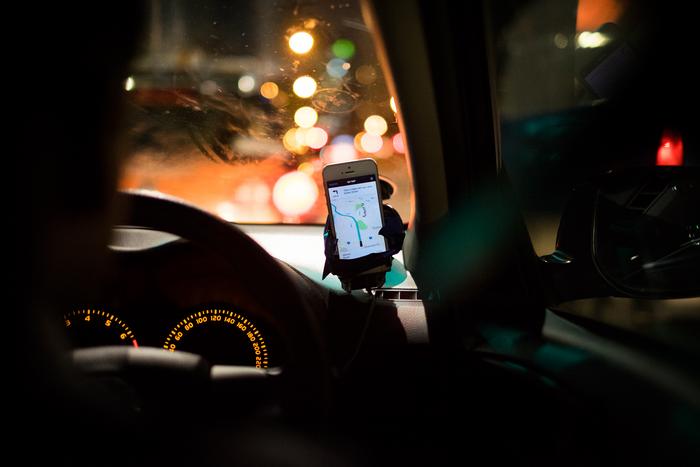

Credit: Noel Tock
More than 50% of ride-hailing trips taken by surveyed riders in California replaced more sustainable forms of transportation — such as walking, cycling, carpooling, and public transit — or created new vehicle miles, according to a study from the University of California, Davis Institute of Transportation Studies.
The study was conducted to help guide development of the Clean Miles Standard, a state regulation designed by the California Air Resources Board to reduce the greenhouse gas emissions from ride-hailing services.
Published in Transportation Research Record: Journal of the Transportation Research Board, the study analyzed data collected among riders in three metropolitan regions — the San Francisco Bay Area, San Diego, and Los Angeles and Orange counties — between Nov. 2018 and Nov. 2019. The data set consisted of 7,333 ride-hailing trips by 2,458 respondents.
About 47% of the trips replaced a public transit, carpool, walking or cycling trip. An additional 5.8% of trips represented “induced travel,” meaning the person would not have made the trip were an Uber or Lyft unavailable. This suggests ride-hailing often tends to replace most sustainable transportation modes and leads to additional vehicle miles traveled.
Equity issues
The study also found that respondents who did not have a household car, or who identified as a racial or ethnic minority, were the least likely to cancel a trip if ride-hailing was not available. This indicates that their Uber or Lyft ride was an essential, not discretionary trip, although the authors say this finding requires more research.
“Hopefully, the results of this study can be used to increase the sustainability of ride-hailing and also address potential equity issues that are apparent,” said lead author James Giller, a Ph.D. candidate at the Institute of Transportation Studies at UC Davis.
At their best, ride-hailing services can connect people to mobility opportunities they may otherwise not have had, ideally while saving emissions and reducing traffic when the vehicle is electric and the ride is shared. When not used sustainably, however, such services can also increase traffic, reduce the use of public transit — an economical and sustainable mode of transportation for a variety of income levels — and increase social inequities.
Recommendations for sustainable ride-hailing
To improve sustainability, the study recommends ride-hailing trips — especially those offered by shared, or pooled, services—be better connected to public transit in low-demand areas, so they complement those services rather than replace them.
“There’s certainly a place for ride-hailing and opportunities to improve its sustainability,” Giller said. “It’s all about making sure it’s used in the most efficient way by increasing the occupancy of the vehicles; by making sure these trips connect people to transit stations for longer distance travel; that they’re done in efficient, clean cars; and that we can reduce as much as possible the inefficiencies associated with finding passengers and going to pick them up.”
Study coauthors include senior author Giovanni Circella of the UC Davis Institute of Transportation Studies and Mischa Young of the Université de l’Ontario français in Canada.
“This study helps inform agencies on the role that ride-hailing has in complementing versus substituting the use of other travel modes,” Circella said. “The study is particularly unique due to the richness of the data used. While the data were collected before the pandemic, and thus might refer to different market conditions, the research helps establish an important benchmark that will help policymakers improve the sustainability of passenger travel as part of efforts to decarbonize transportation in California and beyond.”
The study was funded primarily by the California Air Resources Board. Additional funding was provided by the 3 Revolutions Future Mobility Program of UC Davis.
Journal
Transportation Research Record Journal of the Transportation Research Board
Method of Research
Survey
Article Title
Correlates of Modal Substitution and Induced Travel of Ridehailing in California
Article Publication Date
8-Aug-2024
Cite Scienmag News
Courtney Benton. (August 28, 2024). Half of Uber, Lyft trips replace more sustainable options. Scienmag. https://scienmag.com/half-of-uber-lyft-trips-replace-more-sustainable-options/
Courtney Benton. "Half of Uber, Lyft trips replace more sustainable options." Scienmag, 28 August 2024, https://scienmag.com/half-of-uber-lyft-trips-replace-more-sustainable-options/. Accessed 6 September 2026.
Courtney Benton. "Half of Uber, Lyft trips replace more sustainable options." Scienmag. August 28, 2024. https://scienmag.com/half-of-uber-lyft-trips-replace-more-sustainable-options/

