


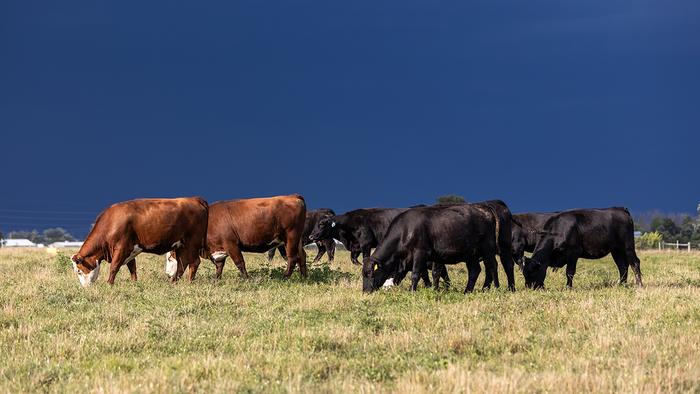
COLUMBIA, Mo. — University of Missouri researchers are working to develop the first-ever vaccine proven to protect cattle from a devastating tick-borne cattle disease known as bovine anaplasmosis. The research is vital to the state’s economy as it aims to protect Missouri’s $1.6 billion cattle industry.

Credit: University of Missouri
COLUMBIA, Mo. — University of Missouri researchers are working to develop the first-ever vaccine proven to protect cattle from a devastating tick-borne cattle disease known as bovine anaplasmosis. The research is vital to the state’s economy as it aims to protect Missouri’s $1.6 billion cattle industry.
Bovine anaplasmosis — which is common in Missouri — infects the red blood cells of cattle and causes hundreds of millions of dollars in economic losses nationwide each year and nearly $1 billion in losses worldwide, primarily due to reduced cattle production, treatment costs and deaths.
Roman Ganta, a McKee endowed professor in Mizzou’s College of Veterinary Medicine and a Bond Life Sciences Center researcher, led the study that created the new vaccine. The work involved genetically modifying the pathogen Anaplasma marginale — which causes bovine anaplasmosis — in a lab. By deleting a specific gene and then injecting the modified pathogen into cattle, the vaccinated cattle were successfully immunized against the disease.
“I often receive calls from cattle producers who are excited about our research and want to know how soon they can get the vaccine,” Ganta said. “There is currently no effective, widely available, vaccine for the disease, and cattle farmers are very worried about the disease harming or killing their cattle. We want to help farmers in Missouri and around the world and are working hard to come up with a viable solution.”
Moving the needle forward
Ganta, who has been researching molecular genetics and vector-borne diseases for more than 30 years, was hired at Mizzou in 2023 as part of MizzouForward, a 10-year, $1.5 billion transformational effort that focuses on faculty expansion, infrastructure growth and student success.
Throughout his career, Ganta has published more than 100 studies in peer-reviewed journals and earned more than $22 million in grants from organizations such as the National Institutes of Health, the U.S. Department of Agriculture, the Centers for Disease Control and Prevention, industry partners and foundations. He is an example of why Mizzou is a leading research university and a member of the prestigious Association for American Universities.
Working at a land-grant university, Ganta’s research will ultimately help improve the health of cattle — and the agricultural economy — throughout Missouri, particularly in rural areas.
“Missouri is a hotbed for tick-borne diseases, and bovine anaplasmosis causes massive economic losses both here in Missouri and around the world,” Ganta said. “Mizzou has already made substantial contributions to protecting cattle against ticks. For example, many farmers currently give their cattle an antibiotic called chlortetracycline, which was first discovered at Mizzou’s Sanborn Field in 1945. While effective, that medicine doesn’t fully eliminate the infection, so this new vaccine is an innovative step forward to fully eliminate the infection.”
Ganta said the new vaccine has been proven to give immunized cattle protection against bovine anaplasmosis for at least a month, and he and his team are eager to conduct additional research to determine how long the genetically modified pathogen can provide immunity for cattle. Ganta is also collaborating with industry partners to discuss future distribution of the new vaccine — which has been patented — to cattle producers.
“The genetically modified live vaccine offers protective immunity against wild-type Anaplasma marginale tick-transmission challenge” was published recently in Vaccine. Funding for the study was provided by the National Institutes of Health and Russell L. Rustici Rangeland and Cattle Research Endowment, University of California, Davis.
Leading the charge in tick research
Mizzou — the state of Missouri’s flagship and most prominent research university — has been on the frontlines of tick research for years. A 2021 Mizzou study found recent increases in both the number and severity of tick-borne diseases in the Midwest, particularly in the humid climates of Missouri, Kansas, Oklahoma and Arkansas. The documentation of what, when and where ticks are present helps public health officials better understand the threat of tick-borne diseases to people, pets and livestock.
Researchers in Mizzou’s College of Veterinary Medicine and College of Health Sciences also were the first to identify the invasive longhorned tick in northern Missouri in 2022 and in Boone County, Missouri, in 2023. Mizzou’s Veterinary Medical Diagnostic Laboratory assists livestock producers who notice various health issues in their cattle with tracking down the causes of such signs in an effort to support Missouri’s agriculture industry.
Journal
Vaccine
Method of Research
Experimental study
Subject of Research
Animals
Article Title
Genetically modified live vaccine offers protective immunity against wild-type Anaplasma marginale tick-transmission challenge
Article Publication Date
15-Jun-2024
Cite Scienmag News
Kristina Jarvis. (August 28, 2024). New vaccine created by Mizzou researchers protects cattle from deadly tick-borne disease. Scienmag. https://scienmag.com/new-vaccine-created-by-mizzou-researchers-protects-cattle-from-deadly-tick-borne-disease/
Kristina Jarvis. "New vaccine created by Mizzou researchers protects cattle from deadly tick-borne disease." Scienmag, 28 August 2024, https://scienmag.com/new-vaccine-created-by-mizzou-researchers-protects-cattle-from-deadly-tick-borne-disease/. Accessed 3 September 2026.
Kristina Jarvis. "New vaccine created by Mizzou researchers protects cattle from deadly tick-borne disease." Scienmag. August 28, 2024. https://scienmag.com/new-vaccine-created-by-mizzou-researchers-protects-cattle-from-deadly-tick-borne-disease/

