


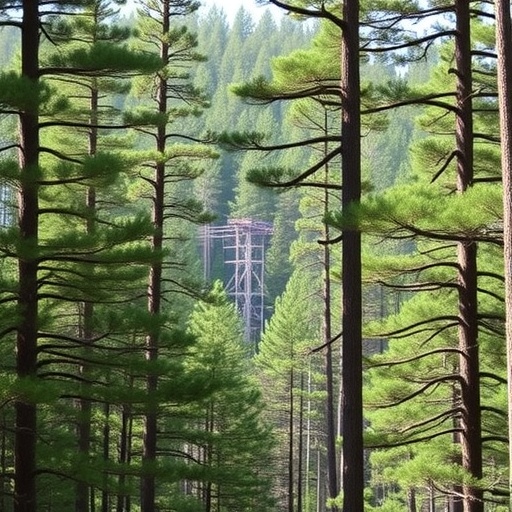
In the southeastern United States, pine plantations serve as critical components of the forestry economy, predominantly managed through intensive site preparation techniques designed to enhance tree growth and accelerate harvest cycles. These plantations often employ soil bed construction to improve drainage and the application of herbicides to mitigate competition from weeds and woody shrubs. While earlier studies have documented that such interventions yield promising early growth in pine species such as slash pine (Pinus elliottii) and loblolly pine (Pinus taeda), the long-term efficacy of these practices remains ambiguous, necessitating comprehensive longitudinal research to unravel their sustained impact on forest productivity.
Addressing this knowledge gap, a recent extensive study conducted in the Lower Coastal Plain of North Florida monitored pine plantations for up to 27 years, offering unprecedented insights into how various site preparation strategies influence extended growth trajectories and timber yield. The research, published in the peer-reviewed journal Forest Ecosystems, meticulously examines the interplay between bed construction timing, the intensity of bedding passes, and herbicide application schedules, providing forest managers with evidence-based recommendations that optimize long-term productivity.
The investigative team, based at the University of Georgia, structured their experimental design to compare the outcomes of multiple treatment variables: early bedding versus late bedding, single-pass bedding against double-pass bedding, and pre-plant herbicide applications as opposed to post-plant applications. This multi-factorial approach enabled a robust evaluation of formulations balancing physical soil modifications and chemical vegetation control measures, with a focus on discerning which combinations demonstrably sustain superior tree growth over nearly three decades.
Crucially, the data revealed that two-pass bedding treatments consistently surpassed the efficacy of single-pass or no bedding strategies in promoting tree growth, underscoring the importance of soil manipulation intensity. The improved outcomes were closely correlated with enhanced vegetation control efficacy, particularly regarding the suppression of woody shrub competitors, which otherwise pose long-term allelopathic and resource competition challenges to young pine stands. These findings validate the notion that robust mechanical site preparation is foundational to silvicultural success.
Enterprise-scale observations further highlighted the critical influence of herbicide application patterns. The study noted significant growth advantages when herbicide was broadcast uniformly across the entire plot area rather than confined to banded applications directly over soil beds. This suggests that controlling woody and herbaceous competition comprehensively rather than selectively is paramount, as residual vegetation between bedding rows may undermine early structural interventions if left unmanaged.
Site-specific responses to bedding timing illuminated the nuanced relationship between silvicultural technique and local environmental variables. Although the impact of bed construction timing was less pronounced than herbicide treatment effects, early bedding coupled with pre-plant herbicide application emerged as the optimal strategy within the Florida flatwoods ecosystem. This synergy enhances early vegetation control, reduces competition, and provides a conducive microenvironment for root establishment and tree growth.
However, the study also identifies complexities in managing competing vegetation, noting that while double bedding suppresses woody plants more effectively, it may inadvertently encourage the proliferation of herbaceous weeds. This secondary effect necessitates additional integrated weed management steps post-bedding to retain the benefits of intensive site preparation, emphasizing a holistic approach rather than relying solely on mechanical or chemical tactics.
In terms of practical forestry outcomes, these findings coalesce into actionable recommendations. For short-rotation pine plantations, integrating broad-spectrum herbicide applications with intensive bedding regimens offers the most reliable path to maximizing early and mid-term timber productivity. Conversely, plantations intended for longer rotation cycles may afford more flexibility in management interventions, as growth differentials across treatment types become less pronounced over extended periods, potentially allowing for cost savings without substantial productivity loss.
Importantly, the research underscores that successful pine plantation establishment and maintenance are contingent on vigilant, effective control of both woody and herbaceous competitors. Ignoring either can precipitate reduced site quality, impaired resource availability, and compromised stand growth trajectories. Investing effort and resources into meticulously planned site preparation thus yields compounded benefits that manifest across decades, ensuring plantation sustainability and economic viability.
This comprehensive longitudinal analysis offers a blueprint for refining forest management practices amid evolving ecological and economic pressures. It affirms that strategic integration of mechanical soil treatments with targeted chemical vegetation control is indispensable for advancing silvicultural outcomes in southern US pine ecosystems. Moreover, the gradual attenuation of treatment effects over time invites further investigation into adaptive management strategies that evolve alongside forest stand dynamics.
The sophisticated experimental approach and extended temporal scope imbue this study with significant relevance for the broader forestry research community. It also delivers actionable intelligence for practitioners engaged in forest restoration, bioenergy feedstock production, and sustainable timber harvesting, where balancing growth acceleration with ecosystem health is paramount. These insights could translate broadly into other temperate and subtropical pine ecosystems exhibiting similar competitive vegetation challenges.
Given increasing climate variability and shifting land use paradigms, enhancing the resilience and productivity of pine plantations assumes heightened strategic importance. This research contributes to this objective by elucidating how fine-tuned silvicultural practices can fortify plantings against biotic competition and abiotic stresses. Forest managers equipped with this knowledge stand better poised to deliver sustainable economic returns while maintaining ecological integrity, ultimately supporting regional and national forest resource goals.
In summary, the nearly three-decade assessment of site preparation impacts on slash and loblolly pine plantations reveals that the benefits of multi-pass bedding combined with comprehensive herbicide application endure long-term. This dual strategy addresses the multifaceted challenges of vegetation competition, optimizes early stand development, and sets the stage for productive forest rotations, highlighting a critical leverage point for silvicultural innovation in the southeastern United States.
News Publication Date: 9-Sep-2025
Web References: https://doi.org/10.1016/j.fecs.2025.100381
Cite Scienmag News
Alan Morgan. (October 31, 2025). Growing Stronger Pine Forests: Insights from a 27-Year Study. Scienmag. https://scienmag.com/growing-stronger-pine-forests-insights-from-a-27-year-study/
Alan Morgan. "Growing Stronger Pine Forests: Insights from a 27-Year Study." Scienmag, 31 October 2025, https://scienmag.com/growing-stronger-pine-forests-insights-from-a-27-year-study/. Accessed 3 September 2026.
Alan Morgan. "Growing Stronger Pine Forests: Insights from a 27-Year Study." Scienmag. October 31, 2025. https://scienmag.com/growing-stronger-pine-forests-insights-from-a-27-year-study/


