

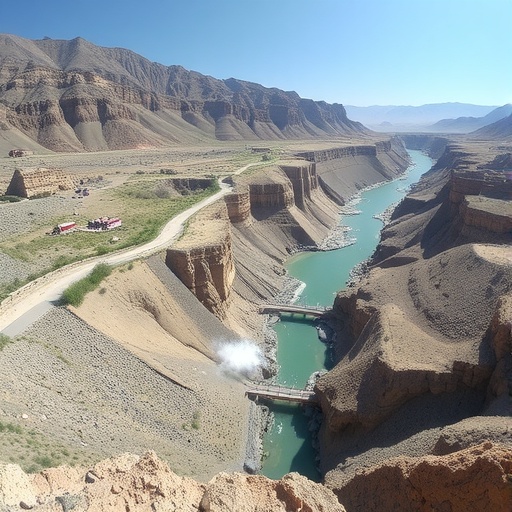
In the arid and semi-arid regions of the world, groundwater serves as a critical resource for sustaining life, agriculture, and industry. A recent comprehensive study has illuminated the patterns of groundwater fluctuations in the central Sub-Basin of Erbil, located in Northern Iraq—a region confronting increasing water security challenges. The research, conducted by Mamand, Yashooa, Ali, and colleagues, dives into the complexity of underground water levels and presents vital insights that could transform water resource management in this geopolitically pivotal area.
Groundwater serves as an essential buffer against periods of drought, yet it remains one of the least understood components of the hydrological cycle in many parts of the Middle East. The central Sub-Basin of Erbil is characterized by a semi-arid climate with erratic rainfall patterns, making it highly susceptible to fluctuations in groundwater recharge and extraction. Understanding these fluctuations forms the backbone of sustainable management strategies, ensuring that future demands on water supplies do not outstrip the basin’s natural replenishment capacity.
The researchers processed an extensive dataset spanning multiple decades, integrating hydrogeological measurements, climatic variables, and human extraction rates to analyze the temporal and spatial variations of groundwater levels. The work highlights a trend of declining groundwater tables over the last 20 years, attributable mainly to increased abstraction for agricultural irrigation and domestic consumption. They deployed sophisticated modeling techniques to capture the interplay between natural recharge mechanisms and anthropogenic pressure.
What distinguishes this study is the methodological rigor with which the team approached the assessment of groundwater dynamics. State-of-the-art numerical models were calibrated with real-time data obtained from an array of monitoring wells scattered strategically across the basin. These models incorporated parameters such as soil permeability, aquifer porosity, and the intricate network of subsurface water flow paths, enabling simulations of groundwater responses to diverse environmental and anthropogenic influences.
One of the key findings identifies that despite episodic rainfall events, the overall recharge rate remains insufficient to compensate for the accelerated abstraction rates, especially during the dry summer months. This imbalance has led to a persistent and measurable drop in water tables, resulting in negative consequences such as increased pumping costs, the intrusion of saline water in some areas, and the deterioration of water quality. Such outcomes have profound implications for the economic resilience of local communities heavily dependent on groundwater for sustenance.
The study further contextualizes these fluctuations within the broader framework of climate change impacts. Rising temperatures and shifting precipitation patterns are projected to exacerbate groundwater stress in the near future. The researchers utilized climate model projections to forecast groundwater levels under various emission scenarios, demonstrating a potential for significant depletion unless immediate mitigation measures are implemented. This forward-looking analysis offers a critical warning about the sustainability of current water use practices.
Importantly, the research underscores the role of governance and policy interventions that can alleviate pressure on the central Sub-Basin. Water resource managers can leverage the insights gained to design adaptive management strategies that balance extraction with recharge rates. Techniques such as managed aquifer recharge, demand-side water conservation, and regulation of well drilling could stabilize groundwater levels and secure water availability for future generations.
A unique aspect of this investigation lies in its integration of socio-economic data with biophysical measurements. By incorporating demographic growth patterns, agricultural intensification trends, and industrial development, the authors paint a comprehensive picture of how human activities are intertwined with natural systems. This holistic perspective enhances the relevance of their findings to policymakers seeking to harmonize economic development with environmental stewardship.
Moreover, the authors discuss the uncertainties inherent in hydrogeological modeling and recommend the establishment of an enhanced groundwater monitoring network. Such infrastructure would provide continuous, high-resolution data streams critical for real-time decision-making. Advances in remote sensing and sensor technology could further augment these monitoring efforts, enabling efficient tracking of groundwater dynamics at regional scales.
Another intriguing component of the study is the historical reconstruction of groundwater levels, which was achieved through the analysis of well logs and archival records. This temporal depth allows a distinction between natural variability and anthropogenically induced changes, an essential factor for accurate impact attribution. The authors’ ability to tease apart these influences strengthens the scientific foundation upon which water management policies can be based.
The research also brings attention to the transboundary nature of groundwater resources in the region. As basins often extend beyond administrative borders, cooperative frameworks between neighboring jurisdictions are necessary to prevent overexploitation and conflict. The insights from this study could serve as a blueprint for regional water agreements that promote equitable and sustainable use of shared aquifers.
From a technical perspective, the assimilation of geological, hydrological, and climatic data into cohesive models represents a significant advancement. The study employs Geographic Information Systems (GIS) to spatially visualize groundwater fluctuations and identify hotspots of depletion. Such visual tools are crucial for communicating complex scientific information to stakeholders and facilitating participatory water management.
In the context of global water scarcity challenges, the findings from Erbil’s central Sub-Basin resonate far beyond Northern Iraq. Regions worldwide grappling with similar climatic and developmental pressures can adapt the methodologies and lessons gleaned from this study. As groundwater resources become increasingly stressed, robust scientific assessments like this one are indispensable for crafting sustainable solutions.
Collectively, this research epitomizes the critical intersection of environmental science, resource management, and socio-economic considerations. It lays a foundation for ongoing monitoring and iterative policy refinement to ensure that groundwater—the lifeblood of many communities—remains a reliable resource amidst changing environmental realities. The urgency of the study’s conclusions implores governments, scientists, and citizens alike to commit to proactive stewardship of subterranean water reserves.
Ultimately, the study by Mamand and colleagues elevates the discourse on water sustainability in arid regions by providing a scientifically sound, policy-relevant evaluation of groundwater fluctuations. It challenges stakeholders to recognize groundwater not as an inexhaustible commodity but as a vulnerable asset requiring informed, coordinated management. With aquifers worldwide under mounting pressure, this research could well become a cornerstone reference for addressing one of the twenty-first century’s most pressing environmental challenges.
Subject of Research: Groundwater level fluctuations in the central Sub-Basin of Erbil, Northern Iraq.
Article Title: The study of groundwater level fluctuations in the central Sub-Basin of Erbil-Northern Iraq.
Article References:
Mamand, B.S., Yashooa, N.K., Ali, B.A. et al. The study of groundwater level fluctuations in the central Sub-Basin of Erbil-Northern Iraq. Environ Earth Sci 85, 27 (2026). https://doi.org/10.1007/s12665-025-12742-y
Image Credits: AI Generated


