


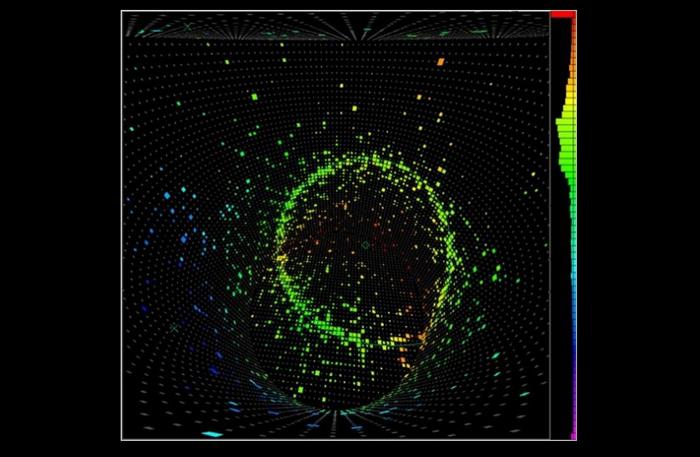
The landscape of particle physics continues to reveal new wonders and challenges as researchers study the enigmatic behavior of neutrinos. A pivotal development emerged from the joint undertaking by the Super-Kamiokande and T2K Collaborations, who have conducted a comprehensive examination of neutrino oscillation parameters utilizing both atmospheric and beam neutrino data. This groundbreaking study underscores the intricate connections between different neutrino reactions and enhances our understanding of the fundamental forces shaping our universe.
The Super-Kamiokande experiment is a colossal water Cherenkov detector situated deep within the Kamioka mine in Gifu, Japan. Its main function is to monitor atmospheric neutrinos—subatomic particles that are notoriously difficult to detect due to their fleeting existence and weak interactions with matter. Meanwhile, the T2K long-baseline neutrino experiment utilizes a high-intensity muon neutrino beam generated at the Japan Proton Accelerator Research Complex (J-PARC). This facility, located in Ibaraki, Japan, produces neutrinos that travel a distance of approximately 295 kilometers to the Super-Kamiokande detector.
By analyzing a significant dataset that encompasses 3,244.4 days of atmospheric neutrino data, alongside 19.7 × 10²⁰ protons on target in various exposure modes, the researchers were able to observe how neutrinos oscillate between different flavor states. This phenomenon challenges classical physics and suggests that neutrinos have mass, a pseudo-independent characteristic that has deep implications for our understanding of the Standard Model of particle physics.
In their analysis, the collaboration found a striking 1.9sigma exclusion of CP conservation, which corresponds to the condition where the matter and antimatter behaviors of neutrinos would agree entirely. This intriguing result holds potential implications not just for particle physics, but also for the broader understanding of why the universe consists predominantly of matter rather than antimatter. Distinguishing between subtle differences in particle interactions might unlock answers to why our universe is lopsided in terms of matter.
Furthermore, a 1.2sigma exclusion of inverted mass ordering was reported, suggesting that the mass hierarchy, which delineates the differences in the masses of various neutrinos, is not what some earlier models predicted. Such revelations compel physicists to reevaluate their assumptions and models concerning how neutrinos behave and interact within theoretical frameworks.
In trying to understand the magnitude of the results, it is essential to consider the comprehensive methodology adopted in this joint analysis. By unifying the datasets from both the Super-Kamiokande and T2K experiments, researchers mitigated the impact of systematic uncertainties, which can often obscure findings in particle physics. The collaborative effort illustrates how combining resources and information can enhance the precision and accuracy of fundamental research efforts.
The implications of these findings go beyond the realm of particle physics—understanding neutrinos might help scientists decipher some of the most fundamental questions about the universe and its origins. The study of neutrinos is linked to cosmic phenomena, such as supernova explosions and the dynamics of black holes, which could potentially yield insights into the very architecture of the cosmos. The interplay of neutrinos in astrophysical contexts remains an exciting avenue for research.
The Super-Kamiokande detector, with its enormous volume of water, serves as a backdrop for numerous interactions occurring as neutrinos pass through. Given the rarity of neutrino interactions, the sheer scale of the detector helps maximize the opportunities to observe these elusive particles. This experiment continually adapts its detection strategies, incorporating advancements in technology to improve its sensitivity and resolution.
T2K’s long-baseline approach is unique in its ability to track the evolution of neutrinos over a substantial distance. By sending a beam of neutrinos across roughly 295 kilometers to the Super-Kamiokande detector, researchers gain an unparalleled perspective on how these particles change flavors during their journey. This method has enabled scientists to gather evidence supporting the oscillation phenomenon and also champions collaborative research initiatives among universities and institutes worldwide.
As the results of these investigations are disseminated within and beyond the scientific community, they open discussions regarding potential new physics that existing models may not account for. Future experiments could focus on refining mass measurements of neutrinos, providing greater clarity on whether we can distinguish subtle interactions that may point toward grand unified theories.
Furthermore, the nuanced findings elicited by the Super-Kamiokande and T2K collaborations underscore the importance of international partnerships in scientific discovery. The interconnectedness of global research initiatives fosters an environment in which knowledge can be shared and innovative ideas can germinate. This spirit of collaboration not only enhances the output of each individual project but also contributes to a collective advancement in humanity’s understanding of the universe.
In summary, the groundbreaking analysis conducted by the Super-Kamiokande and T2K Collaborations stands as a testament to the significance of investigating the elusive behavior of neutrinos. Their findings challenge the existing frameworks of physics while paving the way for future inquiries into the underlying mechanisms that govern our universe. This collective endeavor exemplifies the power of collaboration in illuminating the mysteries of nature, reinforcing the idea that the pursuit of knowledge knows no bounds.
With such exciting developments on the horizon, the scientific community watches closely as these collaborations continue to explore the depths of particle physics and reveal astonishing insights that are intricately woven into the very fabric of our universe.
Keywords
Neutrinos, Super-Kamiokande, T2K, Particle Physics, Oscillations, CP Conservation, Matter-Antimatter Asymmetry, Mass Hierarchy, Collaborative Research, Fundamental Forces, Standard Model, Experimental Physics.
Cite Scienmag News
Russell Cooper. (March 25, 2025). Groundbreaking Study: First Comprehensive Analysis of Super-Kamiokande Atmospheric and T2K Accelerator Neutrino Data. Scienmag. https://scienmag.com/groundbreaking-study-first-comprehensive-analysis-of-super-kamiokande-atmospheric-and-t2k-accelerator-neutrino-data/
Russell Cooper. "Groundbreaking Study: First Comprehensive Analysis of Super-Kamiokande Atmospheric and T2K Accelerator Neutrino Data." Scienmag, 25 March 2025, https://scienmag.com/groundbreaking-study-first-comprehensive-analysis-of-super-kamiokande-atmospheric-and-t2k-accelerator-neutrino-data/. Accessed 4 September 2026.
Russell Cooper. "Groundbreaking Study: First Comprehensive Analysis of Super-Kamiokande Atmospheric and T2K Accelerator Neutrino Data." Scienmag. March 25, 2025. https://scienmag.com/groundbreaking-study-first-comprehensive-analysis-of-super-kamiokande-atmospheric-and-t2k-accelerator-neutrino-data/


