


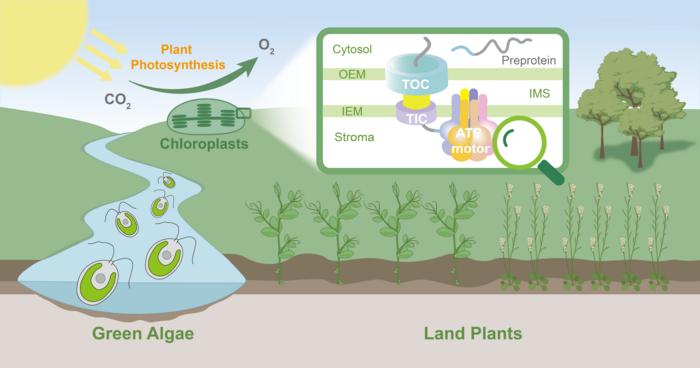
Two groundbreaking studies published in the journal Cell shed light on the assembly, function and evolutionary diversity of the chloroplast protein import system.

Credit: Designed and generated by the Zhen Yan Lab
Two groundbreaking studies published in the journal Cell shed light on the assembly, function and evolutionary diversity of the chloroplast protein import system.
Chloroplasts are fundamental organelles in plant cells that act as the primary site of photosynthesis to sustain life on Earth. Although chloroplasts have their own genome, most of their proteins are encoded in the nucleus and synthesized as preproteins in the cytosol. These preproteins are subsequently transported across the outer and inner envelope membranes of the chloroplasts. The translocon machineries, known as the TOC (translocon at the outer chloroplast membrane) and TIC (translocon at the inner chloroplast membrane) complexes, provide the route for preprotein translocation, while energy derived from ATP hydrolysis is required for this process. An ATPase import motor is believed to provide the pulling force from the stromal side to drive the translocation of preproteins, which is essential for the development and biogenesis of chloroplasts. Despite the fundamental role of the chloroplast import motor, its molecular composition and mode of action remain elusive.
Recently, the Zhen Yan Lab at Westlake University published a study in Cell titled “Structural Insights Into the Chloroplast Protein Import in Land Plants.” The researchers purified the native Ycf2-FtsHi complex and the TIC complex from Arabidopsis thaliana and determined their high-resolution cryo-EM structures. They also determined the cryo-EM structure of a translocation intermediate ultracomplex isolated from Pisum sativum at a moderate resolution. Together, these structures provide compelling evidence for the cooperation between the two complexes and offer a valuable look into the translocation mechanism of chloroplast preproteins in land plants.
In the same issue of Cell, the Zhen Yan Lab also published a related study titled “Conservation and Specialization of the Ycf2-FtsHi Chloroplast Protein Import Motor in Green Algae.” The researchers isolated the native Ycf2-FtsHi complex from Chlamydomonas and determined its high-resolution cryogenic electron microscopy structures in apo and ATP/AMPPNP bound states. These structures offer detailed insights into the composition and assembly of the Ycf2-FtsHi complex in green algae. By comparing these findings with those of the Ycf2-FtsHi complex from land plants, this study further illuminates the conservation and specialization of the Ycf2-FtsHi complex across species during evolution.
The two articles contribute to a comprehensive understanding of the conservation, diversity, evolution, and working model of the chloroplast protein import Ycf2-FtsHi complexes. Mastering the structure and mechanism of the chloroplast protein import system is like obtaining the key to unlock the chloroplast gate. This breakthrough may allow humans to regulate the efficiency of the chloroplast gate for faster passage or to adjust its structure to only permit specific proteins to pass through, thereby optimizing photosynthesis. This, in turn, could significantly increase the yield of food crops per unit area and greatly enhance the carbon sequestration capacity of plants. Such progress may help address the challenge of food shortages, accelerate the achievement of carbon neutrality goals, and pave the way for a sustainable future for the Earth.
The Zhen Yan Lab, led by Dr. Zhen Yan, employs a multidisciplinary approach, including biochemistry, gene editing, bioinformatics, single-particle cryo-electron microscopy, artificial intelligence modeling, and in situ cryo-electron tomography. Their research focuses on unraveling the workings of important protein complexes, with a particular emphasis on chloroplast development, regulation, and homeostasis.
Dr. Yan and her team welcome researchers, postdoctoral fellows, research assistants, and undergraduate or master’s students with relevant backgrounds to join the lab. They offer personalized training programs tailored to each member’s professional aspirations, nurturing the next generation of scientific elites.
Journal
Cell
Method of Research
Experimental study
Subject of Research
Not applicable
Article Title
Structural Insights Into the Chloroplast Protein Import in Land Plants
Article Publication Date
27-Aug-2024
Cite Scienmag News
Drew Townsend. (August 27, 2024). Groundbreaking studies provide key insights into chloroplasts protein import motor. Scienmag. https://scienmag.com/groundbreaking-studies-provide-key-insights-into-chloroplasts-protein-import-motor/
Drew Townsend. "Groundbreaking studies provide key insights into chloroplasts protein import motor." Scienmag, 27 August 2024, https://scienmag.com/groundbreaking-studies-provide-key-insights-into-chloroplasts-protein-import-motor/. Accessed 3 September 2026.
Drew Townsend. "Groundbreaking studies provide key insights into chloroplasts protein import motor." Scienmag. August 27, 2024. https://scienmag.com/groundbreaking-studies-provide-key-insights-into-chloroplasts-protein-import-motor/

