

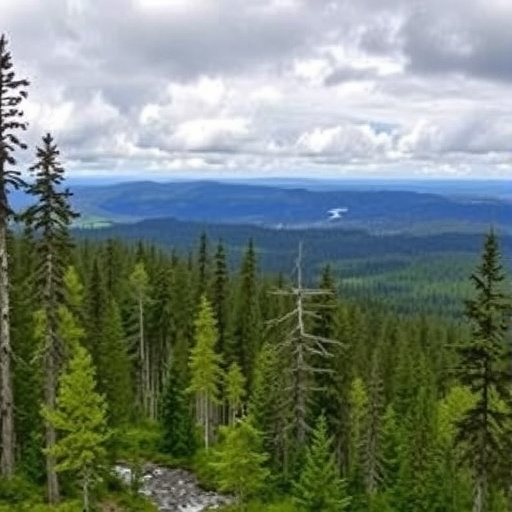
The boreal forests of the northern hemisphere are vital carbon reservoirs, sequestering vast amounts of carbon dioxide within their towering spruce and pine trees, as well as the soils layered beneath their dense canopies. These ecosystems play a crucial role in regulating global climate dynamics by locking away greenhouse gases that would otherwise accelerate climate change. However, a groundbreaking new study led by researchers from Lund University and Stanford University reveals that industrial forestry practices, particularly clear-cutting and soil disruption, are critically undermining the carbon storage capacity of these northern woodlands. This research, published in the journal Science, presents the first comprehensive quantification of carbon across old-growth and managed boreal forests in Sweden, exposing alarming differences in carbon stocks that carry profound implications for forest management and climate policy worldwide.
The research team undertook an extensive empirical campaign in Sweden, combining detailed field measurements from over 200 forest plots with historical national forest and soil carbon inventory datasets spanning several decades. This integrative approach allowed for precise estimations of carbon stocks not only in the biomass of live trees and dead wood but also in the often-overlooked soil layers as well as in harvested wood products such as bioenergy materials, pulp, and timber. Their analysis demonstrated that intact old-growth forests retain approximately 72% more carbon per acre than the secondary forests commonly managed through industrial silviculture. Notably, this figure includes carbon accounted for in harvested wood products; excluding these products enhances the carbon storage differential to an astonishing 83% per acre advantage in primary forests.
Such a significant discrepancy starkly contrasts with prior official assessments, which have substantially underestimated the carbon sequestration gap between primary and managed forest ecosystems. To contextualize the magnitude, restoring Sweden’s managed forests to emulate the carbon storage of primary forests could avoid the release of nearly eight billion metric tons of CO₂, mirroring the cumulative fossil fuel emissions of Sweden over the last two centuries. This revelation positions boreal forest conservation as a linchpin in climate mitigation strategies, offering potential benefits that dwarf current national emission reduction targets. Crucially, these findings challenge prevailing assumptions that managed forest plantations reliably substitute for natural old-growth stands in climate models and carbon accounting frameworks.
Among the most startling outcomes of this work is the discovery that forest soils are the dominant carbon reservoirs within boreal woodlands—a fact that has received inadequate attention until now. The researchers found that in undisturbed primary forests, roughly two-thirds of the total ecosystem carbon resides within the upper meter of soil, whereas live tree biomass accounts for about one-third and dead wood a mere fraction. This soil carbon is intricately linked to microbial communities, root networks, and complex organic matter stabilization processes that can be drastically disturbed by mechanical soil disruption typical of industrial forestry. Practices such as scarification, plowing, and drainage ditch construction dramatically degrade soil structure and diminish its carbon sequestration functions, leading to persistent losses that forest regeneration alone cannot readily offset.
Sweden’s boreal forests have experienced an alarming reduction of unprotected old-growth areas at a rate of approximately 1.4% annually between 2003 and 2019. This deforestation pace is approximately six times higher than that observed in the Amazon’s primary rainforest, underscoring the urgency to address forest conservation in temperate and boreal zones, which traditionally receive less global attention than tropical regions. The difficulty lies in monitoring these forest changes using satellite remote sensing, as managed and old-growth boreal stands often consist of the same native tree species, rendering visible distinctions minimal from aerial perspectives. This obscurity has impeded effective policy responses and conservation efforts based on accurate deforestation data in these northern ecosystems.
The persistence of logging in Sweden’s remaining primary forests signifies ongoing risks to their ecological integrity and climate function. According to the study’s senior author Rob Jackson, Professor of Earth System Science at Stanford, the loss of soil carbon caused by industrial forestry is both substantial and enduring. The research indicates that safeguarding the limited remnants of primary forests is imperative not only for climate mitigation but also for preserving biodiversity and ecosystem resilience. Furthermore, the restoration of degraded forest lands offers a promising avenue for enhancing carbon storage and ecosystem services but requires a nuanced understanding of the specific management techniques that influence soil carbon dynamics.
This study also interrogates the assumptions embedded in many climate-scenario models which assume a net benefit from bioenergy production sourced from northern forests. If, as the data suggests, managed plantations store less than half the carbon of the old-growth forests they replace, the projected climate benefits from substituting fossil fuels with biomass energy may be substantially overstated, especially given boreal forests’ slow growth rates. This realization calls for a recalibration of climate policies and renewable energy strategies that rely heavily on forest bioenergy, promoting greater emphasis on conservation and improved silvicultural practices instead.
Lead author Didac Pascual, a postdoctoral scholar at Lund University, emphasized the surprising magnitude of soil carbon differences, noting that primary forest soils alone store more carbon than the combined pool of trees, dead wood, and soils in managed forests. This underscores the complexity of belowground carbon processes and signals the need to integrate soil health as a priority in forest management and climate mitigation frameworks. Addressing this challenge requires collaborative research spanning ecology, microbiology, and forestry science.
Looking ahead, the study’s authors aim to dissect the mechanisms underpinning high soil carbon storage in primary boreal forests. Collaborating with Stanford biologist Kabir Peay, the team is exploring the role of diverse microbial communities, including fungi and bacteria within tree roots and soil matrices, in enhancing carbon sequestration. They hypothesize that unique microbial assemblages in old-growth forests contribute to soil carbon stabilization, and understanding these relationships could unlock biotechnological solutions to accelerate carbon accumulation in managed forest soils. Such insights would enable a faster transition to carbon-rich forest ecosystems without waiting centuries for natural old-growth conditions to develop.
Professor Kabir Peay highlighted the transformative potential of this microbial approach, stating that harnessing soil microbes may revolutionize forest restoration by enabling enhanced carbon sequestration and ecosystem resilience. This avenue of research offers innovative strategies to reconcile timber production with climate goals, emphasizing synergistic interactions between soil biology and forest management practices. It points toward a future where microbial ecology becomes a cornerstone of sustainable forestry.
The broader implications of this research resonate beyond Sweden and boreal regions, extending to global efforts to meet ambitious climate targets. As northern forests represent one-third of the world’s forested land area, integrating these findings into international forest conservation policies is critical. The results advocate for prioritizing the protection and restoration of primary forests to maximize carbon sequestration and biodiversity preservation. They also underscore a pressing need to revise carbon accounting methodologies to incorporate soil carbon losses induced by contemporary forestry practices.
This landmark study ultimately redefines our understanding of boreal forest carbon dynamics, spotlighting the profound, previously underestimated role of soils and microbial life in climate regulation. By revealing the persistent and substantial carbon deficits caused by industrial forestry, it challenges policymakers, conservationists, and land managers to rethink conventional approaches. The future of boreal forests, and their capacity to mitigate climate change, hinges on embracing innovative, multidisciplinary strategies that honor the complex, living systems beneath the forest floor.
Subject of Research: Carbon storage capacity in primary versus managed boreal forests in Sweden, with a focus on soil carbon dynamics and the impacts of industrial forestry on carbon sequestration.
Article Title: Higher carbon storage in primary than in secondary boreal forests in Sweden
News Publication Date: 19-Mar-2026
Web References:
- https://doi.org/10.1126/science.adz8554
- https://sustainability-accelerator.stanford.edu/project/hidden-sink-old-growth-fungi-carbon-solution
- https://news.stanford.edu/stories/2024/10/tapping-into-the-fungal-network
- http://woods.stanford.edu
- http://energy.stanford.edu
- http://sustainability.stanford.edu
References:
Jackson et al., “Higher carbon storage in primary than in secondary boreal forests in Sweden,” Science, 2026. DOI: 10.1126/science.adz8554.
Image Credits: Philippe Roberge
Keywords: Boreal forests, carbon storage, soil carbon, old-growth forests, forest management, industrial logging, climate change mitigation, microbial ecology, Sweden, forest conservation, carbon sequestration, bioenergy


