


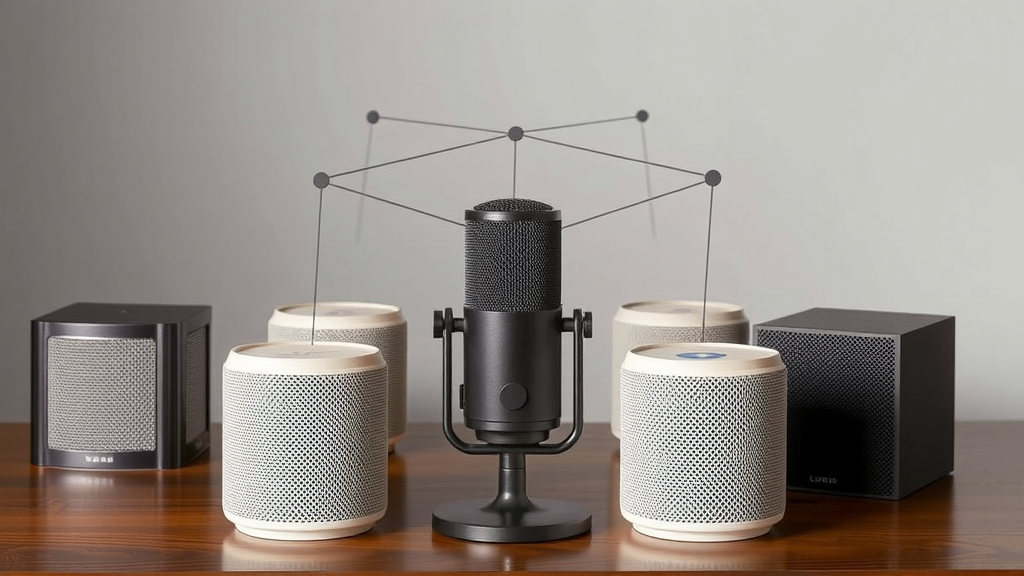
Speaker verification, the technology that decides whether a voice belongs to a claimed identity, has quietly become one of the most important building blocks of modern life. It unlocks smartphones, guards bank accounts, and wakes up smart home hubs. Yet the technology has a persistent weakness: it works brilliantly when a microphone is close to the speaker’s mouth, and it falters badly when the voice must travel across a noisy, reverberant room. A new study published in the open-access journal Vicinagearth by Yijiang Chen, Chengdong Liang, Xiao-Lei Zhang and colleagues at Northwestern Polytechnical University and collaborating institutions tackles this far-field problem head-on, and its solution is as elegant as it is ambitious: treat every smart device in a room as a node in a graph, and let the devices learn to collaborate.
The core difficulty is physics. When a person speaks from across a room, the sound that reaches a distant microphone is attenuated, smeared by echoes bouncing off walls and furniture, and buried under background noise from fans, traffic, or televisions. Early speaker verification systems, dating back to the 1960s, relied on statistical models such as Gaussian mixture models with universal background models and later i-vectors. The deep learning era brought neural embeddings like x-vectors that dramatically improved accuracy, but the fundamental problem remained: a single distant microphone simply does not capture enough of the speaker’s characteristic vocal signature. Previous remedies included deep-learning speech enhancement front-ends that attempt to strip noise before verification, and domain adaptation techniques that treat noisy speech as a shifted version of clean speech. These help, but they leave a crucial resource untapped: spatial information.
Multi-channel approaches try to recover that spatial information by combining signals from several microphones. Fixed microphone arrays, the kind built into dedicated hardware, can apply beamforming algorithms that steer acoustic sensitivity toward the speaker. Researchers have combined neural beamforming with verification back-ends, fed multi-channel signals directly into convolutional networks, and encoded direction-of-arrival estimates into spatially aware speaker vectors. But fixed arrays have small apertures and fixed geometries. When the speaker is far away or moves around, even these sophisticated systems struggle. The truly interesting opportunity, the authors argue, lies in the devices people already own: smart speakers, phones, tablets, and other internet-connected gadgets scattered around a home or office, each with its own microphone.
This is the concept of the ad-hoc microphone array. Instead of a rigid cluster of microphones, an ad-hoc array is a loose federation of independently placed devices, each acting as an intelligent edge endpoint that can process audio locally. The architecture aligns with AI Flow, a decentralized artificial intelligence paradigm in which intelligent agents distributed across edge devices cooperate through coordinated computation and communication rather than shipping everything to a central server. The catch is that in an ad-hoc array, nobody controls where the devices sit. Some will be close to the speaker and capture clean audio; others will be far away, tucked behind furniture, or near a noise source, and their signals may actively harm the system. Earlier work on ad-hoc speaker verification used attention mechanisms to reweight all channels, but the new study makes a sharper observation: channels that are too noisy should not merely be down-weighted, they should be discarded.
The team’s framework, called a spatial-temporal graph attention network, or ST-GAT, reformulates the entire multi-channel problem as learning on a graph. In graph neural networks, data points become nodes and relationships between them become edges, described by an adjacency matrix. What makes this paper unusual is its treatment of time. Existing graph-based approaches to multi-channel audio modeled only the relationships between microphones, ignoring how information flows between successive time frames. The authors instead make each frame of each channel a node in a single static graph, so that both the spatial relationships between microphones and the temporal relationships between frames are captured in one structure. To their knowledge, this is the first time spatial-temporal data has been formulated as a static graph learning problem, a choice that is simpler, requires fewer parameters, and trains with standard graph neural network machinery.
There is a practical obstacle: the full adjacency matrix would be enormous. A ten-second recording from forty microphones, analyzed in ten-millisecond frames, produces a graph with forty thousand nodes and an adjacency matrix of forty thousand by forty thousand. The authors sidestep this by decomposing the aggregation into two successive modules. A temporal module builds a graph over the frames of each individual channel, and a spatial module builds a graph over the channels at each frame. They implemented the aggregation in two ways: a self-attention mechanism that uses the adjacency matrix as a mask over attention scores, and a true graph attention network in which each node attends to its neighbors using its own representation as the query. Both use multi-head attention, and the blocks are stacked to deepen the model.
The second innovation is a graph-based channel selection block that exploits prior knowledge during training. When the training data includes labeled positions of microphones, speakers, and noise sources, the authors construct an auxiliary adjacency matrix that connects only the most useful channels, for example the microphones closest to the speaker, or those with the best signal-to-noise ratio, while masking out nodes near a noise source or behind the speaker’s head. Crucially, this selection happens only during training. At test time, when the layout of devices and speakers is unknown, the network applies a fully connected graph and autonomously decides which channels to trust, because the attention parameters have learned the selection rule through backpropagation. The authors frame this as a form of informed machine learning, where handcrafted rules inject prior knowledge into the graph topology.
Training proceeds in two stages. First, a standard single-channel verification system, built from a residual convolutional network front-end, self-attentive pooling, and a classification layer, is trained on abundant single-channel speech. The frame-level feature extractor is then frozen, and the graph-based channel fusion modules are trained on spatial-temporal data from ad-hoc arrays. The evaluation was thorough: two simulated datasets, LibriSIMU-noise and LibriSIMU-reverb, generated with random room dimensions, reverberation times up to 1.2 seconds, and signal-to-noise ratios down to minus five decibels, plus two real-world corpora, Libri-adhoc40, a forty-node replayed array recorded in a highly reverberant office, and Hi-mia, a far-field text-dependent smart home dataset. Six representative baselines were compared, including oracle selection of the closest microphone, classical beamforming, energy-envelope channel selection, and attention-based multi-channel aggregation methods.
The results are striking. On the simulated datasets, the best proposed variant achieved a relative reduction in equal error rate of 15.39 percent compared with the strongest reference method, and on the real-world data the reduction reached 17.70 percent. Ablation studies showed that the auxiliary adjacency matrix brought especially large gains when combined with the ST-GAT backbone, cutting the error rate by roughly 15.65 percent relative on noisy simulated data and about 18.94 percent relative on the real Libri-adhoc40 corpus in the eight-channel scenario. The system remained robust across signal-to-noise ratios from minus five to twenty decibels and reverberation times up to 1.2 seconds, and it transferred to a different verification architecture, ECAPA-TDNN, with a further relative improvement of 12.3 percent over the best baseline. Analysis of the learned attention weights confirmed the mechanism: when trained with the distance-based or SNR-based auxiliary matrix, the channels receiving the highest attention weights were consistently the microphones physically closest to the speaker.
The implications reach well beyond the laboratory. As homes and offices fill with voice-capable edge devices, the ability to fuse their microphones into a virtual array, without centralizing raw audio and without knowing where the devices sit, points toward privacy-preserving, robust voice interfaces that work as well from across the room as they do at arm’s length. The authors are candid about open questions, notably that the adjacency matrix design improves the graph attention mechanism but not the plain self-attention variant, and they envision future extensions using signal-to-interference ratios for multi-speaker scenes and estimated SNR when distances are unknown. For now, the study demonstrates a compelling principle: when microphones learn to collaborate as a graph, the sum of many imperfect ears becomes a remarkably sharp listener.
Subject of Research: Far-field speaker verification using spatial-temporal graph attention networks with ad-hoc microphone arrays
Article Title: Edge-collaborative multi-channel speaker verification via spatial-temporal graph with ad-hoc microphone arrays
Article References: Chen, Y., Liang, C., Chen, S., Feng, L., Zhu, B., Zhang, C., & Zhang, X.-L. (2025). Edge-collaborative multi-channel speaker verification via spatial-temporal graph with ad-hoc microphone arrays. Vicinagearth, 2(1), Article 12. https://doi.org/10.1007/s44336-025-00023-y
Image Credits: AI Generated
DOI: 10.1007/s44336-025-00023-y
Keywords: speaker verification, ad-hoc microphone arrays, graph attention networks, far-field speech processing, edge computing, AI Flow, channel selection, spatial-temporal graph neural network, multi-channel audio, equal error rate, smart home, informed machine learning
Cite Scienmag News
Blake Davidson. (September 24, 2026). Graph Networks Turn Scattered Smart Speakers Into Powerful Microphone Arrays. Scienmag. https://scienmag.com/graph-networks-turn-scattered-smart-speakers-into-powerful-microphone-arrays/
Blake Davidson. "Graph Networks Turn Scattered Smart Speakers Into Powerful Microphone Arrays." Scienmag, 24 September 2026, https://scienmag.com/graph-networks-turn-scattered-smart-speakers-into-powerful-microphone-arrays/. Accessed 4 October 2026.
Blake Davidson. "Graph Networks Turn Scattered Smart Speakers Into Powerful Microphone Arrays." Scienmag. September 24, 2026. https://scienmag.com/graph-networks-turn-scattered-smart-speakers-into-powerful-microphone-arrays/


