


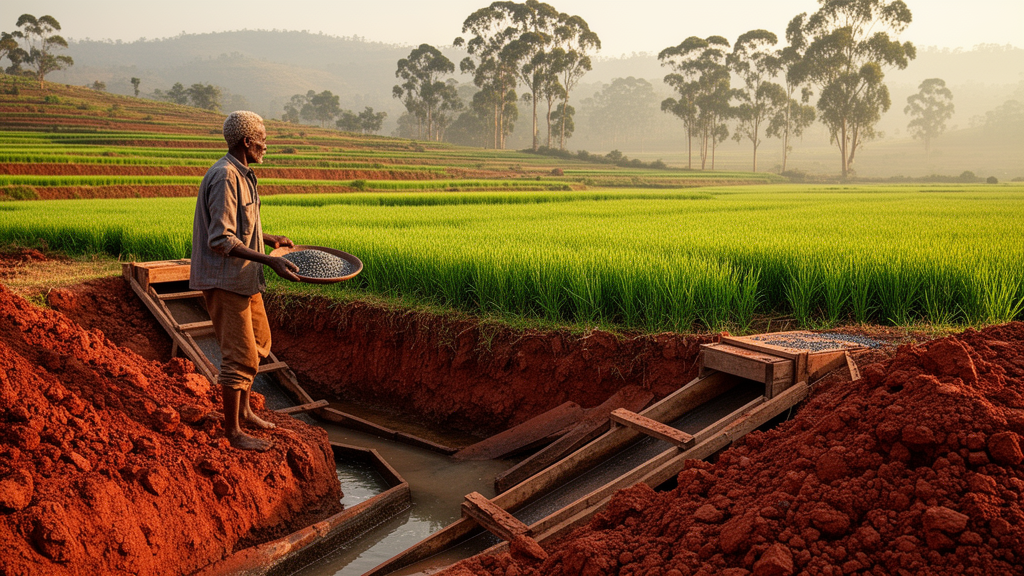
In the rural districts of Ethiopia’s Guji Zone, the glint of gold in the soil has become both a lifeline and a warning. A new study published in SN Social Sciences examines how artisanal gold mining shapes the livelihoods of rural households in this part of southern Oromia, and it arrives at a conclusion that is more nuanced than the usual boom-or-bust framing. Mining, the researchers find, genuinely lifts household incomes in communities where farming alone rarely provides enough. Yet the benefits are being blunted by unsafe working conditions, thin training programs, and a deep well of distrust between miners and the government agencies meant to support them. The research, led by Dawit Udessa Gede of Bule Hora University together with Daniel Hidi and Debela Udessa Gede, offers one of the most detailed household-level portraits yet of how informal gold digging interacts with state policy in Ethiopia’s mining heartlands.
The team employed a mixed-methods design that combined a cross-sectional survey with qualitative narratives from participants. Of 384 questionnaires distributed across selected districts of the Guji Zone, 337 were completed and returned, an 88 percent response rate that is unusually strong for household surveys in rural settings and lends considerable statistical weight to the findings. The quantitative strand measured how mining participation related to household income and broader livelihood outcomes, while the qualitative strand captured miners’ own accounts of working conditions, safety, and their dealings with officials. This dual approach matters because income figures alone can mask the fragility of a livelihood that depends on unregulated pits, rudimentary tools, and daily exposure to physical hazard.
The headline economic result is unambiguous: artisanal gold mining significantly enhances household income. For many families in the study area, income from gold provides essential economic support that subsistence agriculture cannot match on its own. This aligns with a growing body of evidence from across sub-Saharan Africa, where artisanal and small-scale mining, often abbreviated as ASM, employs millions of people directly and indirectly. Studies in Ghana, Tanzania, and Sierra Leone have documented similar patterns, with mining income smoothing consumption, funding school fees, and buffering households against crop failures and price shocks. In the Guji Zone, where gold has long been dug by hand alongside farming, the researchers found that the two livelihoods are not simply competitors but interwoven strands of household survival strategy.
But the qualitative narratives reveal the costs that income statistics conceal. Participants described persistent safety concerns in the pits and processing sites, a lack of adequate training in both mining technique and financial management, and a striking absence of trust in government support institutions. Occupational injury is a documented hazard in Ethiopian artisanal mining; prior research cited in the study records high rates of nonfatal injuries among small-scale gold workers, including in the Oddo Shakiso district of the Guji Zone itself. Without formal safety standards, protective equipment, or emergency response systems, miners absorb the physical risk of extracting a commodity whose price is set on global markets far beyond their control.
The study’s most distinctive contribution lies in its treatment of government policy as a moderating variable rather than a background condition. The researchers explicitly tested whether policy interventions altered the relationship between mining and household livelihood outcomes. They did, but not always in the way policymakers might hope. Government policies were shown to affect the socio-economic impact of artisanal gold mining, yet they tend to prioritize regulation over direct economic assistance. In other words, the state’s presence is felt chiefly through rules, permits, and oversight rather than through training programs, credit, safety infrastructure, or market support that would strengthen miners’ economic position. Regulation without accompaniment, the findings suggest, moderates livelihood outcomes in ways that can diminish rather than amplify the benefits of mining.
This regulatory emphasis has deep roots in the governance literature. The study draws on institutional frameworks associated with scholars such as Elinor Ostrom, whose work on governing the commons emphasized that resource outcomes depend on institutions that users perceive as legitimate and fair. Trust, as the Guji Zone data make plain, is not a soft variable. When miners distrust the agencies that license and inspect them, they are less likely to adopt safer practices, report hazards, or participate in formalization schemes. Research on knowledge exchange in environmental science and policy has repeatedly shown that trust is a precondition for effective cooperation between communities and authorities. The Ethiopian findings extend that insight into the everyday economics of gold digging.
The Guji Zone case also sits within a broader continental debate about whether artisanal mining is a poverty trap or a development springboard. In Ghana, studies of mining communities have traced how gold digging reshapes rural livelihood trajectories, sometimes pulling labor away from farming and sometimes complementing it through cash income that funds agricultural inputs. Comparable work in Tanzania has examined state-led efforts to reduce the environmental footprint of small-scale mining and their implications for the Sustainable Development Goals. The Ethiopian study contributes an important moderating lens to this literature: the same mining activity can produce different livelihood outcomes depending on the policy environment that surrounds it. That makes policy design not an afterthought but a central determinant of whether gold helps or harms rural households.
The researchers’ recommendations follow directly from their evidence. First, they call for balanced policies that ensure miners’ safety while promoting sustainable economic growth, a formulation that implicitly criticizes the current tilt toward regulation alone. Second, they urge increased investment in community training initiatives, which would address both the technical deficits that contribute to accidents and the financial skills needed to convert mining income into durable household assets. Third, they recommend enhanced stakeholder engagement in the policymaking process so that local needs, as articulated by miners themselves, are reflected in the rules that govern them. Each recommendation targets one of the three deficits the qualitative data exposed: safety, training, and trust.
What makes these findings resonate beyond Ethiopia is the sheer scale of the phenomenon they describe. Artisanal and small-scale gold mining is one of the fastest-growing rural livelihoods in the Global South, driven by rising gold prices, population growth, and the erratic returns of rain-fed agriculture. It is also a sector under intensifying scrutiny for its environmental impacts, including mercury use and land degradation, and for its labor conditions. The Guji Zone study suggests that the lever for improvement is not simply stricter enforcement, which risks pushing miners further underground, but a reconfigured relationship between the state and mining households in which assistance, safety investment, and genuine consultation precede or accompany regulation. The alternative, the data imply, is a sector that generates income while quietly eroding the human capital and institutional trust needed to sustain it.
The study, which received ethical approval from the Bule Hora University Institutional Research Review Committee and was conducted with informed consent from all adult participants, was published as volume 6, article 366 of SN Social Sciences. Its authors span three disciplines at Bule Hora University, management, water resources engineering, and natural resource management, a combination that reflects the inherently multidisciplinary character of the problem. For the farming households of the Guji Zone, the message of the research is double-edged. Gold is real income, and for many families it is indispensable. But without safer pits, better training, and policies built with miners rather than merely imposed upon them, the yellow metal will continue to deliver its benefits at a discount, paid for in risk, insecurity, and foregone opportunity.
Subject of Research: The impact of artisanal gold mining on rural household livelihoods in Ethiopia and the moderating role of government policy
Article Title: Impact of an artisanal gold mining on rural household livelihoods in selected districts of the Guji Zone: the moderating effect of government policy interventions
Article References: Impact of an artisanal gold mining on rural household livelihoods in selected districts of the Guji Zone: the moderating effect of government policy interventions. (n.d.). https://doi.org/10.1007/s43545-026-01663-7
Image Credits: AI Generated
DOI: 10.1007/s43545-026-01663-7
Keywords: artisanal gold mining, Ethiopia, Guji Zone, rural livelihoods, household income, government policy, mining safety, occupational injuries, rural development, sub-Saharan Africa, livelihood framework, policy intervention
Cite Scienmag News
Alan Morgan. (October 16, 2026). Gold Rush on the Farm: Ethiopian Study Weighs Mining’s Promise Against Policy Gaps. Scienmag. https://scienmag.com/gold-rush-on-the-farm-ethiopian-study-weighs-minings-promise-against-policy-gaps/
Alan Morgan. "Gold Rush on the Farm: Ethiopian Study Weighs Mining’s Promise Against Policy Gaps." Scienmag, 16 October 2026, https://scienmag.com/gold-rush-on-the-farm-ethiopian-study-weighs-minings-promise-against-policy-gaps/. Accessed 16 October 2026.
Alan Morgan. "Gold Rush on the Farm: Ethiopian Study Weighs Mining’s Promise Against Policy Gaps." Scienmag. October 16, 2026. https://scienmag.com/gold-rush-on-the-farm-ethiopian-study-weighs-minings-promise-against-policy-gaps/


