Gold dissolves famously well in aqua regia, the corrosive three-to-one volume mixture of concentrated hydrochloric and nitric acid commonly used to dissolve the noble metal. That same acid is also the standard route for pulling gold out of discarded electronics, but it comes with a heavy environmental price: the dissolution process releases toxic chlorine gas, and strong acids of this kind contribute to the industrial acid burden linked to acid rain.
Writing in the open-access journal Gold Bulletin, Miku Yoshizawa, Chihiro Suda, Yuika Mori, Masaki Ueda, Kei Aoshika, Kei Oya and Tomohide Takami describe a bipolar alternating-current electrolysis method that converts gold metal from electronic waste directly into chloroauric acid, HAuCl4, without any strong acid. Chloroauric acid is itself a valuable compound, widely used as the starting material for producing gold nanoparticles, and the researchers demonstrated that the acid-free product could indeed be turned into gold particles using the classic citric-acid-based Turkevich synthesis.
The motivation is easy to quantify. The authors note that recycling one ton of mobile phones could yield on average 0.34 kilograms of gold, a concentration far beyond anything Fritz Haber could find in seawater when the German government asked him, unsuccessfully, to extract gold from the ocean to pay war reparations; seawater holds only about 65 milligrams of gold per cubic meter. Meanwhile, the global e-waste management market volume was estimated at 69.1 million metric tons in 2024 and is projected to grow at a compound annual growth rate of 6.7 percent from 2025 to 2030, making cleaner extraction chemistry increasingly relevant.
The new work builds on the team’s earlier finding that alternating current can dissolve gold in potassium chloride solution. The reason AC matters lies in what happens under direct current: DC electrolysis coats the anode with an insulating black substance called gold black, a one-to-one mixture of gold(I) chloride and gold(III) chloride with the formula Au4Cl8, which interrupts the electrolysis. Alternating current avoids this passivation, allowing the dissolution to continue.
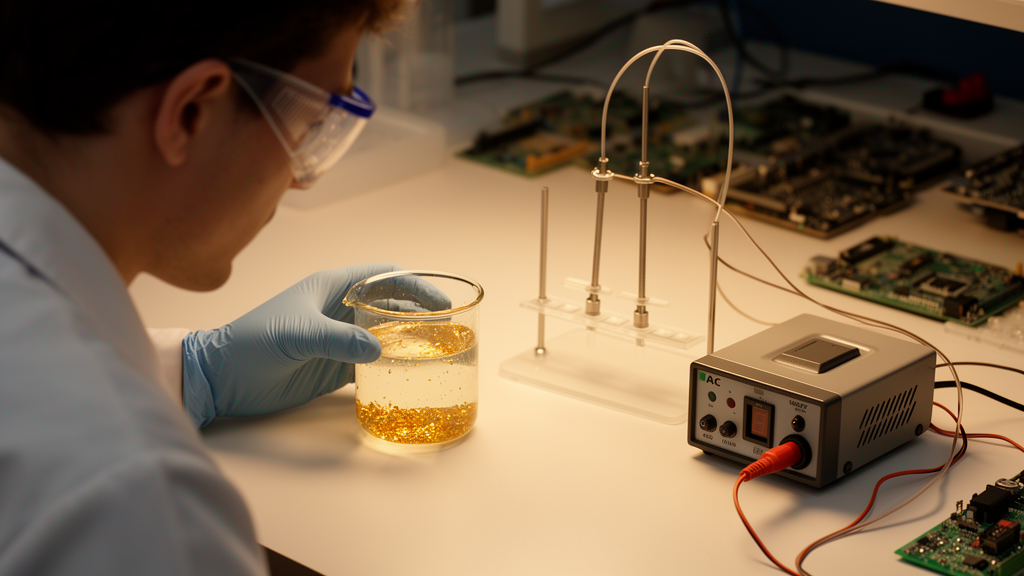
The bipolar arrangement adds a second layer of ingenuity. A bipolar electrode is an electrically conductive material that drives electrochemical reactions at its poles without any direct ohmic contact. When sufficient voltage is applied across an electrolyte in which such an electrode is immersed, the potential difference between the electrode and the solution drives oxidation and reduction reactions on its surfaces. Because no wired connection is needed, large arrays of electrodes can be controlled with a single power supply, and the researchers placed their gold-containing waste samples between two carbon plate electrodes rather than attaching them to wires.
Thermodynamic calculations set the operating conditions. From standard Gibbs energies of formation, the team estimated a minimum potential of 7.31 volts for forming chloroauric acid versus only 1.29 volts for forming gold black, and after accounting for overpotential they concluded that more than 9 volts had to reach the gold-containing sample to favor the desired product. They therefore applied 70 volts of alternating current, amplified from a 200-hertz sinusoidal wave, across the bipolar carbon electrodes immersed in 1 molar KCl solution.
Frequency proved decisive. Using gold electrodes, the team found that below 150 hertz the product was a yellow paste, while above 300 hertz black Au4Cl8 powder formed, indicating the sample potential was insufficient for chloroauric acid. Above 500 hertz the polarity flipped too quickly for electrolysis to occur at all, and nothing was produced. The optimum, delivering the HAuCl4 solution without the paste, was 200 hertz, which the team adopted for the study. They also confirmed that hypochlorous acid, not chlorine gas, formed at the anode, verifying its presence with a test paper based on the SAT-3 method.
The results with real samples were encouraging but modest. From a test sample of gold wire, ultraviolet-visible spectroscopy calibrated against a standard chloroauric acid solution showed a 57.3 percent recovery rate, with losses attributed to adsorption on the carbon electrodes, incomplete reduction, by-product formation, physical losses during recovery and unoptimized conditions. The amount of gold recovered from actual electronic waste, including gold-coated crimp terminals, silicon wafers and a printed circuit board, was too minute to estimate a recovery rate numerically. Fluorescent X-ray spectroscopy confirmed gold in the extracted solutions, but for the circuit board the spectra also showed copper, nickel, iron and bromine peaks, and the authors suggest heat decomposition with bromine adsorption as a possible future separation step.
Remarkably, the electrolyte does not even need to be laboratory-grade salt solution. The team showed the process works in filtered seawater from Tokyo Bay, roughly 3 percent sodium chloride, with the only required treatment being to keep the pH below 7; otherwise white magnesium hydroxide precipitate forms and floats on the solution. Adding sodium borohydride to the produced chloroauric acid solution turned it into a black precipitate that settled within 30 minutes, yielding 10.1 milligrams of collected solid in that demonstration.
The authors are candid about the limits. With their bipolar power supply capped at 70 volts and 900 watts, they could not always apply sufficient potential to the samples, and the process was limited to dissolving approximately 0.1 grams of gold from 1 gram in 10 minutes. Scaling up to industrially meaningful quantities, they write, will require higher voltage and power, and they plan to modify the setup to run on ordinary alternating-current mains at 50 or 60 hertz and 100 volts root-mean-square, with salt water as the electrolyte. If that works, the prospect of recovering gold from the growing mountain of electronic waste using nothing more hazardous than salty water would move a step closer to practice.
Subject of Research: Acid-free production of chloroauric acid from electronic waste by bipolar AC electrolysis in salt solution
Article Title: Production of chloroauric acid from electronic waste in salt solution by AC electrolysis
Article References: Yoshizawa, M., Suda, C., Mori, Y., Ueda, M., Aoshika, K., Oya, K., & Takami, T. (2025). Production of chloroauric acid from electronic waste in salt solution by AC electrolysis. Gold Bulletin, 58(1), Article 5. https://doi.org/10.1007/s13404-025-00358-w
Image Credits: AI Generated
DOI: 10.1007/s13404-025-00358-w
Keywords: electronic waste, gold recycling, chloroauric acid, AC electrolysis, bipolar electrochemistry, potassium chloride, aqua regia alternative, gold nanoparticles, seawater electrolyte, green chemistry, hydrometallurgy, gold black
Cite Scienmag News
Bethany Barker. (October 30, 2026). Gold Recovered from Electronic Waste Using Only Salt Water and AC Electrolysis. Scienmag. https://scienmag.com/gold-recovered-from-electronic-waste-using-only-salt-water-and-ac-electrolysis/
Bethany Barker. "Gold Recovered from Electronic Waste Using Only Salt Water and AC Electrolysis." Scienmag, 30 October 2026, https://scienmag.com/gold-recovered-from-electronic-waste-using-only-salt-water-and-ac-electrolysis/. Accessed 4 November 2026.
Bethany Barker. "Gold Recovered from Electronic Waste Using Only Salt Water and AC Electrolysis." Scienmag. October 30, 2026. https://scienmag.com/gold-recovered-from-electronic-waste-using-only-salt-water-and-ac-electrolysis/