


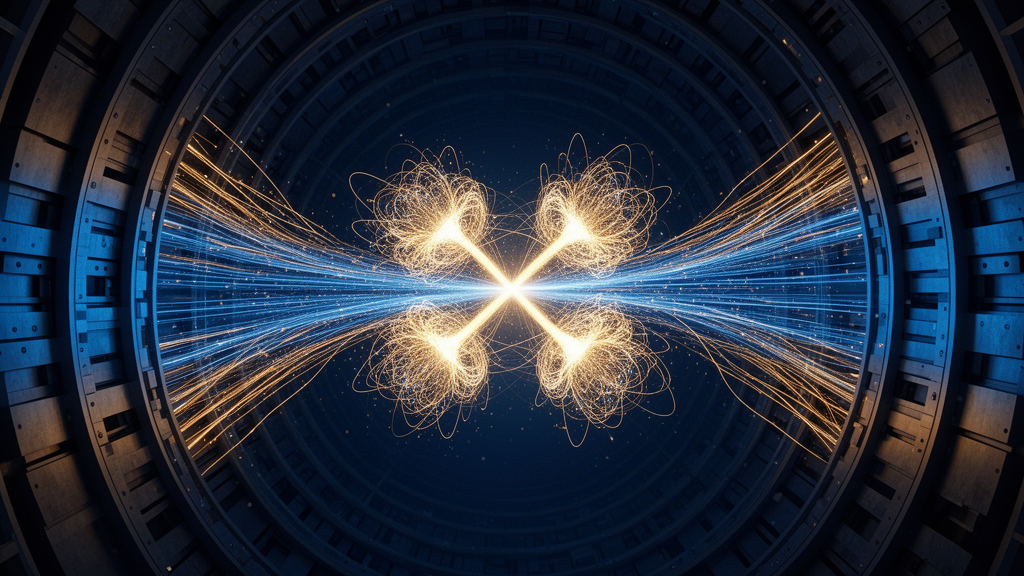
For more than half a century, physicists have taught a deceptively simple story about the proton and the neutron: nearly all of the visible mass in the universe is locked inside these nucleons, and each nucleon’s defining quantum property, its baryon number, is carried entirely by its three valence quarks, with each quark contributing one third of a unit. That picture, enshrined in the naive quark model, has survived generations of textbooks and examinations. But a growing body of high-precision experimental evidence from heavy-ion colliders is now forcing a radical revision. According to a new perspective article published in Frontiers in Physics by Jia-Yu Chen of Changzhi Medical College, the baryon number that piles up at the center of high-energy nuclear collisions cannot be explained by valence quarks alone. Instead, an exotic, purely gluonic topological structure known as the gluon junction appears to act as an independent carrier of baryon number, one that transports baryon number without carrying any net electric charge.
The experimental stage for this confrontation is the central rapidity region of high-energy nucleus-nucleus collisions. Rapidity is a kinematic variable, closely related to velocity, that describes how fast a produced particle moves along the beam direction; the central region corresponds to particles emerging roughly perpendicular to the beams, where the collision debris from the two nuclei overlap most completely. When two nuclei smash into each other at energies ranging from a few gigaelectronvolts to several trillion electronvolts, the partons inside the nucleons are released into a transient fireball far hotter and denser than ordinary nuclear matter. By measuring the rapidity distributions, transverse momentum spectra and yield ratios of the resulting hadrons, physicists can reconstruct, in reverse, how baryon number was transported through the collision. The net baryon density at mid-rapidity, the difference between baryon and antibaryon densities, has therefore become the single most discriminating observable for testing competing models of baryon transport.
The story begins in the late twentieth century at the Alternating Gradient Synchrotron at Brookhaven National Laboratory and the Super Proton Synchrotron at CERN. In central gold-gold collisions at AGS energies, the net baryon number density in the central rapidity region reached two to three times the saturation density of ordinary nuclear matter, a value far above what the independent nucleon-nucleon collision superposition model predicted. Traditional nucleon cascade calculations expected most baryon number to remain in the forward and backward fragmentation regions, leaving the center comparatively empty. The anomaly, known in the field as net baryon stopping, was explained by invoking strong early-stage stopping: at low energies the colliding nucleons interact repeatedly, depositing a large share of their baryon number in the middle of the system. SPS measurements then showed that the central net baryon density stayed high as energy rose, only beginning a clear decline at around twenty gigaelectronvolts per nucleon pair, and strange hyperon yields grew markedly with collision centrality, hinting that baryon transport was already deviating from purely hadronic expectations.
When the Relativistic Heavy Ion Collider began operating in 2000, the accessible energies stretched from 7.7 to 200 gigaelectronvolts per nucleon pair, and the STAR collaboration accumulated an unprecedented data set on net baryon distributions across that range. At first, the results seemed to vindicate the valence quark transport picture: as the beam energy increased, the central net baryon density fell steadily, dropping to roughly one tenth of nuclear saturation density at the highest energies, consistent with valence quarks streaming almost unimpeded toward the forward and backward rapidities. Fitting the measured rapidity distributions required increasingly sophisticated functional forms, from single Gaussians at low energy to double-Gaussian, triple-Gaussian and even cylinder-based parametrizations at higher energies, reflecting the complex interplay of fragmentation sources and a possible distinct central source.
But as the statistical precision of the STAR measurements improved, anomalies emerged that no valence-quark-only picture could accommodate. The most striking involves the ratio of net baryon yield to net charge yield in isobar collisions, in which two nuclei with identical mass numbers but different proton numbers, such as ruthenium-96 and zirconium-96, are collided. Because the two systems differ essentially only in their total electric charge, comparing their net baryon and net charge outputs isolates the relationship between baryon number and charge transport with minimal nuclear-geometry bias. Under the naive quark model, every stopped valence quark carries both one third of a baryon number unit and a fixed fractional charge, so the ratio of stopped baryon number to stopped charge has a hard theoretical ceiling of 24. The measured value in the intermediate energy range, from about 10 to 60 gigaelectronvolts, comes out at roughly 44.16, about twice the allowed maximum. That is not a marginal discrepancy; it is a contradiction at the level of quantum numbers, implying that a substantial fraction of the stopped baryon number is carried by something that carries no electric charge at all.
A second anomaly deepens the puzzle. After correcting for the known suppression of strange particle production, the net yields of different hyperon species at mid-rapidity exhibit an almost perfect flavor blindness: the extracted exponential slope parameters for net-proton, net-lambda, net-xi and net-omega yields, drawn from RHIC Beam Energy Scan Phase-I data in gold-gold and proton-proton collisions, agree with one another within uncertainties and show essentially no dependence on beam energy. In a valence-quark transport picture, quarks of different flavors have different initial momentum distributions and different energy-loss rates in the medium, so hyperon yields of different flavors should vary distinctly with energy. The observed energy-independence instead points to a universal transport carrier that is indifferent to quark flavor.
The decisive evidence comes from the final experimental campaigns at RHIC, summarized in a 2026 STAR collaboration analysis published in Science. In addition to the isobar program, which confirmed the anomalous baryon-to-charge ratio while excluding detector and nuclear-systematic effects, the collaboration exploited the enormous electromagnetic fields generated by relativistic heavy ions to perform photo-nuclear collisions, in which an equivalent photon strikes a nucleus. Photons carry no baryon number, so every baryon in the final state must originate from the target nucleus. If valence quarks were the sole carriers, a hard photon interaction would knock valence quarks out of their nucleons, producing a strongly asymmetric net-proton rapidity distribution concentrated near the target fragmentation region. Instead, the measured distribution is remarkably flat, with a large fraction of the baryon number transported to mid-rapidity. Together with the isobar result and the flavor-blind hyperon yields, these observations form a coherent evidence chain pointing to a baryon number carrier that is chargeless, flavorless and strongly stopped in collisions, precisely the signature predicted for the gluon junction.
The gluon junction is not a new invention. Its theoretical roots reach back to non-perturbative QCD studies in the 1970s, and it envisions three gluon field lines, one attached to each valence quark, converging at a topological node inside the nucleon to form a stable Y-shaped structure. Crucially, this junction carries one full unit of baryon number while carrying no net electric charge and no net color charge, properties that arise entirely from the non-perturbative topology of the gluon field. At RHIC energies, the valence quarks retain most of the nucleon’s forward momentum and sail through the collision zone toward the beam directions, while the junction, holding only a small momentum fraction, interacts readily with the surrounding medium and is strongly decelerated. It therefore dumps its baryon number into the central region, explaining how the stopped baryon content can exceed what the stopped valence quarks could possibly supply, and why the accompanying stopped charge falls far short of naive expectations. The model also naturally accounts for the photo-nuclear results, since a photon can excite the junction out of the nucleon and carry its small momentum fraction toward mid-rapidity, and for the flavor-blind hyperon yields, since the junction contains no flavor information and can materialize quarks of any flavor during hadronization.
Chen’s synthesis organizes the full energy landscape into three regimes governed by three interrelated factors: the collision energy, the initial overlap of the colliding nuclei, and the transport properties of the baryon carriers. At low energies below roughly twenty gigaelectronvolts, valence quarks dominate the transport, junction excitation is negligible, and central net baryon densities are correspondingly high. In the intermediate regime, valence quarks become too fast to stop, junction excitation grows with the rising gluon density, and gluon junctions take over as the core carriers, producing the characteristic pattern in which the central net baryon density first falls rapidly and then flattens into a plateau. At the highest energies, including the Large Hadron Collider, most junctions have split and evolved before the collision, and the residual central baryon density is set by the tiny asymmetry of sea quark pairs produced in the initial interactions together with partially thermalized junction remnants. ALICE measurements of net-baryon cumulants and yield ratios in lead-lead collisions at 2.76 and 5.02 trillion electronvolts confirm that proton and antiproton yields are equal to within about one percent, exactly the near-vanishing net density this picture predicts.
The implications reach well beyond collider phenomenology. If baryon number can reside in a pure-gluon topological structure, then the conventional understanding of how quantum chromodynamics stores this quantum number is incomplete, and the non-perturbative sector of the theory is richer than the quark-based picture suggests. The gluon junction may also carry a substantial share of the nucleon’s spin, offering a fresh angle on the long-standing nucleon spin crisis, in which quark spins account for only a small fraction of the proton’s total angular momentum. In cosmology, the existence of a gluonic baryon carrier opens a new possibility for the origin of the matter-antimatter asymmetry of the universe: during the QCD phase transition of the early cosmos, topological gluonic interactions could in principle generate a baryon asymmetry without invoking particles or forces beyond the Standard Model. Looking forward, the Electron-Ion Collider in the United States and China’s planned EicC are designed to tomographically image the interior of the nucleon, and searches for baryon junction signatures in electron-nucleus scattering and semi-inclusive deep inelastic scattering are already being mapped out theoretically. If those experiments succeed, the humble three-quark picture that has defined the nucleon for fifty years will give way to a far stranger and more beautiful object, one whose baryon number lives partly in the topology of the gluon fields that bind it together.
Subject of Research: Baryon number transport and gluon junctions in high-energy nuclear collisions
Article Title: Central rapidity net baryon density and baryon number carriers in high-energy collisions
Article References: Chen, J.-Y. (2026). Central rapidity net baryon density and baryon number carriers in high-energy collisions. Frontiers in Physics, 14, Article 1987364. https://doi.org/10.3389/fphy.2026.1987364
Image Credits: AI Generated
DOI: 10.3389/fphy.2026.1987364
Keywords: baryon number, gluon junction, heavy-ion collisions, net baryon density, RHIC, STAR collaboration, quantum chromodynamics, valence quarks, rapidity distribution, isobar collisions, photo-nuclear collisions, quark-gluon plasma
Cite Scienmag News
Katie Riggs. (October 16, 2026). Gluon Junctions Emerge as Hidden Carriers of Baryon Number in High-Energy Collisions. Scienmag. https://scienmag.com/gluon-junctions-emerge-as-hidden-carriers-of-baryon-number-in-high-energy-collisions/
Katie Riggs. "Gluon Junctions Emerge as Hidden Carriers of Baryon Number in High-Energy Collisions." Scienmag, 16 October 2026, https://scienmag.com/gluon-junctions-emerge-as-hidden-carriers-of-baryon-number-in-high-energy-collisions/. Accessed 16 October 2026.
Katie Riggs. "Gluon Junctions Emerge as Hidden Carriers of Baryon Number in High-Energy Collisions." Scienmag. October 16, 2026. https://scienmag.com/gluon-junctions-emerge-as-hidden-carriers-of-baryon-number-in-high-energy-collisions/


