


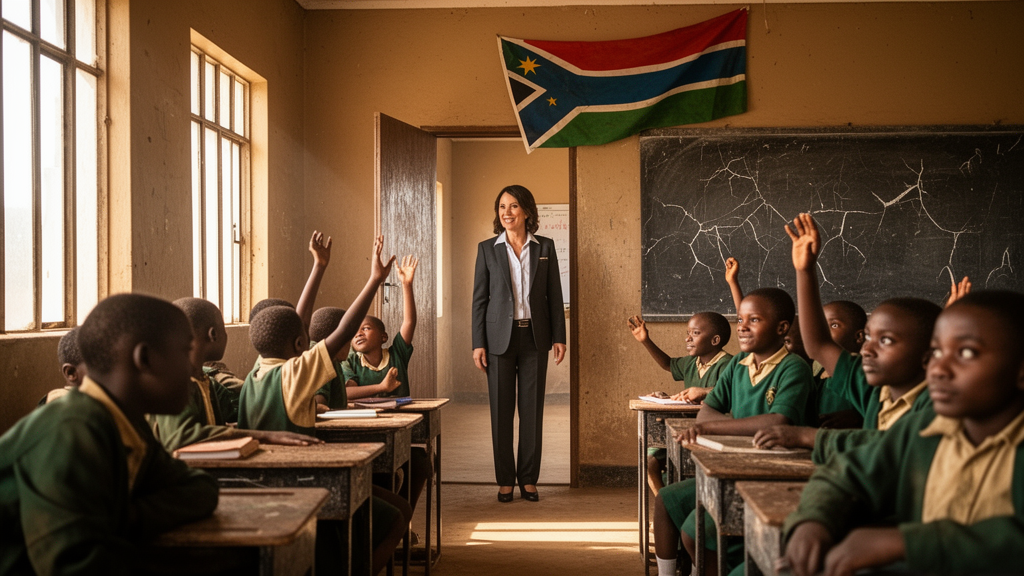
Human dignity sits at the very top of South Africa’s constitutional order. Section 10 of the Constitution states plainly that everyone has inherent dignity and the right to have that dignity respected and protected. Yet a new qualitative study from two public primary schools in Mpumalanga Province shows how difficult it is to translate that lofty legal promise into the daily texture of school life, where bullying, humiliation, and punitive discipline still undermine the children the law is meant to shield.
The research, published in Frontiers in Education by a team from the University of the Free State, examined how School Management Teams, or SMTs, understand and promote learners’ right to dignity. Led by Ngwenya Lihle Tracia, Makhasane Sekitla Daniel, and Mulaudzi Lebohang Victoria, the study focused on eight senior leaders, including principals, deputy heads, and departmental heads, drawn from two primary schools in the Ehlanzeni District. The district, which borders Mozambique and Eswatini, is home to roughly 2.27 million people, is about 70 percent rural, and is linguistically diverse, with SiSwati and isiZulu the most common home languages.
Methodologically, the study was anchored in Human Rights Theory, which treats dignity not as a privilege granted by institutions but as an inherent characteristic of personhood. The researchers adopted an interpretive qualitative case study design, generating data through semi-structured interviews and document analysis. Each interview lasted between 30 minutes and an hour, was audio-recorded and transcribed verbatim, and followed a protocol of 22 core questions covering understandings of dignity, leadership practices, challenges, policy influences, and stakeholder involvement. The researchers also examined school codes of conduct and disciplinary records, triangulating what leaders said with what their institutions formally prescribed.
Analysis followed Braun and Clarke’s six-phase thematic approach, with manual coding rather than software assistance. The team paid particular attention to convergence and divergence between the two schools, and to minority accounts that complicated any easy consensus. Trustworthiness was reinforced through member checking, in which participants reviewed their own transcripts, and through an audit trail supervised within the research team. Ethical clearance came from the University of the Free State’s research ethics committee, with permission from the Mpumalanga Department of Education and the participating principals.
The findings paint a picture of leaders who grasp dignity in richly multidimensional terms. Across both schools, SMT members framed dignity as respect, fair treatment, inclusion, and recognition of learners’ inherent worth regardless of background, poverty, or academic performance. One deputy head described dignity as not degrading or belittling people or making them ashamed of themselves, while a departmental head linked it to treating everyone with fairness and compassion without discrimination. School codes of conduct in both institutions formally echoed these commitments, stating that every learner must be treated with dignity and respect, free from discrimination or humiliation.
Yet the cross-case comparison revealed a striking difference in institutional vocabulary. Leaders at School 1 more often spoke in explicit rights language, describing anti-bullying committees, campaigns, and reporting mechanisms. Leaders at School 2 more frequently framed dignity through belonging, shared core values, relational modelling, and continuity between home and school. One School 2 leader described the school as a home away from home where children’s worth is respected, while School 1’s principal connected inclusion directly to safety and academic engagement. The researchers interpret these not as competing definitions but as different local translations of a common constitutional principle.
The practical machinery of dignity promotion emerged clearly from the interviews. SMTs described assemblies, anti-bullying campaigns, learner debates, peer education, and parent meetings as recurring spaces for teaching respect. They emphasised ethical role modelling, with one leader noting that young children learn by seeing, so a leader who violates dignity damages learners emotionally. Discipline emerged as a crucial test case: rather than abandoning discipline, leaders distinguished corrective approaches, such as talking to a learner and explaining why behaviour is wrong, from punitive practices like public humiliation, name-calling, or making a child stand on a chair while classmates continue working. Both schools relied on codes of conduct as normative anchors, with one deputy head calling it the law book of the school.
But the study’s most consequential finding is what the researchers call a dignity implementation gap. Formal policy presence did not guarantee consistent practice. Both schools had codes prohibiting bullying and degrading treatment, yet participants in both cases still described such practices occurring. Teachers occupied a deeply ambivalent position: they were cast as the adults best placed to model and protect dignity, yet some were also identified as sources of humiliation, verbal abuse, stereotyping, and even corporal punishment, which remains legally prohibited. One participant noted that even a teacher’s frown could communicate degrading disapproval, illustrating how expansively some leaders interpreted the relational demands of dignity.
The constraints leaders described were layered and systemic. Overcrowded classrooms, staff shortages, and the absence of counsellors or psychologists forced SMTs to absorb responsibilities beyond their formal roles. Cultural and linguistic diversity created tensions between home practices and school norms, while inconsistent parental involvement, and in some cases parental preference for punitive discipline, complicated schools’ efforts. Participants also traced dignity harms to home environments, where harsh criticism or emotional abuse could damage self-esteem long before a child arrived at the school gate, and to community-level influences, including social media exposure that participants said normalised disrespect among peers.
Despite these constraints, the study positions SMTs as what human rights theory calls institutional duty-bearers, actors responsible for translating constitutional commitments into lived experience. Participants insisted that dignity promotion is a shared responsibility, not a leadership solo. Parents were engaged through meetings and, in one striking case, through a participatory process in which families helped identify the school’s four core values. Learners themselves were cast as active participants who report bullying, serve as peer mediators, and perform small acts of care, such as sharing food with a classmate who cannot afford it. Community organisations, NGOs, churches, and local businesses extended support beyond the school’s own capacity, with sponsorships ensuring that no child was excluded from activities on financial grounds.
The researchers argue that their contribution shifts the conversation from whether dignity is legally protected to how it is operationally sustained. Dignity, they contend, is not merely a legal principle but a leadership, governance, curricular, and relational practice. Their recommendations are concrete: make learner dignity a standing item in staff meetings at least once per term; build ongoing human-rights and dignity education into Life Skills, assemblies, and staff development; establish clear reporting channels for bullying; move staff training beyond legal compliance toward non-humiliating communication and restorative responses; and strengthen home-school collaboration so that parents hear about dignity before problems arise, not only after.
The study’s limitations are acknowledged candidly. It examined only two schools in one district, focused solely on leadership perspectives, and did not collect demographic data on race, ethnicity, or home language that might have enriched the cross-case comparison. The findings are therefore contextually situated rather than statistically generalisable. Future research, the authors suggest, should include learners, teachers, parents, and school governing bodies, compare differently resourced schools, and combine leadership interviews with direct observation of disciplinary and classroom interactions to test whether stated commitments match enacted practice.
What emerges from this research is a sober but not despairing account. South African primary school leaders are not waiting for perfect conditions to affirm children’s dignity. They are assembling awareness campaigns, restorative discipline, parent evenings, and community partnerships with whatever resources they have. The gap between constitutional ideal and school reality is real, but so is the leadership commitment working to close it, one assembly, one conversation, and one corrected practice at a time.
Subject of Research: How school management teams in South African primary schools understand and promote learners' right to human dignity
Article Title: Promoting learners’ right to human dignity: perspectives of school management teams in two South African primary schools in the Ehlanzeni District
Article References: Lihle Tracia, N., Sekitla Daniel, M., & Lebohang Victoria, M. (2026). Promoting learners’ right to human dignity: perspectives of school management teams in two South African primary schools in the Ehlanzeni District. Frontiers in Education, 11, Article 1916212. https://doi.org/10.3389/feduc.2026.1916212
Image Credits: AI Generated
DOI: 10.3389/feduc.2026.1916212
Keywords: human dignity, learner rights, school management teams, school leadership, South Africa, primary schools, human rights theory, bullying, restorative discipline, qualitative case study, Ehlanzeni District, constitutional rights
Cite Scienmag News
Courtney Benton. (October 16, 2026). School Leaders in South Africa Struggle to Turn Constitutional Dignity Into Daily Practice. Scienmag. https://scienmag.com/school-leaders-in-south-africa-struggle-to-turn-constitutional-dignity-into-daily-practice/
Courtney Benton. "School Leaders in South Africa Struggle to Turn Constitutional Dignity Into Daily Practice." Scienmag, 16 October 2026, https://scienmag.com/school-leaders-in-south-africa-struggle-to-turn-constitutional-dignity-into-daily-practice/. Accessed 16 October 2026.
Courtney Benton. "School Leaders in South Africa Struggle to Turn Constitutional Dignity Into Daily Practice." Scienmag. October 16, 2026. https://scienmag.com/school-leaders-in-south-africa-struggle-to-turn-constitutional-dignity-into-daily-practice/


