


Bayesian Analysis Confirms Universal Parton Energy Loss Exponent in Colliding Nuclei
A new Bayesian analysis of charged-particle data across four different nuclear collision systems establishes a universal energy-loss scaling exponent consistent ...
A new Bayesian analysis of charged-particle data across four different nuclear collision systems establishes a universal energy-loss scaling exponent consistent ...

Theoretical physicists modeling quantum chromodynamics have identified that pion system dynamics and quark density balances constrain the location of the ...

Theoretical physicists investigating rotating holographic quark matter have discovered that while thermodynamic phase boundaries scale kinematically, string-based confinement criteria exhibit ...

Physicists from the ALICE Collaboration have measured multi-strange hyperon yields in ultra-dense proton-proton collisions at 13 TeV, demonstrating that strangeness ...

Physicists have developed a theoretical model describing how relativistic particles move through extreme fluids, offering new insight into the universe's ...

First-principles calculations show strong magnetic fields enhance charge flow along field lines while suppressing it across them, yet heat transport ...
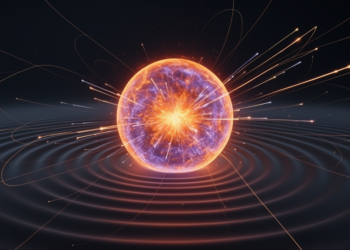
A new methodological study applies a moving-average smoothing procedure to separate collective flow from jet signals in two-particle correlation data ...

A new theoretical analysis shows that conserved charge fluctuations mimic free quarks above the chiral crossover because they are insensitive ...
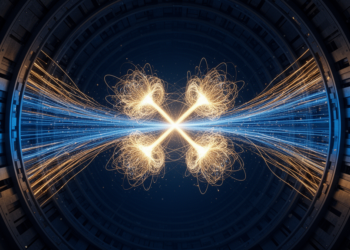
New experimental evidence from RHIC suggests that gluon junctions, not valence quarks alone, carry baryon number through high-energy nuclear collisions.
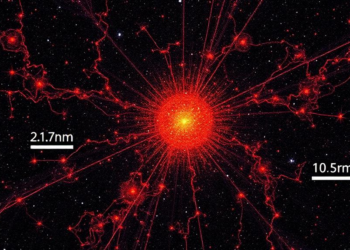
A new constraint analysis of CMS and LHCb data shows that quarkonium suppression in high-multiplicity proton-proton and proton-lead collisions cannot ...


Embark on a thrilling journey of discovery with Scienmag.com—your ultimate source for cutting-edge breakthroughs. Immerse yourself in a world where curiosity knows no limits and tomorrow’s possibilities become today’s reality!