


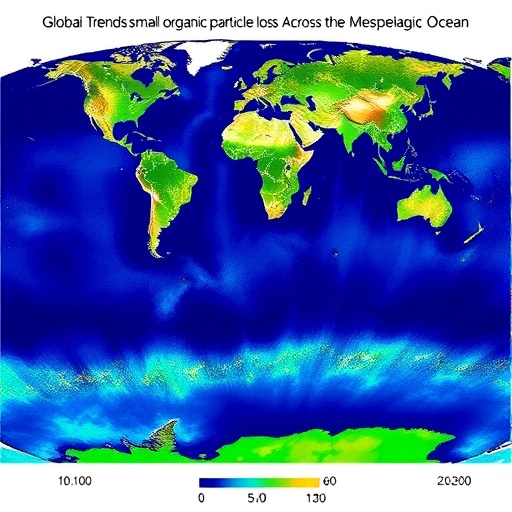
The ocean’s twilight zone is emerging as one of Earth’s most important—and least understood—climate regulators. Stretching roughly from 200 to 1,000 metres below the surface, the mesopelagic ocean is too dark for most photosynthesis but still receives a constant rain of biological material from sunlit waters above. Tiny fragments of organic matter drift downward, carrying carbon, nutrients and chemical energy into the deep sea. A new study by Henson, Sauzède, Aumont and colleagues, published in Communications Earth & Environment, examines global patterns in the loss of small organic particles as they move through this shadowy ocean layer. Its central message is that the fate of microscopic particles in the mesopelagic is not a minor detail of ocean biology. It is a global process that helps determine how much carbon remains near the surface, how much is recycled by marine organisms, and how much can eventually reach the deep ocean.
The particles at the centre of the research are far smaller than the dramatic flakes of marine snow often shown in underwater images. They include fragments of dead organisms, cellular debris, mucus-like material released by plankton, and other forms of organic matter produced in the upper ocean. Some are consumed directly by bacteria and other microorganisms; others dissolve into the surrounding seawater, where their chemical components become available for further biological processing. Still more may be broken apart by physical turbulence or grazing animals. The study’s focus on “small organic particle loss” draws attention to a component of the ocean carbon cycle that can be easy to overlook. Large particles often sink rapidly, while small particles can remain suspended, circulate laterally and be transformed repeatedly before gravity carries them deeper.
This matters because the ocean operates one of the planet’s largest natural carbon transport systems. Phytoplankton near the surface absorb carbon dioxide during photosynthesis and convert it into organic matter. When these organisms die, are eaten or release material into the water, a fraction begins sinking. The process is known as the biological carbon pump. It removes carbon from contact with the atmosphere for varying lengths of time, depending on how rapidly the material is broken down and how far it travels. If organic particles are consumed in the upper ocean, much of their carbon is quickly returned to seawater as carbon dioxide. If they survive the long journey into the deep ocean, the carbon may be isolated from the atmosphere for centuries or longer. Small changes in particle loss can therefore have consequences far beyond the particles themselves.
The mesopelagic is where much of this transformation takes place. It is a biologically active zone populated by bacteria, microscopic grazers, gelatinous animals, fish and other organisms adapted to darkness and scarce food. Every day, many animals migrate upward at night to feed and return to deeper waters during daylight, transporting organic matter through their bodies and waste. Microbes also act as chemical recyclers, attaching themselves to particles and releasing enzymes that break complex molecules into simpler compounds. As a result, sinking material is not merely falling through a passive water column. It is being continuously reworked by biology, chemistry and physics. A particle that begins as a piece of plankton can be fragmented, dissolved, consumed and repackaged many times before its carbon either returns to the atmosphere or continues into the abyss.
By analysing global patterns in the loss of these small particles, the researchers address a major challenge in ocean science: the same amount of surface-produced organic matter may have very different fates in different regions. Temperature, oxygen concentration, nutrient availability, microbial activity, plankton community structure, particle composition and ocean circulation can all influence how quickly material disappears from the sinking pool. A particle rich in easily degradable compounds may be consumed rapidly, while one containing more resistant material may travel farther. Warm conditions can accelerate biological reactions, but regional ecological differences may be equally important. Mapping these processes across the global ocean can reveal whether particle loss follows broad planetary rules or reflects a patchwork of local environments.
The findings are especially relevant to how scientists build Earth-system models. Climate models must estimate how carbon moves between the atmosphere, ocean surface and deep sea, yet many models simplify the behaviour of sinking particles. They may represent particle loss as a straightforward decline with depth, using a mathematical relationship that treats the ocean as relatively uniform. Real oceans are more complicated. The intensity of particle transformation can vary with depth and location, and small particles may be transported sideways by currents rather than simply sinking vertically. By documenting global patterns, the study provides evidence that could help refine the equations used to represent the biological carbon pump. Better descriptions of particle loss could improve projections of how the ocean responds to warming, changing productivity and shifting circulation.
The work also highlights why the smallest material can have an outsized influence. Large particles are visually striking and often dominate measurements of rapid sinking, but small particles may represent a substantial and dynamically important fraction of the organic matter suspended in the mesopelagic. Their slower movement gives microorganisms more time to act on them. At the same time, their size allows them to be carried by currents over long distances, potentially separating the location where carbon is produced from the location where it is finally recycled. This makes the mesopelagic a kind of planetary processing network: organic matter enters from above, is redistributed through water masses and food webs, and is chemically altered before its final destination is determined. Understanding that network requires looking beyond the largest particles.
The study arrives as scientists are reassessing the ocean’s capacity to absorb and store carbon in a changing climate. Warming waters, ocean acidification, deoxygenation and changes in nutrient supply can alter plankton communities and microbial metabolism. These changes may influence the quantity, composition and sinking behaviour of organic matter. If particles are broken down closer to the surface, the ocean’s long-term carbon storage could weaken. If changing ecosystems produce material that sinks more efficiently or resists decomposition, carbon export could increase in some regions. The direction and magnitude of these effects cannot be inferred from surface productivity alone. A productive ocean does not automatically mean an efficient carbon sink; what matters is how much of the resulting organic material survives the journey through the mesopelagic.
The global perspective is therefore the study’s most newsworthy feature. Rather than treating the twilight zone as a collection of isolated sampling sites, the research examines particle loss as a process that connects distant ecosystems and influences the climate system as a whole. Its conclusions can help scientists identify where organic matter is most vulnerable to rapid recycling and where it is more likely to continue downward. They may also guide future observations, including autonomous floats, optical sensors, biogeochemical instruments and targeted expeditions designed to measure particles and their transformation across depth gradients. Such observations are essential because the mesopelagic remains difficult to study: it is vast, dark, constantly moving and populated by organisms that are challenging to sample without disturbing their environment.
The broader lesson is that the ocean’s climate power may depend on an invisible rain of particles whose journeys are measured in darkness. Every fragment of organic matter that disappears from the sinking pool represents a chemical decision point in the global carbon cycle. It may be consumed by a microbe, released as dissolved carbon, transferred through a food web or transformed into material capable of travelling deeper. By revealing global patterns in the loss of small organic particles, Henson, Sauzède, Aumont and their colleagues bring a hidden process into sharper focus. The research reinforces a growing scientific understanding: to predict the future of the climate, researchers must follow not only the great currents and the visible blooms at the ocean surface, but also the microscopic particles quietly moving through the twilight zone.
Cite Scienmag News
Violet Maxwell. (August 21, 2026). Global Trends in Small Organic Particle Loss Across the Mesopelagic Ocean. Scienmag. https://scienmag.com/global-trends-in-small-organic-particle-loss-across-the-mesopelagic-ocean/
Violet Maxwell. "Global Trends in Small Organic Particle Loss Across the Mesopelagic Ocean." Scienmag, 21 August 2026, https://scienmag.com/global-trends-in-small-organic-particle-loss-across-the-mesopelagic-ocean/. Accessed 4 September 2026.
Violet Maxwell. "Global Trends in Small Organic Particle Loss Across the Mesopelagic Ocean." Scienmag. August 21, 2026. https://scienmag.com/global-trends-in-small-organic-particle-loss-across-the-mesopelagic-ocean/


