


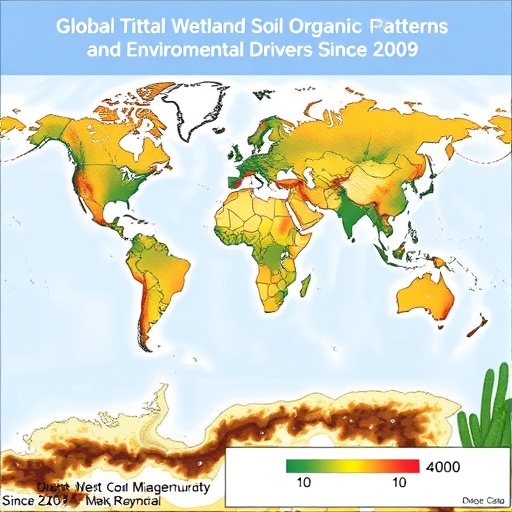
A new analysis tracing the fate of soil organic carbon across the world’s tidal wetlands has flagged how strongly climate, hydrology, and local environmental conditions steer carbon storage over time. Published in Nature Communications in 2026, the study compiles spatially explicit evidence for global tidal wetland soils from 2009 onward, tracking where carbon stocks are rising, stabilizing, or declining.
Using a spatio-temporal framework, the researchers characterize carbon dynamics as more than a static map. Instead, they treat soil organic carbon (SOC) as a moving target shaped by repeated wetting–drying cycles, salinity shifts, sediment inputs, and temperature-driven biological activity. The work emphasizes that “what’s happening now” depends on “what happened since 2009.”
Across regions, SOC patterns show coherent structure rather than random variability. Hotspots of high carbon storage align with wetland areas where conditions favor persistent organic matter accumulation—often where flooding regimes and sediment deposition maintain favorable burial and limit rapid decomposition. Conversely, areas experiencing heightened disturbance or less stable inundation tend to show weaker retention of stored carbon.
The study’s environmental controls point to a multi-factor steering mechanism. Temperature appears to modulate decomposition rates, while hydrological conditions influence oxygen exposure and the residence time of organic substrates. Salinity gradients further complicate the picture by shaping microbial processing and plant productivity, which ultimately determine both inputs to soils and the rate at which organic material is broken down.
A key technical aspect of the analysis is the integration of long-term, observation-driven spatial datasets to infer trends rather than relying on single-date measurements. By focusing on changes since 2009, the team reduces the risk of overinterpreting short-term anomalies and instead identifies persistent regional trajectories.
The findings also suggest that tidal wetlands are not uniform carbon sinks. Management implications follow naturally: preserving hydrologic connectivity, reducing stressors that alter inundation regimes, and safeguarding sediment supply could help maintain or enhance SOC gains. Where conditions shift, carbon storage trajectories may flip, potentially turning some landscapes from net accumulators toward net losers.
Notably, the study frames environmental drivers in a way that can support scenario thinking. As temperature and regional water dynamics continue to evolve, the balance between carbon inputs and decomposition may change unevenly across coastlines, producing a mosaic of outcomes rather than a single global trend.
Overall, the research offers a timely viral-style takeaway: tidal wetland soils are dynamic reservoirs, and their carbon fate is governed by local controls acting over time. The 2009–present perspective provides a benchmark for monitoring and for refining climate-relevant carbon models.
The work underscores why long-term, high-resolution monitoring matters. If we want to predict coastal climate feedbacks, we must watch how inundation, salinity, and temperature interact on the ground—and act before vulnerable wetlands cross tipping points in their carbon balance.
Cite Scienmag News
Violet Maxwell. (July 28, 2026). Global Tidal Wetland Soil Organic Carbon Patterns and Environmental Drivers Since 2009. Scienmag. https://scienmag.com/global-tidal-wetland-soil-organic-carbon-patterns-and-environmental-drivers-since-2009/
Violet Maxwell. "Global Tidal Wetland Soil Organic Carbon Patterns and Environmental Drivers Since 2009." Scienmag, 28 July 2026, https://scienmag.com/global-tidal-wetland-soil-organic-carbon-patterns-and-environmental-drivers-since-2009/. Accessed 5 September 2026.
Violet Maxwell. "Global Tidal Wetland Soil Organic Carbon Patterns and Environmental Drivers Since 2009." Scienmag. July 28, 2026. https://scienmag.com/global-tidal-wetland-soil-organic-carbon-patterns-and-environmental-drivers-since-2009/


