


According to Copernicus Climate Change Service, February 2024 was the warmest February ever recorded globally. However, North America, Asia, and parts of Europe experienced record-breaking cold temperatures. In some places, such as China’s Mohe and Russia’s Yakutsk, temperatures dipped to the life-threatening lowest levels. Alarmingly, this juxtaposition of increasing temperatures amidst extreme coldness pushes the future of our planet’s climate into uncertainty.

Credit: Jin-Ho Yoon from GIST
According to Copernicus Climate Change Service, February 2024 was the warmest February ever recorded globally. However, North America, Asia, and parts of Europe experienced record-breaking cold temperatures. In some places, such as China’s Mohe and Russia’s Yakutsk, temperatures dipped to the life-threatening lowest levels. Alarmingly, this juxtaposition of increasing temperatures amidst extreme coldness pushes the future of our planet’s climate into uncertainty.
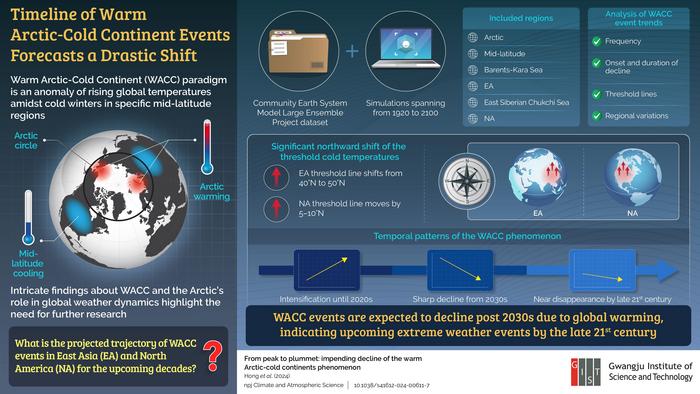
This paradoxical situation is captured by the Warm Arctic-Cold Continent (WACC) phenomenon, where warm Arctic temperatures lead to sea-ice decline and cold blasts across specific mid-latitude regions. The Arctic’s rapid warming indicates global climate change. However, as global warming and the Arctic’s temperature keep increasing, it is unclear how WACC events will unfold in the coming decades.
To bridge this gap, a research group, led by Professor Jin-Ho Yoon and including Ph.D. student Yungi Hong, both from the School of Earth Sciences and Environmental Engineering at Gwangju Institute of Science and Technology, Korea, has recently investigated the dynamics and evolution of extreme winter weather events—technically known as WACC. Using simulations of climate datasets, mainly obtained from the Community Earth System Model Large Ensemble Project, they forecasted the trajectory of WACC events in East Asia and North America, spanning from 1920 to 2100. The study’s findings were published in the journal npj Climate and Atmospheric Science on March 11, 2024.
Explaining their study, Prof. Yoon emphasizes, “The WACC pattern has significantly influenced winter climates, but what we see currently is merely the start of a drastic shift.” The research team found that despite global warming, WACC events have continued to intensify until the 2020s. Prof. Yoon points out, “These events will sharply decline post-2030s. Yet, this decline does not mean reduced extreme weather events in the future. Instead, winters will get warmer as global warming intensifies. Although cold snaps will occur less frequently, they may have more severe consequences when they do happen.”
This declining trend will likely continue until the WACC phenomenon almost disappears by the late 21st century, bringing new extreme weather events.
These findings reshape our understanding of the WACC events and highlight the need to update climate models for accurate predictions, enhancing preparation and response strategies. The findings also resonate with the hardships faced by communities worldwide, especially those in regions historically affected by the WACC.
With the drastic shift in the WACC trajectory lurking closer, immediate action is thus needed to refine global climate strategies and reassess how societies will prepare and adapt. In this regard, Mr. Hong says, “Understanding the impact of the drastic shift in WACC events and devising adaptation and mitigation strategies determines the future of our winter climate, and it’s a stark reminder of the complexity of climate systems and the unexpected outcomes of climate change.”
Overall, this study is a compelling call for communities, policymakers, and scientists to act. It is needed, now more than ever, to collaborate and adapt as we navigate the path to resilience against climate change!
***
Reference
About the Gwangju Institute of Science and Technology (GIST)
The Gwangju Institute of Science and Technology (GIST) is a research-oriented university situated in Gwangju, South Korea. Founded in 1993, GIST has become one of the most prestigious schools in South Korea. The university aims to create a strong research environment to spur advancements in science and technology and to promote collaboration between international and domestic research programs. With its motto of “A Proud Creator of Future Science and Technology,” GIST has consistently received one of the highest university rankings in Korea.
About the authors
Jin-Ho Yoon is a Professor of Earth Sciences and Environmental Engineering at GIST, Korea. His group focuses on understanding and predicting weather-climate extremes under climate change. Prof. Yoon’s group also analyzes how our climate system responds to various climate forcings plus feedback. Before coming to GIST, he was a scientist at Pacific Northwest National Laboratory, USA.
Yungi Hong (first author) is a Ph.D. student at GIST, Korea, working in the Climate Analysis and Modeling (CAM) Laboratory. His research aims to understand the changes in Arctic climate variability and its impact on the midlatitude weather/climate.
Journal
npj Climate and Atmospheric Science
Method of Research
Computational simulation/modeling
Subject of Research
Not applicable
Article Title
From peak to plummet: impending decline of the warm Arctic-cold continents Phenomenon
Article Publication Date
11-Mar-2024
COI Statement
The authors declare no competing interests.
Cite Scienmag News
Russell Cooper. (April 17, 2024). GIST scientists navigate the paradox of extreme cold events in a warming world. Scienmag. https://scienmag.com/gist-scientists-navigate-the-paradox-of-extreme-cold-events-in-a-warming-world/
Russell Cooper. "GIST scientists navigate the paradox of extreme cold events in a warming world." Scienmag, 17 April 2024, https://scienmag.com/gist-scientists-navigate-the-paradox-of-extreme-cold-events-in-a-warming-world/. Accessed 5 September 2026.
Russell Cooper. "GIST scientists navigate the paradox of extreme cold events in a warming world." Scienmag. April 17, 2024. https://scienmag.com/gist-scientists-navigate-the-paradox-of-extreme-cold-events-in-a-warming-world/

