


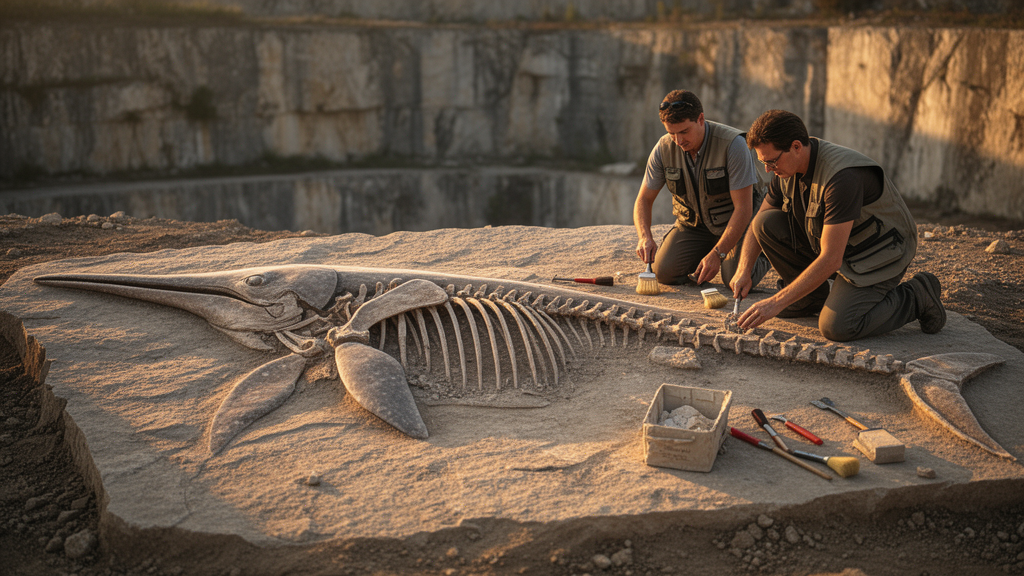
Deep in a former clay pit near the Bavarian town of Mistelgau, roughly ten kilometres southwest of Bayreuth, the Urwelt-Museum Oberfranken has spent decades unearthing one of Europe’s most remarkable windows into late Early Jurassic marine life. Among the ichthyosaurs, plesiosaurs and crocodile-like predators recovered there since the 1990s, one specimen now stands out: a partial skeleton of a gigantic marine reptile catalogued as UMO BT 011237.00, described in the journal Zitteliana. Discovered in 2012 during a routine scientific excavation, the animal has been identified as Temnodontosaurus cf. trigonodon, a member of a genus of apex predators whose name literally means cutting-tooth lizard. With an estimated body length of about 6.6 metres, inferred from a lower jaw measuring roughly 148 centimetres, this was an animal near the top of its food chain, patrolling an epicontinental sea that then lay near palaeolatitude 35° North across what is now southern Germany.
What makes the new specimen extraordinary is not merely its size but its preservation. Ichthyosaur fossils from the Toarcian stage, spanning roughly 184 to 174 million years ago, are famously flattened in the oil shales of Holzmaden and elsewhere, their bones crushed into two-dimensional outlines. The Mistelgau skeleton, by contrast, preserves cranial and mandibular elements in genuine three dimensions, allowing palaeontologists to study internal canals, articular facets and bone surfaces that are usually lost to compaction. The specimen comprises a partial skull with a complete palate, the pectoral girdle, both forefins, the front portion of the vertebral column, dozens of tail vertebrae, more than 100 teeth, four rounded quartz stones interpreted as gastroliths, and numerous isolated bones recovered from the surrounding sediment. Because no duplicate elements of paired bones were found, the researchers are confident that all of the scattered pieces belong to a single individual.
The recovery itself was partly a rescue operation. The skeleton was found while an excavator stripped away overburden to reach the quarry’s main fossil layer below, and only two main slabs, one containing the skull and one containing the trunk, were salvaged in their original orientation. Many other elements were pulled from the spoil heap and carefully matched back to the specimen. Preparation was painstaking: the ventrally embedded skeleton was cleaned mechanically with a pneumatic graver and sandblasting with iron powder, and the slabs were stabilised with epoxy putty, resin and glass-fibre mats to halt destructive pyrite decay. The result is a specimen whose stratigraphic position can be pinned with unusual confidence to the Levesquei Zone of the upper Toarcian, roughly one metre above the region’s characteristic belemnite battlefield, making it significantly younger than most classic Temnodontosaurus material from the lower Toarcian Posidonienschiefer.
Among the most striking anatomical revelations are features of the snout. The premaxilla fragments display pseudoalveoli, bowl-shaped depressions with thickened bone walls at the base of the dental groove, a feature previously known in only two specimens of Temnodontosaurus trigonodon and thought to reinforce the jaws against the mechanical stresses of seizing prey. Even more remarkable is the complexity of the neurovascular groove system running along the outer surface of the premaxilla and dentary. Under low-angle light, the researchers traced a branching network of shallow grooves radiating from foramina connected to an intraosseous canal inside the bone. Such plumbing, documented in detail here for the first time in Temnodontosaurus, likely supplied the teeth and gums with nerves and blood vessels, and the pronounced external branching at the tips of the jaws hints at the presence of sensory organs that may have helped these predators detect prey in murky water.
The palate and braincase yield further novelties. Both pterygoids are preserved in their full 65-centimetre length, with the right one nearly in its original articulation against the braincase, and the parabasisphenoid is exquisitely preserved, revealing a single, funnel-shaped internal carotid foramen. This detail proved taxonomically consequential: paired carotid foramina, separated by a posterior extension of the parasphenoid, have been described in essentially all other Temnodontosaurus specimens and are even embedded in the genus diagnosis. In the Mistelgau animal, the parasphenoid strip stops short of the foramen entirely. The team weighed several explanations, from individual variation to the possibility that the extended parasphenoid broke off, and even evolutionary change within the lineage, but none could be firmly excluded. Combined with the specimen’s younger stratigraphic age and subtle differences in the pterygoid and cultriform process, this uncertainty led the authors to adopt the cautious open nomenclature Temnodontosaurus cf. trigonodon rather than a definitive species name.
Taxonomic caution here reflects a broader problem. Temnodontosaurus, one of the first ichthyosaur genera ever described, back in the early nineteenth century, currently harbours seven recognised species, yet multiple phylogenetic analyses indicate that the genus is non-monophyletic, meaning its species do not all descend from a single common ancestor under that name. A comprehensive revision is overdue, and the Mistelgau specimen supplies exactly the kind of detailed comparative anatomy such a revision will need. In the meantime, the specimen can be safely assigned to the genus on a battery of diagnostic features: a skull and jaw longer than a metre, an extensive extracondylar area on the basioccipital, an ulnare smaller than the intermedium in the wrist, a humerus whose distal end is markedly wider than its proximal end, and forefin leading edges notched along most of their length, a hallmark of T. trigonodon in particular.
Then there is the animal’s medical history, which reads like a palaeontological detective story. Previous work had already documented severe pathological changes in the right pectoral girdle: the right coracoid is inflated to a thickness of about eleven centimetres, five times that of its healthy left counterpart, with a porous, honeycombed bone texture characteristic of trauma followed by infection. The right scapula and humerus show similar disease, and the right mandibular joint carries a club-shaped mass of reactive bone interpreted as the aftermath of an abscess that shortened the angular by about ten centimetres. In life, these conditions must have caused chronic pain and severely compromised both the steering function of the right forefin, which in these animals assists the tail-driven swimming, and the stability of the bite. The researchers argue that the consequences ripple through the rest of the skeleton in ways that are genuinely surprising.
The first consequence is dental. Nearly every preserved tooth, with the exception of three tiny, not-yet-erupted replacement teeth, shows smooth, convex apical wear so extreme that up to a third of the crown is missing on some specimens, a pattern far heavier than seen in other temnodontosaurid teeth from the museum’s collection. Some crowns also bear lateral wear facets and concentric rings. The team proposes that a painful, destabilised jaw joint may have driven the animal toward softer or smaller prey, such as soft-bodied cephalopods, while abnormal tooth contact with hard belemnite rostra, or even with swallowed stones, ground the tips away. This brings in the second consequence: the four rounded quartz pebbles, two to 3.5 centimetres across, found in the trunk region. Gastroliths are exceedingly rare in ichthyosaurs, known previously from only two other Mesozoic specimens and one Triassic form, and here they may record accidental ingestion linked to the animal’s impaired hunting and feeding behaviour, perhaps combined with compensatory overuse of the healthy left forelimb, which bears unusual grooved structures possibly related to strained ligament attachments.
Beyond the pathology, the specimen contributes quieter but significant anatomical firsts. Its atlas and axis are co-ossified as in adult Temnodontosaurus, and the neural arches of the first five vertebrae carry clearly paired zygapophyses, contradicting the long-standing assumption that all post-Triassic ichthyosaurs had simple, unpaired zygapophyses along the entire column; further back, transitional arches and unpaired ones document exactly where and how the shift occurred. The splenial contribution to the robust 65-centimetre mandibular symphysis falls between 62 and 74 percent across comparable specimens, a narrower range than previously reported, and the tongue-and-groove interlocking of the twenty-odd scleral plates that once supported the enormous eyeball is preserved in unprecedented detail. Taken together, the Mistelgau giant confirms that Temnodontosaurus persisted in the Southwest German Basin into the late Toarcian, an interval from which ichthyosaur records elsewhere in Europe are sparse and fragmentary, and it hands researchers both the anatomical groundwork and the taxonomic questions that a long-awaited overhaul of this charismatic genus will now have to answer.
Subject of Research: Three-dimensionally preserved partial skeleton of the ichthyosaur Temnodontosaurus cf. trigonodon from the upper Toarcian of Mistelgau, Germany, revealing novel cranial anatomy, pathologies and gastroliths.
Article Title: A partial skeleton of Temnodontosaurus cf. trigonodon in three-dimensional bone preservation from the upper Toarcian of Mistelgau, Germany
Article References: Eggmaier, S. A., & Albert, U. E. G. (2026). A partial skeleton of Temnodontosaurus cf. trigonodon in three-dimensional bone preservation from the upper Toarcian of Mistelgau, Germany. Zitteliana, 100, 39-80. https://doi.org/10.3897/zitteliana.100.172724
Image Credits: AI Generated
DOI: 10.3897/zitteliana.100.172724
Keywords: Temnodontosaurus, ichthyosaur, Toarcian, Early Jurassic, Mistelgau, palaeopathology, gastroliths, Germany, marine reptiles, neurovascular grooves, three-dimensional preservation, taxonomy
Cite Scienmag News
Gavin Prescott. (October 15, 2026). Giant Jurassic Ichthyosaur Unearthed in Germany Reveals a Life of Pain, Stone-Swallowing and Anatomical Secrets. Scienmag. https://scienmag.com/giant-jurassic-ichthyosaur-unearthed-in-germany-reveals-a-life-of-pain-stone-swallowing-and-anatomical-secrets/
Gavin Prescott. "Giant Jurassic Ichthyosaur Unearthed in Germany Reveals a Life of Pain, Stone-Swallowing and Anatomical Secrets." Scienmag, 15 October 2026, https://scienmag.com/giant-jurassic-ichthyosaur-unearthed-in-germany-reveals-a-life-of-pain-stone-swallowing-and-anatomical-secrets/. Accessed 15 October 2026.
Gavin Prescott. "Giant Jurassic Ichthyosaur Unearthed in Germany Reveals a Life of Pain, Stone-Swallowing and Anatomical Secrets." Scienmag. October 15, 2026. https://scienmag.com/giant-jurassic-ichthyosaur-unearthed-in-germany-reveals-a-life-of-pain-stone-swallowing-and-anatomical-secrets/


