


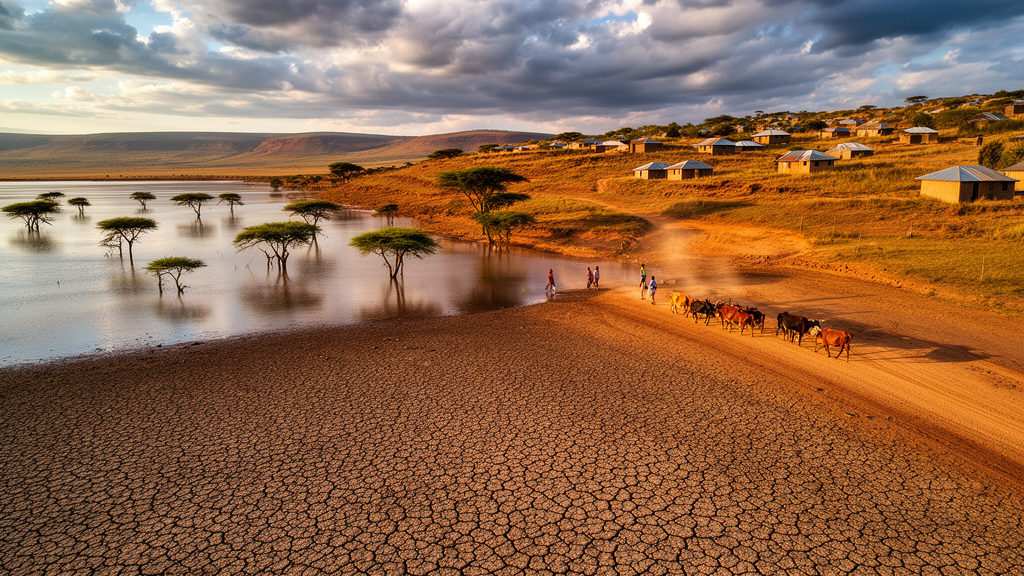
In Kenya’s Rift Valley, the weather has stopped behaving like weather. Major droughts struck in 1991–92, 1999–2001, 2008–09, 2011 and 2020–23, only to be punctuated by destructive floods in 1997–98, 2018 and 2024. Each event has destroyed crops, killed livestock, displaced families and damaged infrastructure. Now, a new Perspective published in Frontiers in Conservation Science argues that these repeated shocks are doing something far more insidious than wrecking harvests: they are inflicting a cumulative psychological injury on entire communities, and that injury is feeding back into the environment in ways that make the next disaster worse. The authors, Gilbert Obwoyere of Egerton University and Oslo New University College and Scott Jones of Oslo New University College, call this self-reinforcing mechanism the climate–trauma–environment feedback loop, and they believe it may explain why decades of adaptation investment so often fail to deliver lasting resilience.
The core idea is deceptively simple. When climate extremes hit rain-fed farming systems, livelihoods collapse. At the individual level, people experience what researchers call ecological grief, climate anxiety and solastalgia—the distress of watching a valued landscape degrade around you. But when losses repeat across a community, and across generations, something bigger emerges: collective trauma, a shared psychological wound that reshapes social norms, institutional trust, cultural memory and patterns of collective action. Drawing on social-ecological systems theory and Conservation of Resources theory, the authors argue that this collective trauma is not merely a by-product of climate change. It is an active driver of environmental change, and one that conventional adaptation frameworks have almost entirely ignored.
The mechanism works like this. Communities that have lost crops, animals and livelihoods several times over prioritize immediate survival over long-term sustainability. They cultivate fragile marginal lands, clear forests for charcoal, overgraze rangelands and abstract water unsustainably. These coping strategies buy a season of relief, but they accelerate soil erosion, reduce rainwater infiltration, increase sedimentation and diminish the landscape’s capacity to regulate floods. Degraded ecosystems buffer climate extremes less effectively, so the next drought or flood hits harder, deepening losses and compounding the trauma. The loop closes, and each rotation leaves both the land and the people more vulnerable than before.
Kenya’s Rift Valley provides the ideal laboratory for this idea. The region spans extraordinary diversity, from the semi-arid rangelands of Baringo, Laikipia and Narok to the high-potential maize belts of Nakuru, Uasin Gishu and Trans-Nzoia, and it contains the Mau Forest Complex, one of East Africa’s most important water towers. A census-based analysis presented in the paper shows more than 12.7 million people living across fifteen counties with densities ranging from roughly 13 persons per square kilometre in Turkana to nearly 400 in Kericho and Trans-Nzoia. That heterogeneity matters, because climate risk is spatially uneven: semi-arid counties face chronic drought and water scarcity, high-rainfall counties face delayed rainfall onset and intense erosive precipitation, and intermediate counties such as Nakuru and Elgeyo-Marakwet face compound hazards including deadly landslides, as occurred in West Pokot and Elgeyo-Marakwet in 2019.
Historical records show that climate-related disasters in the region have become markedly more frequent since the early 1990s, and, critically, that recovery windows between shocks have shortened. The 1991–92 and 1999–2001 droughts devastated pastoral and mixed farming systems in Baringo, Laikipia and Narok, triggering distress livestock sales, migration and expansion into marginal land. The 2008–09 drought coincided with a global food-price crisis, and the 2011 Horn of Africa drought extended the damage regionally. Then the severe 2020–23 drought arrived before many communities had rebuilt their productive assets from the previous catastrophe. The result, the authors argue, is chronic rather than temporary vulnerability: communities are no longer responding to isolated disasters but living in a permanent state of uncertainty that extends across generations.
Land tenure adds another layer of complexity to this picture. The paper reviews census and county data showing that in Nakuru more than 95 percent of land is private freehold or leasehold, while in Baringo roughly 45 percent is private and 55 percent communal, with group ranches subdivided and unregistered community lands persisting elsewhere. Secure tenure encourages farmers to invest in terracing, agroforestry, water harvesting and soil restoration, because they can expect to capture the benefits of long-term investments. Fragmentation and insecure rights discourage them. But the authors are careful to avoid a simple private-versus-communal verdict: in pastoral areas, communal tenure supports the mobility and collective grazing management on which dryland livelihoods depend. What matters, they write, is the security, legitimacy and quality of tenure governance, not the tenure category itself.
Crucially, the framework does not treat trauma as destiny. The authors draw on scholarship on post-traumatic growth to argue that repeated adversity can also generate learning, strengthened social relationships and renewed collective agency. Communities battered by droughts and floods have built water-harvesting infrastructure, developed local early-warning systems, restored degraded landscapes and established mutual-support networks. Which path a community takes—destructive coping or collective transformation—depends on enabling conditions: social cohesion, institutional and policy support, access to resources, and opportunities for meaningful participation. Climate shocks may generate trauma, but trauma can also catalyse resilience when communities are given the resources and institutional space to convert adversity into adaptation.
The practical payoff is a new model of trauma-informed climate governance, which treats adaptation as a psychosocial process rather than a purely technical one. The authors map climate stressors to their trauma responses, ecological consequences and governance implications: recurrent drought produces chronic food insecurity and overgrazing, calling for climate-smart agriculture; flooding produces displacement and riverbank erosion, calling for watershed restoration; livestock mortality drives charcoal production, calling for alternative livelihoods; and repeated shocks produce collective trauma itself, calling for a fundamentally different governance approach. That approach rests on several pillars. Climate-smart agriculture—drought-tolerant varieties, conservation tillage, mulching, crop diversification and efficient water harvesting—reduces exposure, but only works when farmers have confidence in the future. Participatory ecosystem restoration, through community-led reforestation and watershed committees, functions simultaneously as ecological recovery and psychosocial healing. Indigenous and local ecological knowledge informs adaptation while reaffirming cultural continuity in disrupted landscapes. Climate risk financing, including index-based insurance and adaptive social protection, eases the financial desperation that pushes households toward destructive coping. And livelihood-specific psychosocial recovery—community dialogue, peer support, customary conflict resolution and culturally appropriate healing—should be recognized as a legitimate component of adaptation policy, because rebuilding trust is a precondition for collective stewardship.
The policy implications are concrete. Kenya already has a strong institutional architecture, including the Climate Change Act of 2016, the National Climate Change Action Plan for 2023–2027, the National Adaptation Plan running to 2030 and the National Drought Management Authority. But these instruments currently emphasize physical adaptation and disaster risk reduction over psychosocial well-being. The authors argue that explicitly incorporating collective trauma and appropriate metrics into these frameworks—at national, county, community and regional scales, including through the Intergovernmental Authority on Development’s drought management strategies—would make them substantially more effective. They also call for a research agenda: standardized, gender-sensitive indicators for measuring collective trauma in climate vulnerability assessments; interdisciplinary work bridging ecology, psychology, sociology and public health; longitudinal studies of cumulative impacts; and comparative tests of whether trauma-informed governance genuinely produces more durable conservation outcomes than conventional approaches.
What elevates this work beyond a regional case study is its claim about how climate vulnerability works everywhere. Similar cycles of drought, flooding, displacement and degradation are documented across the Sahel, the Horn of Africa, Madagascar, Australia and Indigenous and rural communities in North America. The burdens are unevenly distributed too, with women disproportionately affected given their responsibilities for water and wood collection and childcare. If the authors are right, then conservation science stands at a crossroads: protecting species and restoring ecosystems cannot succeed in isolation from the communities that inhabit those landscapes. Ecosystem health and human well-being, they conclude, are inseparable components of resilient socio-ecological systems—and restoring landscapes and healing communities are mutually dependent processes. Psychosocial recovery, on this view, is not a soft add-on to hard adaptation spending. It is the missing mechanism that determines whether people become partners in conservation or, worn down by loss, its reluctant opponents.
Subject of Research: The role of collective trauma in climate-driven socio-ecological feedback loops and adaptation governance in Kenya's Rift Valley
Article Title: Cyclic droughts, flooding and collective trauma: an environmental feedback loop to inform governance and socio-ecological resilience in Kenya’s rift valley
Article References: Cyclic droughts, flooding and collective trauma: an environmental feedback loop to inform governance and socio-ecological resilience in Kenya’s rift valley. (n.d.). https://doi.org/10.3389/fcosc.2026.1866800
Image Credits: AI Generated
DOI: 10.3389/fcosc.2026.1866800
Keywords: collective trauma, climate adaptation, Kenya Rift Valley, socio-ecological resilience, ecological grief, drought, flooding, land degradation, trauma-informed governance, indigenous ecological knowledge, ecosystem restoration, climate-smart agriculture
Cite Scienmag News
Glenn Wilkins. (October 15, 2026). Droughts, Floods and the Hidden Trauma Reshaping Kenya’s Rift Valley. Scienmag. https://scienmag.com/droughts-floods-and-the-hidden-trauma-reshaping-kenyas-rift-valley/
Glenn Wilkins. "Droughts, Floods and the Hidden Trauma Reshaping Kenya’s Rift Valley." Scienmag, 15 October 2026, https://scienmag.com/droughts-floods-and-the-hidden-trauma-reshaping-kenyas-rift-valley/. Accessed 15 October 2026.
Glenn Wilkins. "Droughts, Floods and the Hidden Trauma Reshaping Kenya’s Rift Valley." Scienmag. October 15, 2026. https://scienmag.com/droughts-floods-and-the-hidden-trauma-reshaping-kenyas-rift-valley/


