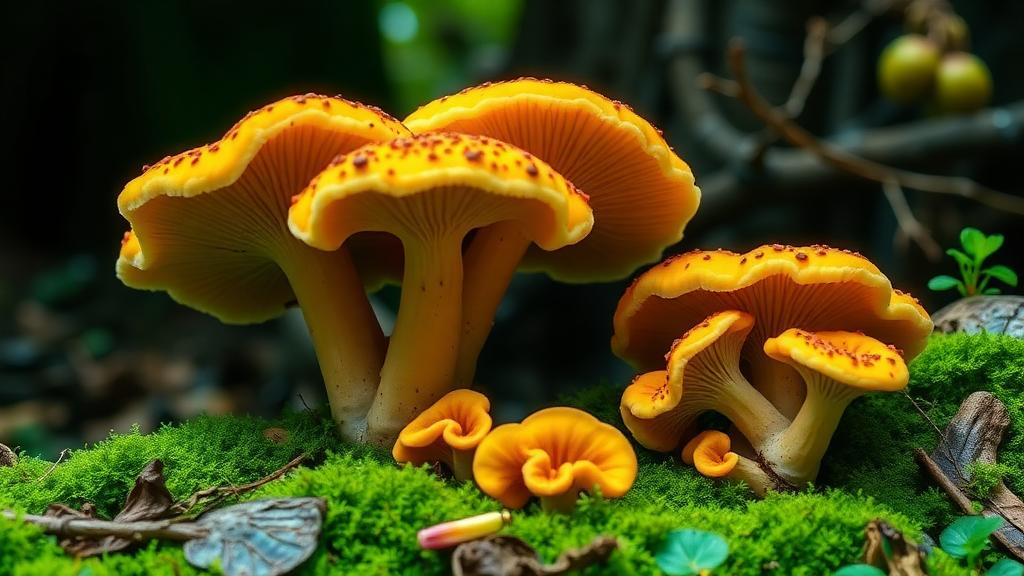
In the forests of Yunnan Province, southwestern China, mycologists have unearthed a fungus that rewrites what we thought possible for the group it belongs to. During surveys in 2024 and 2025, researchers collected specimens producing massive, upright, fleshy fruiting bodies reaching up to 50 centimeters in height and, in the largest recorded case, a staggering 2.2 kilograms in weight. The fungus has now been formally described as Dianjunus rex, the sole species of an entirely new family, Dianjunaceae, within the order Xylariales. Published in Frontiers in Fungal Biology, the discovery represents the largest fruiting bodies ever documented in the Ascomycota, the vast fungal phylum that includes morels, truffles, and most molds, and it dramatically expands the known morphological range of an order better known for small, charcoal-black, wood-decomposing structures.
The story began during routine fungal diversity surveys across three very different Yunnan habitats: a tropical rainforest in Xishuangbanna Dai Autonomous Prefecture, and temperate coniferous forests near Kunming and Lufeng. Collectors noticed pale, finger-like structures emerging from the roots of dying host plants, particularly oaks of the genus Quercus. Young specimens bore bulb-like apices that matured into finger-shaped branches, their surfaces covered in a persistent, powdery, whitish-yellow fibrous layer that darkened with age. Unlike the hard, carbonaceous stromata typical of Xylariales, these structures were fleshy and dehydrated rapidly once detached. The largest bilobed specimen weighed 2.2 kilograms on a field scale, dwarfing the previous record holder, Engleromyces goetzei, whose subglobose stromata on bamboo culms in Kenya reached about 30 centimeters in diameter and roughly 3.2 kilograms in a two-lobed mass.
Establishing that such an unusual organism was genuinely new required an integrative taxonomic approach. The team examined macroscopic and microscopic morphology in exhaustive detail, measuring asci, ascospores, perithecia, and the distinctive apical apparatus that stains blue in Melzer’s reagent, appearing as an inverted trapezoid. The ascospores carry a conspicuous S-shaped germ slit, one-half to four-fifths of the spore length, a feature absent from the closest morphological candidate, the obscure genus Squamotubera described from New Caledonia in 1903. In culture, the fungus produces a nodulisporium-like asexual form with periconiella-like branching patterns, erect conidiophores 17 to 25 micrometers long bearing clusters of cylindrical conidiogenous cells and smooth, ellipsoid conidia. Voucher specimens were deposited at the fungarium of the Kunming Institute of Botany, and the new names were registered in Index Fungorum.
Molecular work confirmed what morphology suggested. The researchers sequenced four genetic loci, the internal transcribed spacer (ITS), the large subunit ribosomal DNA (LSU), RNA polymerase II subunit 2 (RPB2), and beta-tubulin (TUB2), from five collections. A concatenated dataset of 202 strains, analyzed with maximum likelihood and Bayesian inference, placed the new fungus in a strongly supported clade sister to the family Graphostromataceae within Xylariales, with bootstrap support of 100 percent and Bayesian posterior probability of 1.00. Because the morphology differed so markedly from that family, and because only a few graphostromataceous genera produce upright stromata at all, the team erected the new family Dianjunaceae, with Dianjunus rex as its type species. The generic name honors the ancient Dian Kingdom of present-day Yunnan, combined with the Chinese word jun, meaning fungus, while the epithet rex, Latin for king, refers to the majestic size of the fruiting bodies.
To resolve the lineage’s deeper evolutionary history, the team went further, sequencing whole genomes and transcriptomes from three wild-collected stromata. Using the Illumina HiSeq 4000 platform, they generated 49 gigabases of DNA and 51 gigabases of RNA sequence data, assembling genomes of roughly 30 to 32 megabases with completeness scores above 95 percent as assessed by Benchmarking Universal Single-Copy Orthologs. From a phylogenomic dataset of 66 Pezizomycotina species, they extracted 302 single-copy orthologous genes and built genome-scale trees with IQ-TREE, cross-validated with an alternative workflow using OrthoFinder clustering and the coalescent-based ASTRAL algorithm. Across all three workflows, Dianjunus was consistently resolved as sister to Graphostromataceae with maximum support, demonstrating that the placement is unequivocally stable despite minor topological conflicts in unrelated lineages.
Divergence time estimation, calibrated with TimeTree fossil and molecular constraints using the MCMCtree module of the PAML package, produced a striking result: the Dianjunaceae lineage diverged approximately 65 million years ago, with a confidence interval of 50 to 80 million years. That timing places the family’s origin squarely in the early Paleocene, immediately after the Cretaceous-Paleogene (K-Pg) extinction event that eliminated an estimated 75 percent of all plant and animal species, including the non-avian dinosaurs. The authors suggest that the emergence of this morphologically distinct lineage in the aftermath of a major extinction may reflect adaptive radiation or the exploitation of newly available ecological niches during the recovery and reorganization of forest ecosystems. The estimate also falls within the common family-level divergence window of 50 to 150 million years reported for fungi generally.
The genome revealed another surprise: a remarkably compact and conserved repertoire of carbohydrate-active enzymes, or CAZymes, the protein machinery fungi use to dismantle plant cell walls. Across the three sequenced strains, D. rex encodes only about 220 CAZyme genes, less than half the 423 to 635 genes found in related wood-decaying genera such as Xylaria, Daldinia, and Hypoxylon. Most striking is the near-total depletion of pectin lyases, present at zero to one copies compared with seven to nineteen in close relatives. Because pectinases are central to the initial breakdown of host cell walls, and their cleavage products can trigger plant immune responses as damage-associated molecular patterns, their loss is a genomic signature consistent with biotrophic or latent endophytic lifestyles. Meanwhile, glycosyltransferases, which build fungal cell walls, make up an unusually high 26 percent of the enzyme repertoire.
These genomic patterns support a working hypothesis of an endophyte-to-saprotroph lifestyle transition. The fungus appears to live asymptomatically within healthy host tissues and shifts to a saprobic mode only after host death, when its fruiting bodies emerge from roots and rhizosphere soil. Low metabolic maintenance costs for extracellular degradative enzymes, paired with sustained investment in cell wall synthesis, could allow rapid channeling of carbon into fungal biomass, potentially explaining how such massive stromata are built. This dual strategy, symbiotic latency followed by saprotrophic competence, is widely observed among xylarialean endophytes, and D. rex may represent an extreme expression of it.
The discovery carries broader implications for mycology. Ascomycete fruiting bodies are typically small, and gigantism in the phylum was thought to peak with the truffle-like and cup-forming Pezizales. Dianjunus rex demonstrates that giant fructifications evolved independently in multiple ascomycete lineages, expanding the known morphological disparity of the Xylariales, an order of some 16 recognized families whose members function as endophytes, pathogens, and saprobes, and which are prized for bioactive secondary metabolites and lignocellulose-degrading enzymes. With over 6,000 fungal species already documented in Yunnan but total richness estimated to potentially exceed 100,000, the province remains one of the world’s great underexplored mycological frontiers.
Dianjunaceae joins a growing list of monotypic fungal families, of which 432, some 35.4 percent of all known families in Kingdom Fungi, contain only a single known genus. Whether Dianjunus rex has undiscovered relatives hiding in East Asian forests remains an open question, but its combination of ancient origin, genomic streamlining, and record-breaking size makes it one of the most remarkable fungal discoveries of recent years, a reminder that even in well-studied orders, evolution can still produce giants no one expected.
Subject of Research: Taxonomy, phylogenomics, and Paleocene divergence of the giant ascomycete Dianjunus rex and the new family Dianjunaceae (Xylariales)
Article Title: Unearthing a fungal giant: Dianjunaceae fam. nov., a novel Paleocene lineage of Xylariales harboring Dianjunus rex gen. et sp. nov
Article References: Song, J., Yan, Z., Pérez-Moreno, J., Zhang, F., Yang, S., Xie, T., Su, L., Liu, J., Wang, Y., Liu, D., Yang, Z., Yang, C., Liu, W., Shi, X., Wan, S., Cheewangkoon, R., Dai, D., Senanayake, I. C., & Yu, F. (2026). Unearthing a fungal giant: Dianjunaceae fam. nov., a novel Paleocene lineage of Xylariales harboring Dianjunus rex gen. et sp. nov. Frontiers in Fungal Biology, 7, Article 1940464. https://doi.org/10.3389/ffunb.2026.1940464
Image Credits: AI Generated
DOI: 10.3389/ffunb.2026.1940464
Keywords: Dianjunus rex, Dianjunaceae, Xylariales, Ascomycota, fungal taxonomy, Yunnan, phylogenomics, Paleocene, K-Pg extinction, CAZymes, giant stromata, fungal diversity
Cite Scienmag News
Roger Howard. (October 16, 2026). Giant Fungus From Yunnan Reveals a New Fungal Family Born After the Dinosaur Extinction. Scienmag. https://scienmag.com/giant-fungus-from-yunnan-reveals-a-new-fungal-family-born-after-the-dinosaur-extinction/
Roger Howard. "Giant Fungus From Yunnan Reveals a New Fungal Family Born After the Dinosaur Extinction." Scienmag, 16 October 2026, https://scienmag.com/giant-fungus-from-yunnan-reveals-a-new-fungal-family-born-after-the-dinosaur-extinction/. Accessed 16 October 2026.
Roger Howard. "Giant Fungus From Yunnan Reveals a New Fungal Family Born After the Dinosaur Extinction." Scienmag. October 16, 2026. https://scienmag.com/giant-fungus-from-yunnan-reveals-a-new-fungal-family-born-after-the-dinosaur-extinction/