


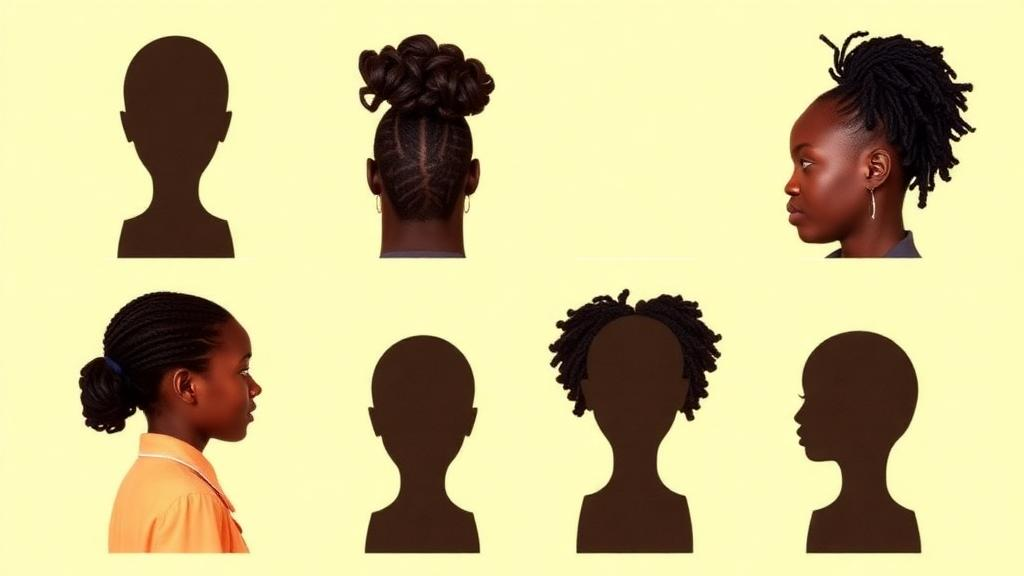
In Ghana’s classrooms, one of the most contested sites of education is not the syllabus but the scalp. A new qualitative study published in Discover Education argues that hairstyle policies in Ghanaian schools operate as a hidden curriculum, quietly teaching students whose identities count as respectable and whose do not. The research, conducted by Stephen Kwakye Apau of the University of Education, Winneba, examined how grooming rules are written, justified, and experienced in everyday school life, and concluded that these seemingly mundane regulations carry the fingerprints of colonial schooling more than six decades after independence.
The study rests on a rich body of evidence. Apau carried out a qualitative case study in public and private basic and secondary schools in Ghana’s Greater Accra Region, interviewing and observing with a purposively selected sample of forty participants: twenty students, ten teachers, and ten school administrators. Data came from semi-structured interviews with staff, focus group discussions with students, and analysis of institutional documents such as rulebooks and policy circulars. Transcripts and documents were analysed thematically, following Braun and Clarke’s widely used framework, with codes generated inductively and then refined through repeated comparison across the three data sources. Triangulation across sources, thick description, and reflexive attention to the researcher’s own positionality as a Ghanaian educator were used to strengthen trustworthiness.
The theoretical scaffolding combines two influential perspectives. Postcolonial theory situates hairstyle regulation within the history of colonial education on the Gold Coast, where missionary and government schools treated bodily discipline, modesty, and subdued hair as markers of Christian virtue and civilised conduct. Hair became a visible boundary marker between the so-called educated native and the denigrated African; straightened, short, or covered hair signified decency, while natural and elaborate African styles were dismissed as untidy or vain. Cultural reproduction theory, drawing on Pierre Bourdieu and Jean-Claude Passeron, explains how such norms persist: schools present dominant cultural standards as natural and legitimate, so that conformity to them is rewarded with acceptance while deviation attracts correction. The study also invokes the concept of symbolic violence, in which imposed cultural values are internalised as common sense, even by those they disadvantage.
The empirical findings are organised around three themes. The first concerns how hairstyle policies are constructed and justified. Administrators and teachers described the rules as long-standing features of school life, embedded in rulebooks that specify short hair or neatly tied plaits for girls and closely cropped hair for boys. One administrator quoted in the paper said the rules were old colonial-era prescriptions meant to make students look proper according to Western standards, while a teacher observed that Ghanaian schools still operate with the mindset that tidy means straight or very short hair. At the same time, staff consistently linked appearance to discipline, attention, and classroom management, arguing that uniform standards make students easier to manage and sustain an orderly atmosphere. Some educators expressed ambivalence, wondering aloud whether definitions of neatness were too narrow even as they enforced them.
The second theme explores how students experience these expectations in relation to identity and belonging. Accounts varied widely. Some students described heightened visibility and shame during inspections and public corrections, saying that wearing twists or natural styles drew stares or punishment and made them feel their identity was not accepted at school. Others reported attaching cultural meaning to their braids that teachers refused to recognise, describing styles that were normal in their culture being labelled untidy or rebellious. Yet the picture was not uniformly negative: some students said enforcement varied by teacher, others noted that shared rules reduced peer competition over styles, and a few reported simply becoming accustomed to the expectations over time. This variation underscores the study’s central claim that the effects of regulation depend on how policies are interpreted and enacted in daily interactions, not merely on what the formal rulebook says.
The third theme maps the repertoire of student responses, which ranged from compliance and adaptation to negotiation, withdrawal, and quiet resistance. Many students complied pragmatically to avoid sanctions rather than out of conviction. Others adapted their appearance to stay within acceptable limits while preserving elements of personal preference, sometimes alternating between acceptable and preferred styles. A minority maintained natural styles despite warnings. Perhaps most strikingly, some students withdrew from participation altogether: avoiding clubs, class discussions, or speaking in class to escape scrutiny of their hair. These withdrawal behaviours suggest that disciplinary visibility can shape not only comfort but also educational engagement, a finding consistent with research on school belonging that links recognition and fairness to students’ participation.
The study’s discussion situates these dynamics within a longer institutional history while resisting a purely colonial explanation. Apau argues that hairstyle regulation reflects the interaction between historical inheritance and contemporary institutional priorities: colonial-era associations between appearance and morality persist, but schools also justify grooming rules through present-day concerns about uniformity, order, and classroom management. Repeated routines of inspection, correction, and surveillance allow particular appearance standards to acquire the status of neutrality, so that conformity becomes associated with discipline and responsibility while deviation invites scrutiny. In this way, the governance of hair distributes recognition and legitimacy across the student body, determining which forms of embodiment are institutionally acceptable.
The research also speaks directly to national controversy. In 2021, Achimota School’s refusal to admit two Rastafarian students because of their dreadlocks ignited public and legal debate across Ghana, and the High Court ultimately ruled in the students’ favour, recognising the discriminatory nature of the policy. The study frames such incidents as symptoms of a broader tension between traditional notions of discipline rooted in conformity and modern demands for religious freedom, diversity, and inclusion. By showing that these tensions play out in routine, low-stakes interactions as well as in courtrooms, the research broadens the frame from headline cases to the ordinary mechanics of schooling.
The implications reach beyond Ghana. Decolonial scholarship on education has concentrated heavily on curriculum content, language of instruction, and representation in knowledge systems. This study shifts attention to embodied, routine practices, demonstrating that schools also regulate which identities and forms of self-presentation are recognisable and legitimate. Apau recommends that school leaders and the Ghana Education Service conduct structured reviews of appearance policies, defining terms such as neatness with practical examples to reduce ambiguity and inconsistent enforcement. Teachers are urged to apply rules proportionately, reconsider public inspection and correction in favour of private, respectful address, and reflect on how everyday practices affect participation. Teacher education programmes should incorporate training on the hidden curriculum and culturally responsive classroom management, and schools should create formal channels, such as student representation on committees, for pupils to shape the policies that govern them.
The study acknowledges its limits: it was confined to selected schools in Greater Accra, relies on self-reported accounts that may be shaped by social desirability and power dynamics, and does not fully capture family expectations, religious norms, or media influences on attitudes to hair. Even so, its conclusion is pointed. Decolonising education, the paper argues, requires rethinking not only what schools teach but how institutional life is organised, experienced, and embodied. Rules that appear ordinary or neutral may nonetheless shape students’ experiences of legitimacy and belonging in profound ways, and genuine inclusion will demand attention to the quiet, daily rituals through which schools decide who fits in and who stands out.
Subject of Research: Hairstyle policies and the hidden curriculum of discipline in Ghanaian schools
Article Title: Decolonising discipline through the hidden curriculum of hairstyle policies in Ghanaian schools
Article References: Apau, S. K. (2026). Decolonising discipline through the hidden curriculum of hairstyle policies in Ghanaian schools. Discover Education, 5(1), Article 990. https://doi.org/10.1007/s44217-026-02101-9
Image Credits: AI Generated
DOI: 10.1007/s44217-026-02101-9
Keywords: Ghana, hidden curriculum, hairstyle policies, school discipline, postcolonial education, cultural reproduction, student identity, school belonging, decolonising education, inclusive education, qualitative research, Greater Accra
Cite Scienmag News
Courtney Benton. (October 13, 2026). Ghana’s School Hair Rules Reveal a Hidden Colonial Curriculum, Study Finds. Scienmag. https://scienmag.com/ghanas-school-hair-rules-reveal-a-hidden-colonial-curriculum-study-finds/
Courtney Benton. "Ghana’s School Hair Rules Reveal a Hidden Colonial Curriculum, Study Finds." Scienmag, 13 October 2026, https://scienmag.com/ghanas-school-hair-rules-reveal-a-hidden-colonial-curriculum-study-finds/. Accessed 13 October 2026.
Courtney Benton. "Ghana’s School Hair Rules Reveal a Hidden Colonial Curriculum, Study Finds." Scienmag. October 13, 2026. https://scienmag.com/ghanas-school-hair-rules-reveal-a-hidden-colonial-curriculum-study-finds/


