


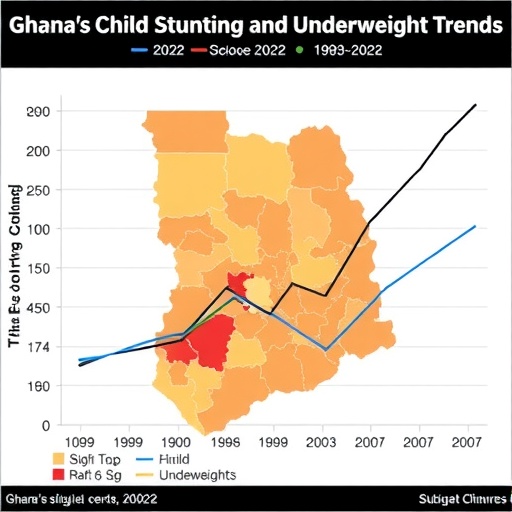
In a comprehensive new study published in the International Journal for Equity in Health, researchers Osborne, Bangura, Sesay, and their colleagues have unveiled critical insights into the evolving landscape of childhood malnutrition in Ghana over three decades, from 1993 to 2022. This extensive longitudinal analysis sheds light on both progress made and persistent disparities surrounding stunting and underweight conditions among children aged between 0 and 59 months. These findings provide an invaluable resource for policymakers, healthcare professionals, and global health organizations striving to overcome one of the most pernicious markers of child health inequality.
Malnutrition, particularly in early childhood, has long-standing implications—not only impairing physical growth but also detrimentally affecting cognitive development and future socioeconomic potential. Stunting, defined as impaired linear growth resulting in a height-for-age measurement significantly below international standards, remains a profound indicator of chronic nutritional deprivation. Underweight, characterized by low weight-for-age, reflects both chronic and acute malnutrition and is often used as a composite indicator of poor health outcomes in children. The study meticulously tracks trends in these two key indicators, producing a nuanced understanding of how Ghana’s children have fared amid shifting economic, social, and political landscapes.
One of the most striking aspects of this research is its long temporal scope. By analyzing nationally representative data spanning nearly thirty years, the authors have been able to identify patterns not immediately apparent in shorter-term studies. Their findings document a noteworthy overall decline in the prevalence of both stunting and underweight conditions, highlighting the positive impact of sustained public health interventions, nutritional programs, and improvements in maternal education and household wealth. However, beneath this broad positive trend lies a complex web of inequalities that remain stubbornly resilient.
The findings reveal that progress in reducing stunting and underweight status has not been evenly distributed across different regions and demographic groups in Ghana. Children from lower socioeconomic backgrounds, rural areas, and marginalized ethnic communities disproportionately bear the brunt of nutritional deficiencies. This unequal distribution raises urgent questions about the effectiveness and reach of existing nutrition policies and health services. According to the study, while urban centers have witnessed accelerated improvements, rural zones continue to lag, making geographic disparities a major barrier to equitable child health outcomes.
A key technical element of the study is its use of advanced statistical modeling to disentangle the effects of multiple covariates over time. The researchers employed mixed-effects logistic regression models that accounted for individual, household, and community-level variables, enabling robust identification of inequality drivers. This methodological rigor enhances confidence in the observed trends and helps policy experts pinpoint critical leverage points for intervention. Notably, maternal education emerged consistently as one of the strongest predictors of better growth outcomes, underscoring the multifaceted value of investing in female education as a nutritional strategy.
Moreover, the study brings attention to how rapid urbanization and shifts in dietary patterns might complicate the nutritional landscape. While increased urban migration holds promise for improved access to healthcare and sanitation, it also introduces dietary risks characterized by a transition toward processed and energy-dense foods. The dual burden of malnutrition—simultaneous undernutrition and rising overweight or obesity—was not the primary focus of this investigation but was acknowledged as an emerging concern warranting further inquiry. Through detailed data visualization and trend analysis, the authors vividly illustrate how Ghana stands at a critical juncture facing traditional nutritional challenges alongside modern public health dilemmas.
The research also provides compelling evidence that national-level averages, while useful for broad monitoring, conceal significant sub-population disparities. It advocates strongly for disaggregated data collection and targeted programmatic efforts. This approach is vital for designing nutrition interventions that are sensitive to local contexts, such as targeting food insecurity hotspots or disadvantaged ethnic groups with culturally adapted health messaging. The authors further emphasize the role of social determinants—inclusive of income inequality, gender dynamics, and access to sanitation—in shaping child growth outcomes, placing child nutrition firmly within the broader framework of social justice.
An important contribution of this investigation lies in its policy implications, which resonate far beyond Ghana’s borders. As many low- and middle-income countries either continue to grapple with or emerge from high burdens of childhood malnutrition, Ghana’s experience serves as a microcosm illustrating both successes and challenges. The study advises international donors and governmental bodies to sustain funding for proven strategies such as micronutrient supplementation, breastfeeding promotion, and community health worker programs. Simultaneously, it calls for innovative approaches that address underlying poverty and infrastructural deficits to achieve meaningful reductions in childhood stunting and underweight prevalence.
Through detailed critique, the authors also highlight limitations common to studies of this nature, such as potential biases stemming from survey nonresponse or measurement error in anthropometric data. Despite these caveats, the comprehensive nature of their data synthesis—from multiple Ghana Demographic and Health Surveys and nutrition assessments—confers considerable weight to their conclusions. Their transparent methodology encourages replication and adaptation in similar contexts, laying the groundwork for a robust evidence-based nutrition policy agenda in the coming decades.
The implications for child health experts are profound. By illuminating the multidimensional nature of nutritional deprivation and emphasizing its intersection with socioeconomic inequities, the research advocates for integrated public health frameworks. Such frameworks must concurrently address food security, maternal and child healthcare, education, and social protection systems. Moreover, the study’s longitudinal insights provide an essential reference point to evaluate the impact of recent global disruptions, including the COVID-19 pandemic, on child nutrition trajectories—a critical area for ongoing surveillance governments must prioritize.
Finally, this research underscores the ethical imperative of ensuring every child enjoys the right to adequate nutrition and a healthy start in life. The persistent disparities reported are not merely statistical artifacts but indicators of systemic failures requiring urgent remedial action. Given the well-documented long-term costs of early-life malnutrition on population health and economic productivity, Ghana’s path forward can offer a blueprint for regional and global strategies aimed at breaking the cycle of malnutrition and fostering enhanced health equity.
In summary, Osborne and colleagues’ landmark study presents an exhaustive and technically sophisticated examination of trends and inequalities in childhood stunting and underweight in Ghana from 1993 to 2022. Their multi-decade analysis affirms positive trends yet casts a spotlight on enduring inequities. By combining rigorous statistical methods with rich demographic data, this work powerfully advocates for targeted, context-sensitive nutrition policies that transcend mere aggregate improvements. As such, it constitutes an essential contribution to the global discourse on child nutrition and health equity, reinforcing the vital importance of sustained, equitable investment in early childhood wellbeing.
Cite Scienmag News
Courtney Benton. (June 10, 2025). Ghana’s Child Stunting and Underweight Trends, 1993–2022. Scienmag. https://scienmag.com/ghanas-child-stunting-and-underweight-trends-1993-2022/
Courtney Benton. "Ghana’s Child Stunting and Underweight Trends, 1993–2022." Scienmag, 10 June 2025, https://scienmag.com/ghanas-child-stunting-and-underweight-trends-1993-2022/. Accessed 9 September 2026.
Courtney Benton. "Ghana’s Child Stunting and Underweight Trends, 1993–2022." Scienmag. June 10, 2025. https://scienmag.com/ghanas-child-stunting-and-underweight-trends-1993-2022/


